
Purpose and problem
A telemetry client sends each reading in a separate remote call. Every call repeats framing, serialization setup, scheduling, and a network round trip. The payload is tiny, but fixed overhead consumes much of the work. More concurrent calls increase pressure without removing that repeated cost.
The client could collect readings before sending them. That saves calls, but the first reading must wait for companions. At low traffic, a count-only buffer might wait indefinitely. Large groups also consume memory and make failures affect more work at once.
Core idea
Batching groups compatible operations so one execution unit shares overhead that would otherwise be paid repeatedly. Members can remain separate logical operations with separate outcomes. A batch need not aggregate their meaning, run them concurrently, or commit them atomically.
Think collect within limits, emit together, resolve outcomes deliberately. The shared cost might be a network request, database commit, scheduling step, or accelerator invocation. The destination must actually support efficient grouped work; a wrapper that merely loops over unchanged expensive calls may save little.
Batching is the established general technique. Microbatch Processing and Batch Serving are more specific architectures, not aliases for every buffered bulk request.
How it works
Bound formation and outstanding work
Group only compatible destinations, authorization contexts, encodings, and operation semantics. An authorization check for one member must not authorize its neighbors. Preserve each member’s identity when results require correlation.
A collector commonly emits when a count or byte threshold is reached, or the oldest pending item reaches its age limit. An age deadline needs a timer or another progress mechanism even when traffic stops. Repeated arrivals should not keep resetting the oldest item’s deadline.
Count limits do not bound bytes. Measure the serialized representation that the destination constrains, including envelope overhead where applicable. Define how to handle a single oversized item: reject, route separately, or split only if semantics permit.
The collector owns pending items until handoff. The sender then owns outstanding batches and their outcomes. Bounding one collector does not bound all collectors, emitted batches, response buffers, or retries. Apply admission control or backpressure when the destination cannot keep up. Stop accepting work and drain or explicitly abandon residual items during shutdown.
Grouping supplies no transaction guarantee
A successful envelope can contain failed members. Microsoft Graph returns individual response statuses; its outer HTTP 200 does not establish success for every request, and responses can arrive in another order. Correlate by identity rather than array position.
A transport failure can leave outcomes unknown. Retry known-unprocessed members according to policy; an ambiguous outcome requires safe repeatability or reconciliation. Grouping a debit with other debits does not make replay safe. Ordering and atomicity come from the destination’s documented contract, not the word “batch.”
Worked example
A small collector with four emission causes
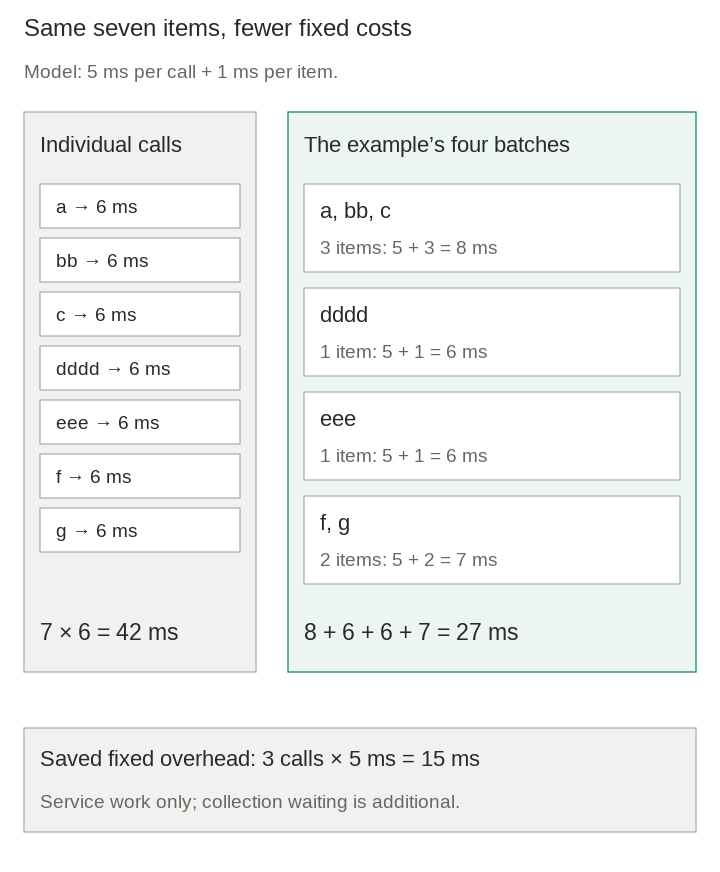
Before batching, seven readings require seven calls. Afterward, the collector emits groups according to count, payload size, age, and final drain. With a hypothetical fixed cost of 5 milliseconds per call plus 1 millisecond per item, service work changes from 7 × 5 + 7 = 42 ms to 4 × 5 + 7 = 27 ms. Collection waiting is additional.
Save this Python 3 program as batching.py and run python3 batching.py. One caller supplies nondecreasing, nonnegative integer milliseconds on a simulated monotonic clock. Payloads are immutable, nonempty byte strings. Limits are three items, six payload bytes, and ten milliseconds from the oldest pending arrival.
class Batcher:
    def __init__(self, max_items=3, max_bytes=6, max_age_ms=10):
        if any(type(n) is not int or n < 1
               for n in (max_items, max_bytes, max_age_ms)):
            raise ValueError("positive integer limits required")
        self.max_items, self.max_bytes = max_items, max_bytes
        self.max_age_ms = max_age_ms
        self.pending, self.size, self.started = [], 0, None
        self.now, self.closed = 0, False

    def _emit(self, reason):
        if not self.pending:
            return []
        batch = (self.now, reason, tuple(self.pending))
        self.pending, self.size, self.started = [], 0, None
        return [batch]

    def advance(self, now_ms):
        if self.closed:
            raise RuntimeError("collector closed")
        if type(now_ms) is not int or now_ms < self.now:
            raise ValueError("nondecreasing integer milliseconds required")
        self.now = now_ms
        if self.pending and now_ms - self.started >= self.max_age_ms:
            return self._emit("age")
        return []

    def add(self, payload, now_ms):
        if type(payload) is not bytes or not 0 < len(payload) <= self.max_bytes:
            raise ValueError("nonempty payload must fit the byte limit")
        batches = self.advance(now_ms)
        if self.size + len(payload) > self.max_bytes:
            batches += self._emit("size")
        if not self.pending:
            self.started = now_ms
        self.pending.append(payload)
        self.size += len(payload)
        if len(self.pending) == self.max_items:
            batches += self._emit("count")
        elif self.size == self.max_bytes:
            batches += self._emit("size")
        return batches

    def close(self, now_ms):
        batches = self.advance(now_ms) + self._emit("close")
        self.closed = True
        return batches


if __name__ == "__main__":
    collector = Batcher()
    emitted = []
    for time_ms, payload in [(0, b"a"), (4, b"bb"), (8, b"c"),
                             (12, b"dddd"), (13, b"eee")]:
        emitted += collector.add(payload, time_ms)
    emitted += collector.advance(23)
    emitted += collector.add(b"f", 24)
    emitted += collector.add(b"g", 25)
    emitted += collector.close(26)
    for time_ms, reason, items in emitted:
        print(time_ms, reason, [p.decode("ascii") for p in items],
              sum(map(len, items)))
The four output lines are 8 count ['a', 'bb', 'c'] 4, 13 size ['dddd'] 4, 23 age ['eee'] 3, and 26 close ['f', 'g'] 2. Fields mean emission time in milliseconds, cause, members, and total payload bytes. Adding eee would exceed six bytes with dddd, so the old group emits before the new item enters it. The idle-time advance(23) emits eee without another arrival.
Age is checked before admitting a new item; equality emits the old group. Count wins if count and byte equality coincide. Invalid payloads are rejected before clock or buffer changes. An emitted tuple transfers responsibility to the caller; it is not a send acknowledgment or durable record.
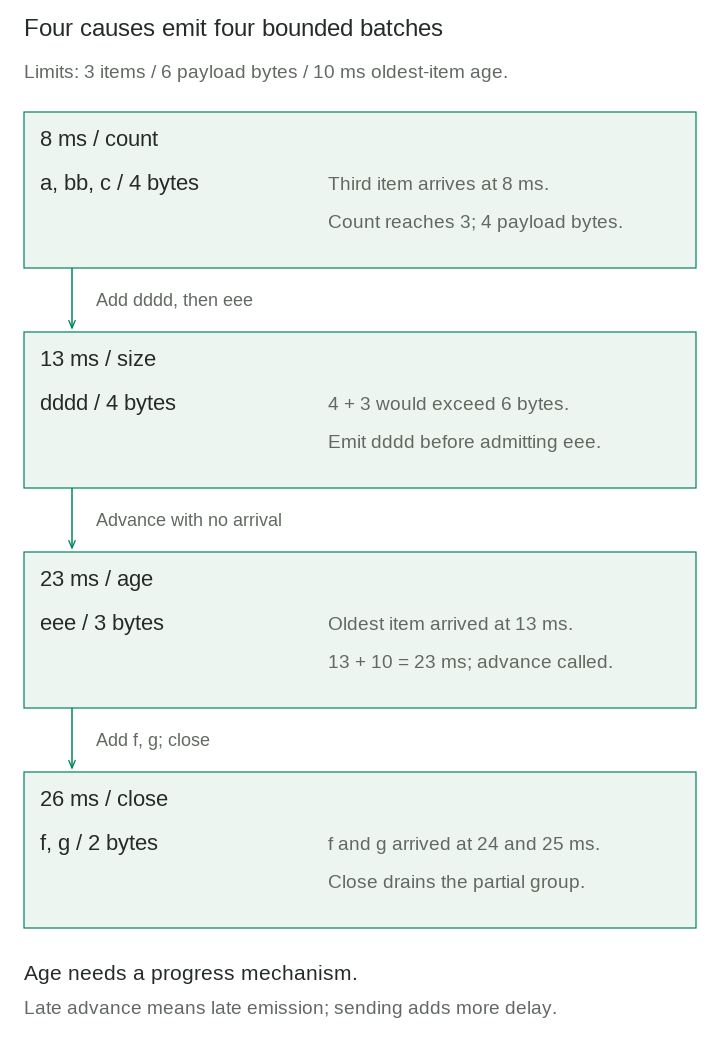
This example forms batches but performs no network or database operations. It has no real timer, concurrency, persistence, retry, or completion tracker. Payload bytes exclude framing. If advance runs late, emission runs late; a slow sender adds more delay. Returned groups and the demo’s accumulated output are outside the pending-buffer bound.
Bulk writes can partly succeed
DynamoDB’s BatchWriteItem makes individual puts and deletes atomic, while the whole batch is not atomic. It returns known unprocessed items for selective retries with backoff. If no reliable response arrives, that distinction cannot reveal which effects occurred. The collector’s emission boundary therefore cannot replace the destination’s recovery contract.
When to use it
Use batching when measurements show significant repeatable overhead, the destination supports grouped execution, and callers can tolerate some collection delay. Bulk ingestion and high-volume remote APIs are common signals.
Keep immediate individual operations when demand is sparse, deadlines are tight, or grouping saves little. A batch size of one is a legitimate low-delay policy, not a performance failure.
Tradeoffs and common mistakes
Larger batches trade fewer fixed costs for more waiting, memory, failure scope, and sometimes lock duration. Measure batch fill, oldest-item age, end-to-end latency, payload bytes, partial failures, and outstanding work. Bigger is not automatically better.
Common mistakes include count-only flushing at low traffic, ignoring the final partial group, assuming outer success means member success, replaying successful members, and confusing fewer requests with fewer business operations or reduced billing. Several batching layers can also add their waiting budgets together.
Related patterns
Microbatch Processing runs a stream as recoverable bounded executions with recorded progress. General batching need not provide replay or checkpointing.
Batch Serving precomputes predictions for later consumption. Batching online inference requests can share execution overhead while still answering current requests.
Aggregator combines related messages into a meaningful result using completion rules. A throughput batch can contain independent operations and preserve separate results.
Backpressure feeds downstream capacity limits back into admission. Batch formation limits alone do not constrain all outstanding work.
Sources
- Microsoft: Use batching to improve application performance — shared fixed costs and buffering by size or elapsed time.
- Google Cloud: Batch messaging — publisher count, byte, and latency settings.
- Microsoft Graph: JSON batching — per-member identities, statuses, and response ordering.
- AWS: BatchWriteItem — individual versus whole-batch atomicity and unprocessed-item retries.
The telemetry scenario, exact limits and arrivals, executable collector, additive cost assumptions, and diagrams are original teaching material.