
Purpose and problem
A document-analysis program combines text clues, page structure, and document-type hypotheses. Some pages contain useful words but little layout evidence; others contain tables that help interpret uncertain text. The next useful operation depends on what has already been found.
A fixed sequence either runs unnecessary analysis or buries increasingly complicated branching in one coordinator. Letting every specialist call every other specialist spreads those decisions across the system. The program needs independent expertise while maintaining a coherent, inspectable account of the developing solution.
Core idea
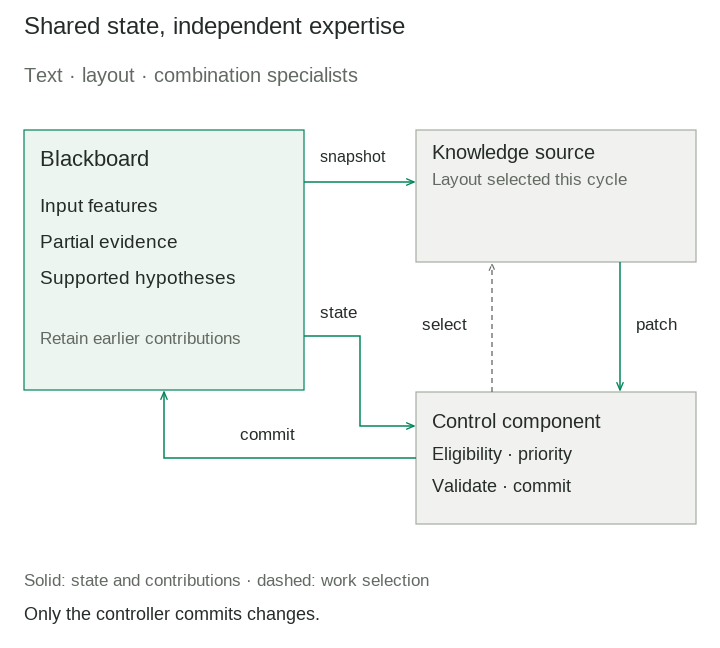
Blackboard has three central parts: a shared workspace containing evidence and partial solutions, independent knowledge sources that contribute expertise, and a control component that chooses useful work. Specialists communicate through the workspace rather than calling one another. Corkill emphasizes that shared storage alone does not make a blackboard system. Blackboard Systems.
The mental model is a developing solution that makes different contributions useful at different times. An update may enable another specialist or change which existing opportunity deserves attention. The controller repeatedly considers the current situation, rather than merely advancing a fixed pipeline.
How it works
Knowledge, representation, and control
Knowledge sources agree on the meaning of board entries: what is observed, what is hypothesized, and what supports a conclusion. They can use different internal techniques. Their applicability conditions should be cheaper to evaluate than the work they propose.
A real agenda commonly contains activations: a knowledge source paired with a particular evidence context, not just a module name. The controller ranks eligible activations, executes one or more, and reassesses after changes. Corkill's account distinguishes knowledge sources from their activations.
The Hearsay-II speech-understanding system illustrates partial interpretations at multiple abstraction levels and heuristic selection of promising actions. Its hypotheses were not simply final answers waiting in a queue. Original Hearsay-II paper.
Progress and stopping are explicit decisions
Define a success criterion, what counts as progress, and when to stop searching. No eligible action means the current configuration is stalled; it does not prove that the problem is impossible. Exhausting a computation budget is different again.
Board ownership also matters. Serial execution permits a controller to validate an addition before making it visible. Concurrent execution needs an explicit policy for stale snapshots, incompatible updates, and revisions. A shared dictionary is not a concurrency protocol.
Worked example
Combine two clues without wiring a pipeline
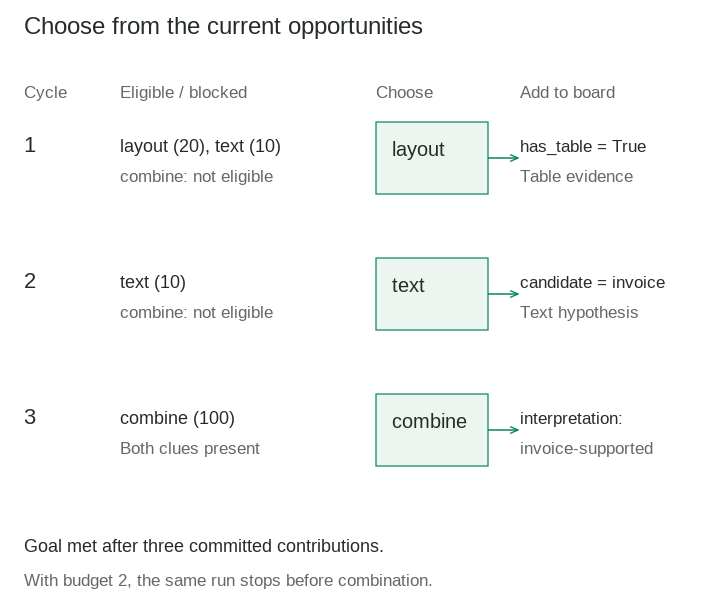
The toy document has tokens including TOTAL and three equal, positive row lengths. Here row lengths count cells, not physical widths. A text specialist proposes an invoice candidate; a layout specialist reports a table-like structure. A combination specialist can support the candidate only after both contributions exist.
These are deliberately small stand-ins for richer analyses, not OCR or a validated document classifier. Save the following three files together and run python3 main.py. They use Python 3.8 or later and its standard library.
controller.py — shared state and scheduling
from dataclasses import dataclass
from types import MappingProxyType
from typing import Callable


@dataclass(frozen=True)
class KnowledgeSource:
    name: str
    priority: int
    ready: Callable
    produce: Callable


def solve(initial, sources, goal, budget=10):
    if type(budget) is not int or budget < 0:
        raise ValueError("Budget must be a nonnegative integer")
    sources = tuple(sources)
    if len({source.name for source in sources}) != len(sources):
        raise ValueError("Source names must be unique")
    board, fired, trace = dict(initial), set(), []
    while True:
        snapshot = MappingProxyType(dict(board))
        if goal(snapshot):
            return "solved", board, trace
        ready = [source for source in sources
                 if source.name not in fired and source.ready(snapshot)]
        if not ready:
            return "stalled", board, trace
        if len(trace) >= budget:
            return "budget", board, trace
        chosen = min(ready, key=lambda source: (-source.priority, source.name))
        patch = dict(chosen.produce(snapshot))
        if not patch or board.keys() & patch.keys():
            raise ValueError("Contributions must add new keys only")
        board.update(patch)
        fired.add(chosen.name)
        trace.append(chosen.name)
sources.py — independent procedures and applicability conditions
from controller import KnowledgeSource


def text_clue(board):
    words = {word.upper() for word in board["tokens"]}
    return {"candidate": "invoice" if "TOTAL" in words else "unknown"}


def layout_clue(board):
    lengths = board["row_lengths"]
    table = len(lengths) >= 2 and len(set(lengths)) == 1 and lengths[0] > 0
    return {"has_table": table}


SOURCES = [
    KnowledgeSource(
        "combine", 100,
        lambda b: b.get("candidate") == "invoice" and b.get("has_table") is True,
        lambda b: {"interpretation": "invoice-supported"},
    ),
    KnowledgeSource("text", 10, lambda b: "tokens" in b, text_clue),
    KnowledgeSource("layout", 20, lambda b: "row_lengths" in b, layout_clue),
]
main.py — one problem instance and its goal
from controller import solve
from sources import SOURCES


initial = {"tokens": ("ITEM", "TOTAL"), "row_lengths": (3, 3, 3)}
goal = lambda board: board.get("interpretation") == "invoice-supported"
status, board, trace = solve(initial, SOURCES, goal)
print(status, board.get("interpretation"))
print(" -> ".join(trace))
# solved invoice-supported
# layout -> text -> combine
Although combination is listed first and has priority 100, it initially cannot act. Layout runs before text because its priority is higher. Source name breaks ties. Each addition changes the next eligibility check; combination becomes eligible only after both clues exist. If table evidence is supplied initially, text can enable combination directly. No source calls another.
The controller owns writes, copies the initial mapping, and rejects empty contributions or overwritten keys. Its read-only snapshots are shallow, so this example requires immutable fact values, such as the tuples and strings shown. Python's MappingProxyType prevents assignment through the proxy, not mutation of objects stored inside it.
Each source runs at most once per problem in this simulation. A production system may activate the same source repeatedly for different evidence contexts. The budget counts executed contributions, not seconds. With budget two, both clues remain but the result is budget; without layout evidence, it is stalled. Neither means a supported interpretation was found. solved means the example's goal predicate passed, not that the hypothesis is objectively correct.
When to use it
Blackboard helps when several kinds of expertise contribute partial results and useful execution order depends on emerging evidence. Interpretation, planning, and recognition tasks can have this shape. Adding expertise is easier when its contract concerns board representations rather than a network of direct calls.
Use a normal function, explicit workflow, or pipeline when the required sequence is already clear. A collection of independent calculations that only shares a cache usually does not need opportunistic scheduling.
Tradeoffs and common mistakes
The representation becomes a shared commitment. Specialists still couple to board schemas and semantics. Record provenance, supporting evidence, and revision identity when conclusions may be disputed. Store competing hypotheses explicitly instead of silently replacing one with another. This example's append-only policy rejects replacement; it does not resolve uncertainty.
Control can dominate the design. Repeated eligibility scans and ranking cost work. Poor priorities can spend the budget on unhelpful actions or starve useful ones in a continuing system. Trace selection decisions and test stopping behavior, not just successful answers.
Termination is not correctness. Preventing repeated no-progress activations helps bound execution, but cannot establish that the available expertise is sufficient. Keep incomplete and successful results distinguishable.
Failures and side effects need ownership. The example is single-threaded with pure contributors; exceptions abort the run. External calls need their own timeout, cancellation, and cleanup policy. An activation budget cannot interrupt a hung source or roll back an external effect.
Related patterns
Pipes and Filters connects successive transformations. Blackboard keeps intermediate results available and chooses subsequent work from the developing shared state.
Mediator centralizes object interactions. A blackboard controller additionally selects knowledge contributions around a shared problem representation.
Observer can notify interested sources about board changes. Notification alone does not choose which activation should run or establish a useful stopping criterion.
Strategy can supply interchangeable scheduling policies while keeping specialist knowledge separate from control.
Sources
Daniel Corkill's Blackboard Systems explains the model, activations, and control. Erman, Hayes-Roth, Lesser, and Reddy's 1980 Hearsay-II paper describes cooperative interpretation and heuristic scheduling. Buschmann, Meunier, Rohnert, Sommerlad, and Stal catalog Blackboard in Pattern-Oriented Software Architecture, Volume 1; the accessible preview establishes that architectural placement.
The document scenario, code, scheduling values, and illustrations are original teaching material. They model bounded, serial cooperation without learned recognition, calibrated confidence, durable storage, or concurrent execution.