
“This happens in every generation”
Leah is arranging help for her mother, Anne, after a planned operation. Her brother, Rob, has not committed to the transport she requested.
“He’s just like Uncle Michael,” Leah tells Anne. “You did everything for Gran, and now I’m doing everything.”
The comparison feels convincing. But Leah knows little about when Michael moved away, what help he provided, or how arrangements changed after her grandfather died.
A family diagram is a Bowenian assessment and research tool for placing family structure, events, and functioning across generations into a visual record. It supports investigation of a family emotional system; it is not one of Bowen’s eight theoretical concepts. Butler, “The Family Diagram and Genogram: Comparisons and Contrasts,” 2008
When family explanations outrun family knowledge
Families accumulate compressed descriptions: “She always rescues everyone,” “He disappeared,” “The daughters do the caring.”
Such accounts may describe real burdens. They can also combine observations, interpretations, missing information, and conclusions about motives.
A family diagram makes room for more specific information. Who lived where? When did contact change? What responsibilities did people undertake? Which events occurred before, during, or after a difficult period?
Bowen’s archived account describes gathering at least three generations of information, including births, deaths, marriages, divorces, employment, and education. These facts provide a broader field of observation than the immediate complaint. Bowen Archives: Bowen Theory in His Own Words
The diagram therefore extends beyond genealogy. Family connections establish its structure; information about functioning and relationships makes it useful for Bowenian inquiry.
The title also preserves Bowen’s terminology. Butler distinguishes the family diagram from later genogram adaptations: they share aspects of notation, but can differ in purpose, theoretical basis, and interpretation. Similar-looking charts are not necessarily being used in the same way. Butler
What the diagram helps you investigate
The underlying Bowen proposition is that individual functioning needs to be considered within ongoing relationships. A diagram helps organize observations relevant to that proposition; drawing connections does not prove it.
In Leah’s situation, a possible reciprocal sequence is already visible. Anne expresses concern about the arrangements. Leah presses Rob for an answer. Rob ends the conversation. Leah and Anne then discuss his unreliability together.
Leah’s taking charge may settle immediate uncertainty for Anne. Ending the call may relieve pressure for Rob. Meanwhile, coordination concentrates on Leah, and direct discussion between the siblings becomes harder.
Those possible functions are hypotheses. Rob’s availability, Anne’s preferences, and practical constraints still require investigation. Papero’s Bowenian clinical account emphasizes observing reciprocal responses and changing one’s own functioning rather than concentrating exclusively on another person’s failings. Papero, “Assisting the Two-person System,” 2014
The Bowen Center presents the diagram as a framework for asking questions about family events, contact, and functioning, and for moving from blame toward curiosity. That is a clinical rationale, not evidence that a chart reveals causes automatically. Bowen Center: Family Diagram
Using information to change participation
In a documented Bowenian coaching approach, gaps in the diagram guide further inquiry. Brief contacts with relatives provide opportunities to observe, listen, revise hypotheses, and consider one’s own participation. The intended project is changing how the person relates, rather than making relatives change. Family Systems Institute: Family of Origin Coaching
For Leah, this means investigating what happened instead of using the earlier generation as a verdict on Rob.
It also means examining her present conduct. She can make a specific request, state what she can undertake, and distinguish an unanswered question from a settled refusal. She cannot determine another person’s availability or require agreement with her interpretation.
The useful outcome is greater capacity for responsible action. Completing the drawing is insufficient. In a January 1985 letter, Bowen criticized the idea that arriving with family diagrams or reporting family information demonstrated differentiation. Bowen Archives: January 22, 1985 letter
Worked example: replacing a resemblance with questions
The family, dates, dialogue, and records below are invented teaching material.
Leah’s first explanation is simple: Anne cared for Joan, while Michael stayed away; now Leah cares for Anne, while Rob avoids helping.
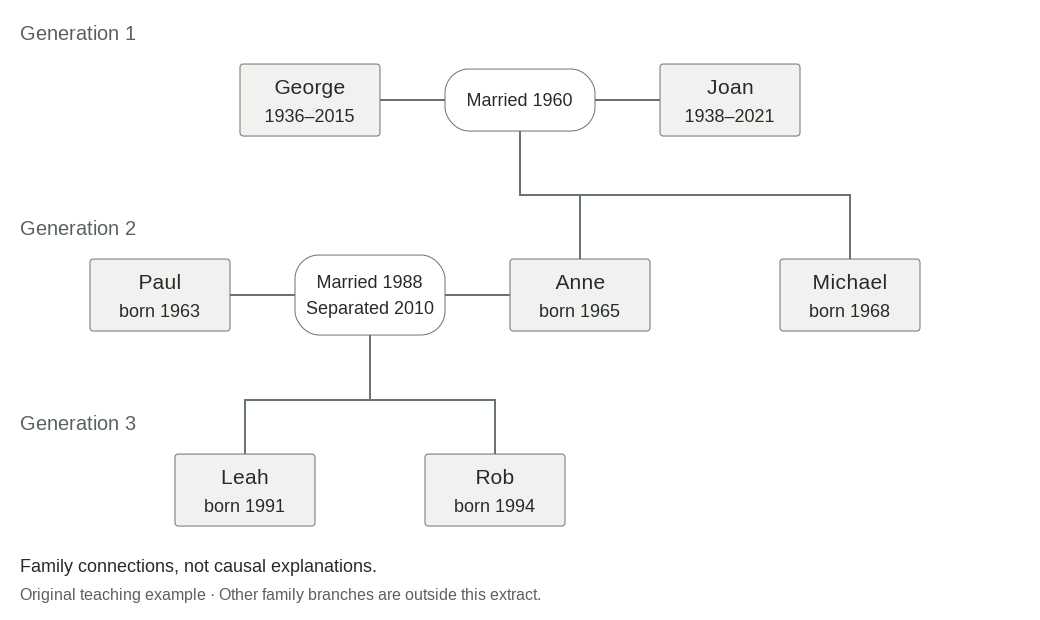
She begins a three-generation diagram. George died in 2015; Joan died in 2021. Anne and Michael are their children. Anne and Paul married in 1988 and separated in 2010; Leah and Rob are their children.
Beside the family links, Leah adds specific information. Anne reports doing Joan’s weekly shopping from 2018 to 2021. Leah does not yet know what Michael did during those years.
She phones him.
“I’ve realized I know Mum’s account much better than yours. When did you move to Bristol?”
“In 2017.”
“What contact did you have with Gran afterward?”
“I called on Sundays. Anne handled most visits.”
Leah records the calls as Michael’s account, rather than treating the conversation as a verdict on Anne’s burden. The amount and usefulness of other help remain unclear.
She approaches Rob differently:
“Can you cover Thursday transport? I can do Tuesday.”
“I can’t leave work Thursday. I could arrange the Saturday deliveries.”
Leah records the offer and the remaining transport gap. She stops using Michael as evidence of what Rob will do.
There is still work to arrange. Anne may remain disappointed, and Leah may still carry an unequal load. The diagram has helped separate events, accounts, and questions; it has not resolved the care problem.
Limits and common mistakes
A resemblance is not an established process. Similar events across generations invite investigation. Their presence on one page does not demonstrate a shared cause.
A report is not independent verification. Dates can be mistaken, relatives can disagree, and meaningful information can remain unavailable. Recording who supplied information helps preserve those distinctions.
Symbols do not settle interpretations. A relationship marked “cutoff” or “conflict” still requires context. Physical distance alone cannot establish emotional cutoff. A diagnosis or illness history cannot establish a family explanation of its cause.
A family diagram can become another instrument of blame. Labels such as “the irresponsible branch” turn inquiry into classification. Unequal workloads, financial constraints, disability, coercion, and actual obligations must remain visible.
Family research does not override privacy or safety. Relatives can decline questions. Missing information can stay marked as unknown; contacting an unsafe person is not a requirement.
The sources cited here describe the tool’s history, theoretical rationale, and clinical use. They do not establish that completing a diagram alone improves relationships or treats illness.
A simplified family diagram
Original teaching illustration. Rectangles identify people; rounded labels identify couple histories. Lines indicate family connections, not causes. This is not a complete notation guide.
| Period | Observation recorded | Information source within the example |
|---|---|---|
| 2017 | Michael moved to Bristol | Michael’s account |
| 2018–2021 | Anne did Joan’s weekly shopping | Anne’s account |
| 2018–2021 | Michael called Joan on Sundays | Michael’s account |
| 2026 | Leah coordinates help; Rob offers Saturday deliveries | Leah’s record and Rob’s offer |
| Unresolved | Thursday transport, Paul’s availability, and Anne’s preferences about involving him | Not yet established |
Text alternative: George and Joan are the parents of Anne and Michael. Anne and Paul, separated since 2010, are the parents of Leah and Rob. The notes distinguish relatives’ accounts from unanswered questions. Other family branches are outside this extract. Nothing depicted establishes an inherited caregiving role.
Related concepts and sources
Differentiation of self supplies the broader purpose: observing one’s participation and acting more thoughtfully under pressure. Triangles helps frame questions about who becomes involved when tension rises.
Person-to-person relationship concerns knowing relatives through direct exchange. Emotional cutoff and multigenerational transmission process provide further questions about contact and patterns across generations, rather than automatic labels for the drawing. Bowen Archives
For further reading, Victoria Harrison’s The Family Diagram & Family Research is a Bowenian guide devoted to constructing and using the tool. Publisher’s description