
Purpose and problem
A file-transfer service has several clients awaiting data. Waiting synchronously for each read wastes an execution context while the device works. A readiness loop avoids that wait, but its handlers still perform reads and preserve progress themselves. If the platform can perform a requested operation asynchronously, the application needs a different collaboration: submit the read now and handle its actual result later.
The difficulty moves into outstanding operations. Which request owns a buffer? Which connection receives a result? Can a canceled request still complete successfully? Closing a connection or recycling its memory too early can turn an ordinary delayed completion into a resource-lifetime bug.
Core idea
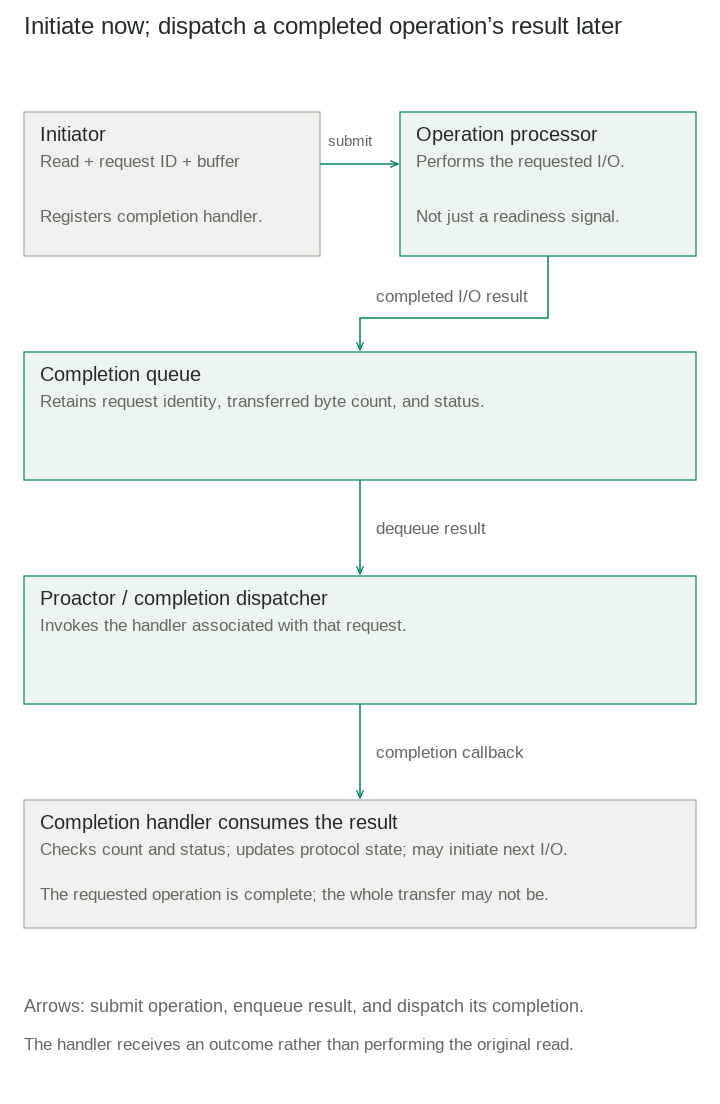
Initiate work; react to its completion. A Proactor separates initiating an asynchronous operation, performing that operation, and dispatching its result. The completion handler receives status and transferred data or byte count; it does not receive merely a hint that I/O might now be attempted.
The established name is Proactor. “Completion dispatcher” names a participant, rather than another article. Reactor dispatches readiness before application I/O; Proactor dispatches results after an initiated operation finishes. A future, callback, or async keyword alone does not establish which mechanism performs the underlying I/O.
How it works
Carry context through the operation
An initiator supplies an operation, resource, buffer, and completion handler. The asynchronous operation processor performs it on the application's behalf. A completion queue retains results until the dispatcher invokes the appropriate handler. Request identity connects the result to its owner even when operations finish out of submission order.
The processor may use native asynchronous I/O or a library's emulation strategy. Boost.Asio presents this collaboration independently of its platform backend. Windows I/O completion ports provide queued completion packets for associated handles; application processing order must not be inferred from submission order. Python documents a Windows ProactorEventLoop, but portable Python coroutine code does not prove native Proactor execution on every platform.
Completion applies to the requested operation, not necessarily the whole business task. A read may return fewer bytes than requested; a write may transfer only a prefix. A handler checks status and count, updates its protocol state, and initiates another operation when necessary. Receiving three bytes is not proof that a complete record or transfer exists.
Keep ownership until the outcome is known
Retain operation context and any buffers borrowed by the I/O API until its documented completion boundary. Windows overlapped I/O documentation explicitly warns against modifying or freeing those resources prematurely. Some APIs can complete immediately; follow their notification contract so immediate return and later notification do not process or release the same request twice.
Cancellation requests race with execution. CancelIoEx does not wait for completion, and the operation can ultimately succeed, report cancellation, or fail otherwise. A timeout likewise does not authorize freeing memory still in use. Stop admission during shutdown, request cancellation where supported, and observe outstanding outcomes before releasing their resources.
The dispatch policy is separate. One dispatcher thread serializes callbacks; multiple threads require synchronization for shared connection state. Keep handlers short and bound both outstanding work and undelivered completions. Async initiation does not provide free memory, CPU time, or backpressure.
Worked example
Two outstanding reads and a cancellation race
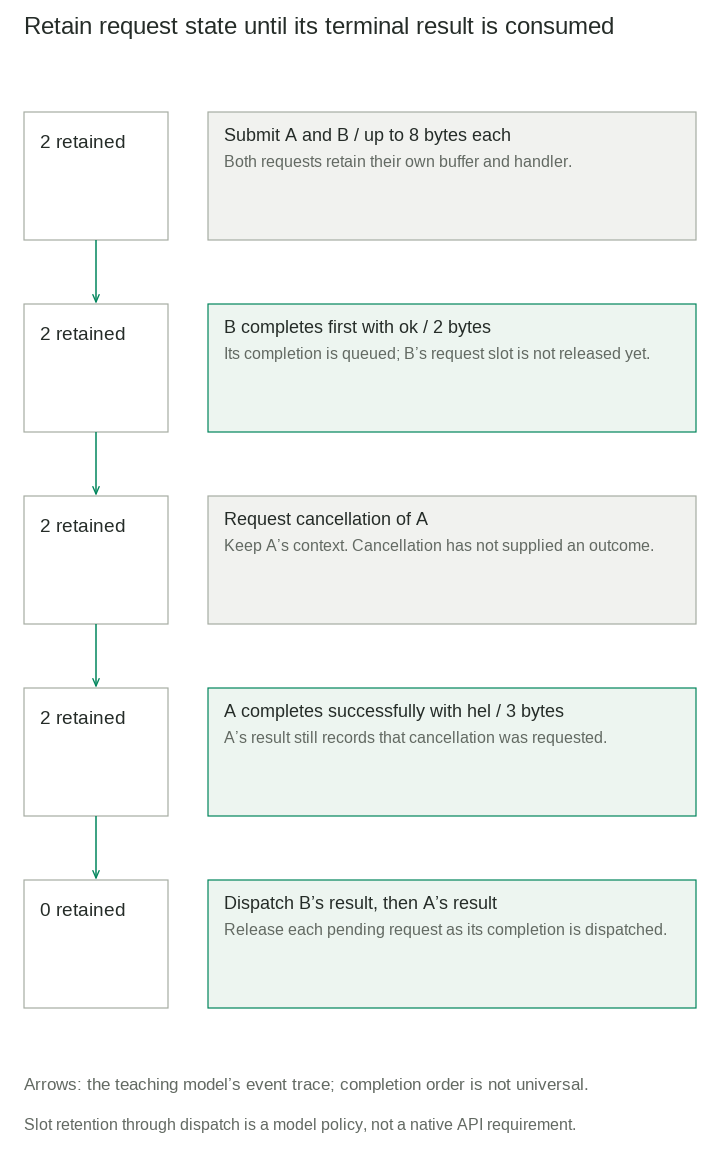
Save proactor.py and demo.py together; run python3 demo.py with Python 3.11+. This deterministic simulation has no OS I/O. read submits, complete is the test backend's terminal-result hook, and dispatch_one invokes a handler. At most two reads remain outstanding, each requesting 1–8 bytes. Labels identify request owners; IDs are local correlation values, not credentials.
from collections import deque
from dataclasses import dataclass


@dataclass
class Request:
    label: str
    buffer: bytearray
    handler: object
    done: bool = False
    cancel_requested: bool = False


@dataclass(frozen=True)
class Completion:
    request_id: int
    label: str
    data: bytes
    error: str | None
    cancel_requested: bool


class Proactor:
    def __init__(self):
        self.pending = {}
        self.ready = deque()
        self.serial = 0

    def read(self, label, size, handler):
        if type(size) is not int or not 1 <= size <= 8:
            raise ValueError("Request 1..8 bytes")
        if not isinstance(label, str) or not label or not callable(handler):
            raise ValueError("Supply an owner label and callable handler")
        if len(self.pending) >= 2:
            raise RuntimeError("Outstanding-operation limit")
        self.serial += 1
        self.pending[self.serial] = Request(label, bytearray(size), handler)
        return self.serial

    def cancel(self, request_id):
        request = self.pending[request_id]
        if request.done:
            return False
        request.cancel_requested = True
        return True

    def complete(self, request_id, data=b"", error=None):
        request = self.pending[request_id]
        if request.done:
            raise ValueError("Duplicate terminal result")
        if type(data) is not bytes or len(data) > len(request.buffer):
            raise ValueError("Invalid completed byte count")
        if error not in (None, "cancelled", "read failed") or (error and data):
            raise ValueError("Invalid terminal status")
        request.buffer[:len(data)] = data
        request.done = True
        self.ready.append((request_id, len(data), error))

    def dispatch_one(self):
        if not self.ready:
            return False
        request_id, count, error = self.ready.popleft()
        request = self.pending.pop(request_id)
        result = Completion(request_id, request.label,
                            bytes(request.buffer[:count]), error,
                            request.cancel_requested)
        request.handler(result)
        return True
from proactor import Proactor


def received(result):
    print(result.label, len(result.data), result.data,
          result.error, result.cancel_requested)


loop = Proactor()
a = loop.read("A", 8, received)
b = loop.read("B", 8, received)
loop.complete(b, b"ok")
loop.cancel(a)
print("retained requests:", len(loop.pending))
loop.complete(a, b"hel")
while loop.dispatch_one():
    pass
c = loop.read("C", 8, received)
loop.cancel(c)
loop.complete(c, error="cancelled")
loop.dispatch_one()
d = loop.read("D", 8, received)
loop.complete(d)
loop.dispatch_one()
print("remaining:", len(loop.pending))
The first line prints retained requests: 2; the last prints remaining: 0. Between them, the handler prints owner, byte count, bytes, error, and whether cancellation was requested. The completion results mean:
| Read result | Final outcome | Cancel requested? |
|---|---|---|
B: 2 bytes, b'ok' |
Success | No |
A: 3 bytes, b'hel' |
Success | Yes |
C: 0 bytes, b'' |
Canceled | Yes |
D: 0 bytes, b'' |
Success: stream EOF | No |
A’s cancellation request did not prevent its successful short read. C’s final outcome is canceled. The error column prints None for the successful rows and cancelled for C.
A's hel still needs higher-level framing and another read if the connection remains active. Queued results retain admission slots until dispatch in this model. Dispatch copies completed bytes, removes pending state before calling the handler, and propagates handler exceptions; it does not retry a failed callback. Error completions carry no data here, an explicit model restriction.
There are no real buffers borrowed by a kernel, handles, threads, timers, durability, or Windows API calls. The backend chooses outcomes manually; the example demonstrates collaboration and lifetime accounting, not cancellation effectiveness or native performance.
When to use it
Use Proactor when an I/O facility or library offers operation-level asynchronous completion and the application can retain request context until results arrive. File transfer and connection handling often benefit from the same initiation/completion separation, even with different backends.
For a few sequential operations, blocking code may be clearer. A readiness-oriented library may already solve the problem well. Prefer an established runtime over recreating native completion machinery, especially where buffer lifetime and shutdown behavior are consequential.
Tradeoffs and common mistakes
A successful submission is not successful I/O. Neither completion ordering nor callback serialization is universal; specify them. Multiple overlapping operations on one connection need protocol ordering and distinct contexts, not a shared mutable buffer reused immediately.
Native I/O can still encounter synchronous behavior or submission errors. Treat those according to the API contract rather than assuming every failure produces a later callback. Do not equate operation completion with persistence, remote application acceptance, exactly-once business effects, or rollback of earlier side effects.
Bound admission, completion queues, and handler work; define cancellation and cleanup separately. The simulation's two-slot policy illustrates one bound, not a production overload policy.
Related patterns
Reactor dispatches readiness so handlers can perform I/O; Proactor dispatches completed operations. A framework can implement a completion-facing API over readiness internally.
Command can represent a submitted request. It does not itself define asynchronous execution, result delivery, or resource lifetime.
Observer maintains notification relationships. A Proactor completion is tied to a particular operation and context, rather than automatically broadcasting a subject's changes.
Sources
- Pyarali, Harrison, Schmidt, and Jordan: Proactor — original pattern, participants, completion dispatch, and partial-transfer continuation.
- Boost.Asio: Proactor design pattern — completion-facing collaboration and implementation alternatives.
- Microsoft: I/O completion ports — completion queues, handles, dispatch, and ordering qualifications.
- Microsoft: Synchronous and asynchronous I/O — borrowed-resource lifetime, immediate outcomes, and completion notification.
- Microsoft: CancelIoEx — cancellation requests versus terminal results.
- Python: asyncio platform support — Windows Proactor event loop and platform distinctions.
The file-transfer scenario, bounded Python model, and diagrams are original teaching material.