
A goal can be sensible while the story about how to reach it is weak. “We need more meetings so people communicate better and make fewer mistakes” contains two causal links, not one self-evident plan.
Core idea
Challenge Goal Logic writes those links down and asks what each would have to mean in practice. The purpose is not to make action impossible; it is to find the few assumptions whose failure would change the strategy.
A written chain makes each dependency available for inspection. If a link fails, the intended outcome can remain valuable while the proposed route changes.
When to use it
This pattern is useful when a plan is justified by a phrase such as “so that,” “which will lead to,” or “obviously then.” It is also useful when a once-successful practice is continued after conditions change.
How it works
Start with a chain. For each arrow, ask what evidence supports it, which conditions must hold, what might interrupt it, and what result would make you update your view. A link can be partly true: more meetings may improve communication for new teams but create interruptions for experienced ones. That conditional answer is often more useful than “meetings help” or “meetings are bad.”
Worked examples
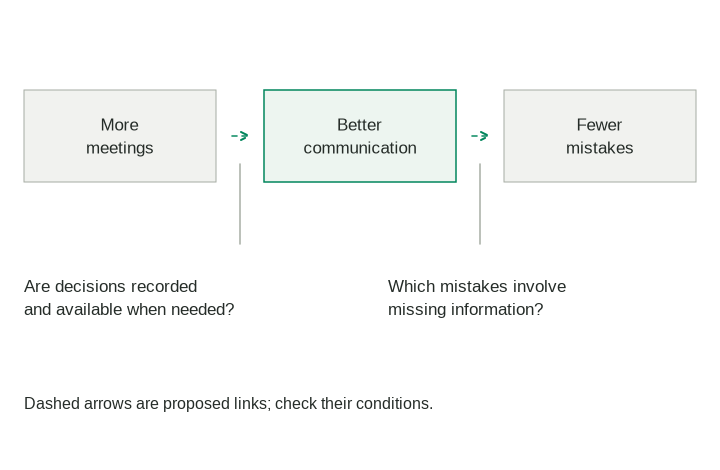
Proposed chain: More meetings → better communication → fewer mistakes.
Check the first arrow: Are misunderstandings occurring because people rarely meet, or because decisions from existing meetings are not recorded?
Check the second: Which mistakes arise from missing information, and which arise from unclear ownership?
Alternative frame: “How do we make the right decisions visible at the moment work depends on them?”
A product chain might read: more features → more customer value → more sales. If current users cannot find the core feature, the first arrow may fail. If buyers value reliability rather than breadth, the second may fail. The team need not stop building features; it should learn which customers value which capability and why.
A personal chain could be: finish a course → demonstrate competence → change careers. Perhaps employers in the target field value a portfolio more than the certificate. Perhaps the course provides essential practice despite weak credential value. The goal of changing careers remains; the assumed route becomes testable.
Pitfalls and limits
Its failure mode is attacking every link equally. Some links are well established and immaterial to the current choice. Focus on uncertain links that would alter a decision, and be fair about evidence that supports the existing plan.
Related patterns
Surface Higher-Level Goals reveals the outcomes and arrows in the first place. Find Alternative Paths seeks other routes to an outcome if a link is weak; Validate the Frame helps design a small observation that could discriminate between the competing chains.
Surface Higher-Level Goals · Validate the Frame
Sources and attribution
Inspired by Thomas Wedell-Wedellsborg's What's Your Problem? This is an original Patternverse procedure, not reproduced book text or an official implementation.