
An immediate goal is often a means to several different outcomes. “Get promoted” may stand for more income, recognition, responsibility, learning, or future freedom. If those outcomes are fused into one target, it becomes hard to see what a promotion would and would not deliver.
Core idea
Surface Higher-Level Goals makes the hierarchy visible without pretending that every person has one hidden motive.
A target may serve several purposes. Making those branches explicit helps explain why two people can agree on the target but disagree about a replacement.
When to use it
Use this pattern when a person is attached to a milestone but unsure why it matters, or when collaborators agree on a target for different reasons.
How it works
A useful method asks, “What would achieving this make possible?” and then stops after the first few answers that could change a decision. The links are hypotheses about the person’s aims and circumstances, not interpretations the assistant should impose. Multiple branches matter because one route can satisfy one branch while neglecting another.
The Liberating Structure 9 Whys, developed by Henri Lipmanowicz, Keith McCandless, and Nancy White, gives purpose inquiry an interpersonal form. Partners start with actual work, ask why it matters, and may continue through further answers up to nine times. The interviewer offers a short action-oriented purpose title and asks permission before sharing it. The number is an upper invitation to explore, not a requirement to force nine increasingly abstract answers.
The direction of inquiry matters. Asking why an activity is important explores what it serves. Asking why a defect occurred investigates causes. Both questions can be worthwhile, but moving between them without noticing can turn a purpose conversation into blame or an unsupported account of someone else's motives. The person describing the work remains the authority on whether a proposed purpose represents their experience.
Worked examples
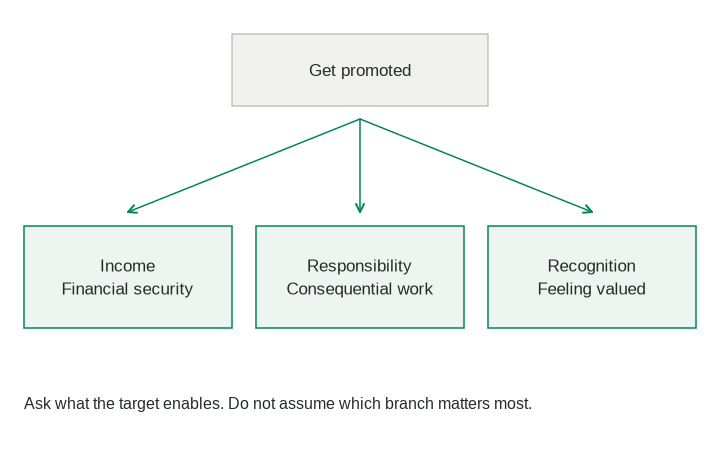
Immediate goal: Get promoted
├─ Earn more → build financial security
├─ Gain responsibility → work on more consequential problems
└─ Receive recognition → feel that the work is valued
If income is central, salary negotiation or a new employer may be relevant. If responsibility is central, a project lead role might help even without a new title. If recognition matters, the person may need feedback, visibility, or a different environment. These are not interchangeable substitutes; the tree clarifies what should be compared.
Immediate goal: “Finish a novel this year.”
Possible higher goals: Tell a story that matters, develop craft, share work with readers, or make writing a stable part of life.
Reframe: “Which outcome would count as meaningful progress if the full manuscript is not finished by December?”
Immediate goal: “Increase sign-ups for our app.”
Possible higher goals: Reach more people who benefit, sustain the service financially, or learn whether the product solves a real task.
Reframe: “Which of these outcomes would more sign-ups actually improve?”
The third example shows why a goal tree also reveals assumptions. More sign-ups might not improve retention or sustainability if the wrong people are joining. That question belongs to Challenge Goal Logic.
Imagine a museum volunteer whose immediate task is preparing labels. An initial answer concerns helping visitors identify objects. A further answer concerns making the collection understandable without needing specialist vocabulary. That purpose opens possibilities involving placement, language, and conversations as well as the wording of labels. It does not establish that the volunteer's existing task is unnecessary. Labels may still be a practical route under the museum's constraints.
An interviewer might offer a title such as Making the Collection Approachable. The volunteer may accept it, change it, or explain that preserving context matters more than approachability. That correction is part of the work, not resistance to insight. If the title will be repeated to a larger gathering, approval of the wording and audience should be explicit. A private conversation does not make its contents available for unrestricted reuse.
The purpose is useful when it changes a choice. The museum volunteer could compare revising a label, adding a short audio explanation, and asking visitors which terms are unclear. Each option needs to be checked against access, accuracy, resources, and the museum's actual authority arrangements. A purpose statement broadens the search without granting permission to change every part of it.
Pitfalls and limits
Its failure mode is repetitive “why?” questioning that climbs until every branch becomes a broad value such as “happiness.” Stop when the higher goal is specific enough to change options. Another misuse is assuming the assistant knows the user’s motives better than the user does. Offer branches as possibilities and invite correction. Find Alternative Paths then holds a chosen higher outcome steady while comparing different routes.
This distinguishes a productive inquiry from endless ascent. If another question produces a broad value that no longer helps compare options, return to the last actionable level. Several legitimate purposes may remain. Preserve them rather than compressing them into an uplifting phrase that nobody can use to make a decision.
Related patterns
Abstraction Laddering deliberately moves between broader purposes and narrower implementations to change a design frame. This article focuses on clarifying the outcomes behind a target; the new worksheet includes a short return to alternatives so that clarification leads somewhere. Its three-step inquiry is a personal adaptation, not the full partner-and-group 9 Whys procedure. The existing illustrative AI operator remains below as a separate tentative reframing example; it does not conduct an interview or infer permission to share.
Challenge Goal Logic · Find Alternative Paths · Abstraction Laddering
Sources and attribution
Inspired by Thomas Wedell-Wedellsborg's What's Your Problem? This is an original Patternverse procedure, not reproduced book text or an official implementation.
9 Whys, credited by the source to Henri Lipmanowicz, Keith McCandless, and Nancy White. Source procedure reviewed 21 October 2026. The added adaptation and new practice use independently written examples and are shared under CC BY-SA 4.0, following the current Liberating Structures license. Personal worksheets and facilitator guides are labeled adaptations, not official implementations. Other pre-existing material retains its existing attribution.
Practice — Explore Purpose and Return to Options
Format: Individual purpose inquiry; optional partner consent. Time: About 15 minutes; external activities may take longer.