
When shared dismay becomes the terms of connection
A familiar scene
The communal laundry is out of service again. Theo posts a photograph in the building’s group chat.
“They take our money and fix nothing.”
Replies arrive quickly: another maintenance failure, another unanswered message, another reason management cannot be trusted.
Maya mentions that a repair is scheduled.
“You’re always defending them,” someone replies.
She stops contributing. Theo adds another photograph. For the next hour, the conversation is lively and unusually companionable.
The laundry problem is real. So is the pleasure of finding people who understand. What becomes difficult is making room for anything besides confirmation that everything is awful.
That difficulty deserves attention. It does not, by itself, establish a game.
What Berne actually described
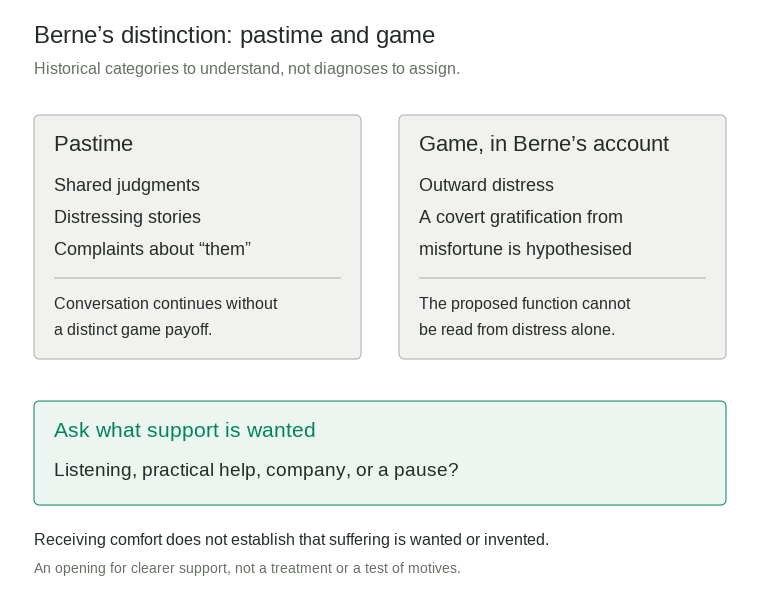
“Ain’t It Awful” opens the Party Games chapter of Games People Play (1964). Berne distinguishes four forms: three pastimes and a game. A pastime, in his account, continues without a distinct dramatic ending or game payoff. His forms include moral condemnation, labelled “Nowadays”; disturbing medical stories, “Broken Skin”; and workplace complaints, “Water Cooler” or “Coffee Break,” with “Bar Stool” as a related form. Berne’s estate-hosted excerpt, full entry
Theo’s opening conversation is closer to the complaint-based pastime than to Berne’s strict game.
The game description is more troubling. Berne proposes that outward distress can conceal gratification from misfortune, using examples of people he claims seek unnecessary operations for care, attention, or escape from responsibilities. These are historical clinical interpretations, not conclusions that can responsibly be drawn from someone seeking medical help. Original entry, “Party Games,” §1
In TA, a game involves recurring exchanges with an apparent purpose, an inferred psychological function, and a familiar payoff. The essential distinction here is between sharing distress and hypothesising a concealed gratification from the misfortune itself. Receiving comfort does not establish the latter. ITAA, Core Concepts
How the conversation can sustain itself
A complaint receives recognition. Recognition encourages another example. Agreement becomes a signal of belonging; qualification risks sounding disloyal.
Participants may feel less alone, more certain of their judgment, or temporarily relieved of uncertainty. Those functions can be understandable and beneficial. Difficulties arise when the conversation cannot accommodate someone’s different experience, an accurate update, or a wish to stop.
Observable features include which contributions receive attention and what happens when the account changes. Motives remain uncertain.
A separate research concept, co-rumination, concerns extensive shared discussion and revisiting of problems. An observational study of adolescent friends found different aspects associated with positive friendship adjustment and emotional difficulties. This supports attending to how people talk, rather than condemning all problem-sharing. It does not validate Berne’s medical claims or establish an adult game. Rose and colleagues, 2014
Openings for change
Berne’s entry gives no separate antithesis, or prescribed counter-response. The suggestions here are Patternverse adaptations, not established solutions from Berne or validated treatments for this game. Original entry
Recognise the trouble without endorsing every conclusion
Maya initially replies, “At least they’re finally doing something.”
Theo hears minimisation. He reminds her how long residents have waited.
She revises: “The delay has been unacceptable. I’m also sharing the repair notice because it may help us plan.”
Both statements can stand. Acknowledging the failure need not require agreement that nobody ever repairs anything.
Someone can also decline a generalisation: “I’m angry about this decision. I don’t know that every member of staff is indifferent.”
That response leaves room for justified criticism without making certainty about everyone’s character the price of participation.
Identify what support is wanted
A listener can ask whether someone wants company, practical help, or space to express frustration. Listening need not immediately produce a plan.
The person speaking can make the request direct:
“I don’t want suggestions tonight. I want someone to understand how exhausting this has been.”
Or:
“I’ve talked about it enough for now. Could you help me write a clear complaint?”
These requests allow support to be offered without requiring another alarming example to keep the conversation alive.
Notice when connection depends on keeping the trouble unchanged
In this original Patternverse adaptation, Theo receives confirmation that the laundry has reopened. He does not post it. Instead, he shares an older photograph, leaving neighbours with the impression that nothing has changed.
Later, he admits to Maya that he liked being the person everyone rallied around. He worried the conversation would disappear once the problem was fixed.
His admission provides information about his own motivation. Another person’s scepticism about a repair would not establish the same motive.
Maya responds, “I understand wanting the company. The old photograph still left people misinformed.”
Theo posts the update and corrects the impression. He also asks whether anyone would like to meet for coffee. Two neighbours accept. Others remain annoyed about the misleading post.
The maintenance failures remain valid grounds for complaint. His need for connection also becomes expressible without preserving an inaccurate account.
Allow action, continued listening, or an ending
A group can agree to collect specific maintenance reports, identify what response is needed, and decide who will communicate them. Organising around a genuine problem is not evidence of a game.
Sometimes there is no useful action available yet. People may still need companionship.
A participant can also set a limit: “I care about this, but I’m leaving the discussion for tonight.” That does not require everyone else to stop or pronounce the problem solved.
If others insist that leaving means disloyalty, the person can maintain the limit. They cannot guarantee the group will welcome it.
When repeated distress needs care
Nadia has persistent symptoms without a clear explanation. She tells a friend about another difficult appointment.
The friend worries that discussing illness has become their only way of connecting and tries changing the subject whenever symptoms arise. Nadia feels dismissed.
They revisit the conversation. Nadia explains that she wants help remembering questions for her next appointment, and sometimes simply wants someone to believe her. Her friend explains that she cannot discuss medical uncertainty throughout every visit.
They agree to make room for both support and other conversation. Nadia’s symptoms remain unresolved.
That outcome does not reveal a hidden gratification from illness. The NHS explicitly recognises that symptoms without an established explanation are real and can impair functioning. Relief at being heard is compatible with unwanted suffering. NHS, Medically unexplained symptoms
Pitfalls and limits
The most harmful shortcut is: You receive attention, therefore you want the problem.
Benefits of care do not establish that someone caused, invented, or welcomes their suffering. Repeated appointments, second opinions, disability claims, and detailed accounts of symptoms do not establish Berne’s game.
Likewise, people experiencing discrimination, exploitation, poverty, coercion, or abuse may need repeated opportunities to describe what remains unchanged. A person with authority must not use this label to avoid investigating a complaint.
Berne’s portrayal includes gendered generalisations and racist complaints in his examples of moralising conversation. These require critical distance. Shared indignation can consolidate prejudice as well as solidarity. His confident attribution of medical motives is especially unsuitable as a basis for judging an individual patient.
Later TA writing encourages direct expression of wants and feelings. That principle may inform a clearer request for support; it does not justify withdrawing compassion to expose a supposed payoff. ITAA, Core Concepts
The model remains interpretive. Evidence about TA generally—or co-rumination specifically—does not establish the effectiveness of these adaptations.
Connections
Co-rumination is a separate research construct about repeated problem discussion, with potentially mixed relational and emotional associations.
Validation without total agreement allows recognition of distress alongside uncertainty about explanations.
Collective problem-solving turns shared concern into an agreed task where action is feasible.
Direct requests for support make listening and companionship available without requiring the situation to become more dramatic. These are neighboring concepts, not claims about existing Patternverse entries.
Sources and attribution
Historical forms and distinctions: Eric Berne, Games People Play (1964), “Party Games,” §1, checked against the full entry and estate-hosted excerpt. Later TA, research, and health guidance are distinguished where used.
All encounters are fictional. The everyday examples, explanatory diagram, and practical responses are original Patternverse adaptations.