
Recognize recurring roles around harmful drinking while preserving care, choice, and responsibility.
Sam misses another morning shift after drinking. Alex phones Sam’s employer and invents an illness. That evening, Alex demands an explanation, then spends an hour finding treatment appointments. Sam promises that things will change, but does not attend the appointment Alex has booked.
“You don’t even want help,” Alex says.
“You’ve already decided what’s wrong with me,” Sam replies.
By the weekend, they are barely speaking. When another difficult night arrives, Alex again handles the immediate consequences.
There is a serious drinking problem here. There is also a familiar relationship sequence. Understanding one does not settle the other.
The core pattern
Alcoholic is the historical name of a game in the “Life Games” section of Eric Berne’s Games People Play. Berne examined the social interactions surrounding excessive drinking, assigning five principal roles:
| Historical role | Function in Berne’s account |
|---|---|
| Alcoholic | The central participant whose drinking organizes the interactions. |
| Persecutor | Accuses, condemns, or punishes. |
| Rescuer | Undertakes to bring about the person’s recovery. |
| Patsy | Provides money or other assistance within the recurring arrangement. |
| Connection | Supplies alcohol. |
One person can occupy several roles at different times. Berne described movement between providing assistance, condemning the drinking, and attempting to secure change. These are historical role labels, not diagnoses or reliable descriptions of particular people. Berne’s original account
The medical distinction is essential. Alcohol use disorder—AUD—is a treatable medical condition involving impaired control over alcohol use despite harmful consequences. It cannot be explained by a relationship game. Behavioral treatments, medications, and mutual-support approaches can support recovery. NIAAA: Understanding Alcohol Use Disorder
The potentially useful question is narrower: Have our responses become repetitive, with responsibility moving between us while effective care and our own needs remain unattended?
How the interaction sustains itself
In Berne’s interpretation, the game’s distinctive payoff concerns the aftermath of drinking: psychological torment, self-condemnation, and exchanges in which punishment is sought or supplied. He treated these as organizing features of the game. They should not be assumed to explain why any individual drinks or returns to drinking. Games People Play, “Alcoholic”
Observable sequences can be described more modestly. A crisis produces urgent action. Someone covers a missed obligation. Fear becomes anger. Anger gives way to renewed efforts to help. A promise brings temporary relief, while the arrangements remain fragile.
Each action can make immediate sense. A partner may protect household income. A parent may fear losing contact. The person drinking may feel overwhelmed, ashamed, ambivalent about change, or unable to obtain suitable treatment. These possibilities require inquiry.
Recognizing short-term relief does not establish a hidden wish to perpetuate harm. Nor does participation imply equal power or responsibility.
Later TA accounts use the Drama Triangle to examine shifts between rescuing, persecuting, and victim positions, and emphasize explicit agreements in therapy. This is a later interpretive development, not independent evidence for Berne’s account of addiction. ITAA: Core Concepts
There is also disagreement within TA. In a 1990 critique, Amos Selavan explicitly rejected treating alcoholism as a game while retaining a possible role for TA within addiction treatment. That conclusion is stated in the paper’s available abstract; its full text was not consulted here. Selavan, 1990
Openings for change
Berne’s proposed antithesis involved a therapist, after preparation, declining the familiar roles and establishing an explicit working agreement. His account concerned a clinical relationship. It does not establish that a relative can resolve AUD by refusing a role. Original discussion
The following are Patternverse adaptations for understanding relationships and discussing support.
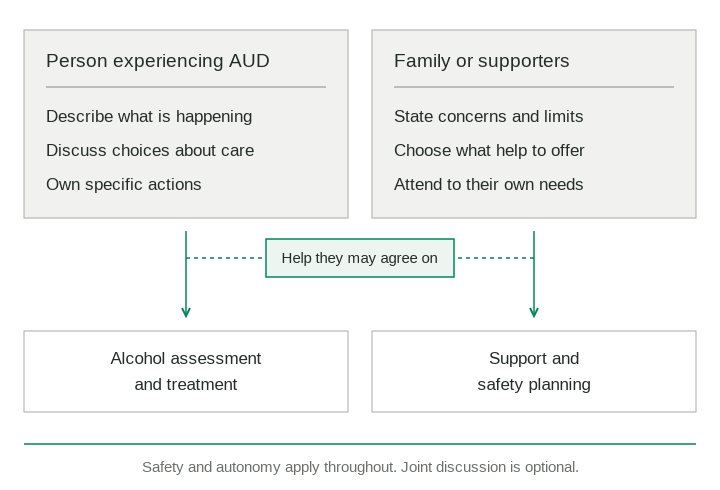
Describe events without turning them into an identity. “You missed two shifts, and I called your employer” gives people something specific to address. “You always manipulate everyone” asserts a motive and makes the person’s character the subject.
Distinguish an offer from taking over. Assistance can be concrete and voluntary:
“I can help you find a clinician or go with you if you want. I cannot make the treatment decisions for you.”
The person experiencing the drinking problem can also make a direct request:
“I’m worried about how much I’m drinking. Would you sit with me while I arrange an assessment?”
Make limits about your own actions. A supporter might decide, “I won’t give a false explanation to your employer again.” That does not require a threat or an agreement that the other person is playing a game. Limits should be realistic and chosen with attention to safety.
Bring professional care into the picture. Changing relationship habits cannot replace assessment or treatment. For people who have been drinking heavily over a prolonged period, suddenly stopping can cause potentially life-threatening withdrawal. Medical help is important when planning a safe change. NIAAA: Cutting Down or Quitting
Family members can seek support even when the person drinking declines treatment. Community Reinforcement and Family Training, or CRAFT, is one researched approach addressing communication, family well-being, and encouragement of treatment entry. Its evidence concerns that intervention; it does not validate the game interpretation. Review of family-involved approaches
What this looks like in practice
Revising an unsuccessful offer
After Sam misses the appointment, Alex initially says, “Fine. I’m finished rescuing you.”
The phrase expresses exhaustion but leaves the practical arrangement unclear. Does Alex mean no more false explanations, no transport, or no contact?
Later, when both can talk safely, Alex becomes more specific: “I booked that without asking. I won’t book another appointment for you. I also won’t call your employer with an excuse.”
Sam says the appointment time was impossible and admits being frightened of the assessment. Alex listens without offering to manage everything again. Sam agrees to request information from another service. Alex arranges separate support for the strain of living with the situation.
Nothing guarantees that Sam will follow through. Alex’s next step no longer depends entirely on that promise, and the offer of help is clearer.
When similar behavior needs a different explanation
Lena, who has been drinking heavily for years, becomes shaky and unwell after stopping. Her brother has recently read about rescuing and worries that arranging care will reinforce dependency.
The relevant question is medical. They seek urgent assessment because withdrawal may be dangerous. A relational interpretation must never delay necessary care. NIAAA withdrawal guidance
Later, there may be room to discuss transport, communication, and what support each person can provide. Getting help for illness does not establish a game.
Pitfalls and limits
The greatest misuse is to suggest that addiction is deliberate theater or that suffering relatives secretly require it.
Berne’s account contains gender stereotypes and language that assigns complicity to a person experiencing partner violence. Those assumptions should not be carried forward. Being harmed is not evidence of consenting to a role. Where violence, intimidation, or fear of retaliation is present, safety and individual support take priority over a joint conversation. Research-based family-treatment guidance also identifies circumstances in which conjoint therapy is inappropriate. Family-treatment review
Care is not automatically rescuing. Maintaining a boundary is not automatically persecution. A return to drinking does not prove that someone wanted punishment or rejected recovery.
Berne also proposed resumed social drinking as a criterion of a “game cure.” That historical claim should not become a recovery test. Decisions about alcohol use need to reflect the person’s health and clinical circumstances. NIAAA guidance
For Patternverse, the defensible use of this entry is limited: recognizing repetitive responses may help clarify choices and responsibilities. It cannot diagnose motives, explain addiction, or promise recovery.
Connections
I’m Only Trying to Help You offers a neighboring TA account of investment in helping and disappointment when advice fails. It should not be used to discredit legitimate care.
The Drama Triangle examines changing interpersonal positions; it is not a map of who caused an illness.
Proposed companion patterns include Make Helping a Shared Agreement and Set a Boundary You Can Maintain. They focus on observable arrangements and actions within one’s control.
Sources and attribution
Historical interpretation: Eric Berne, Games People Play (1964), “Alcoholic”; later role terminology: ITAA’s Core Concepts. Historical criticism: Amos Selavan (1990), abstract consulted. Medical context and family-treatment evidence: NIAAA and McCrady and Flanagan’s 2021 review.
The encounters, suggested language, and illustration are original Patternverse adaptations, not a treatment protocol.