
When finding one fault becomes a reason to dismiss the person
A familiar scene
At dinner, Jonah meets Amira. She listens closely, tells an engaging story about her work, and asks thoughtful questions.
Then he discovers she has never seen a film he considers essential.
“Really? I thought everyone had seen that.”
She laughs and asks what he likes about it. He gives a short answer and turns to someone else.
On the way home, his friend asks what he thought of Amira.
“Pleasant enough. But she hasn’t even seen that film.”
He mentions the gap again the following day. Everything else about the encounter has become secondary.
His friend has noticed this before: meeting someone new seems to become easier once Jonah has found a reason they need not be taken seriously.
The core pattern
Berne placed “Blemish” among the Party Games in Games People Play (1964). He describes searching for another person’s flaw as a source of reassurance and a way of avoiding closeness that might expose one’s own shortcomings. His formulation shifts from “I am no good” towards “They are no good.” These are his historical interpretations, not established explanations of an individual’s criticism. Berne’s estate-hosted excerpt
The distinctive mechanism is the search for a disqualifying detail, followed by relief or justification when it is found. The supposed blemish may be an actual mistake, an irrelevant difference, or a prejudicial criterion that should never have been treated as a defect.
In transactional analysis, a game is a recurring exchange with an apparent social purpose, an inferred psychological function, and a familiar ending or payoff. Here, apparent discernment may also provide reassurance or distance. That second level remains a hypothesis. ITAA, Core Concepts
Recognising the possibility can help when attention repeatedly settles on whatever permits dismissal. It does not require accepting everyone, overlooking misconduct, or abandoning relevant standards.
How the search closes
The sequence may begin with uncertainty around someone new: admiration, comparison, curiosity, discomfort, or simple unfamiliarity.
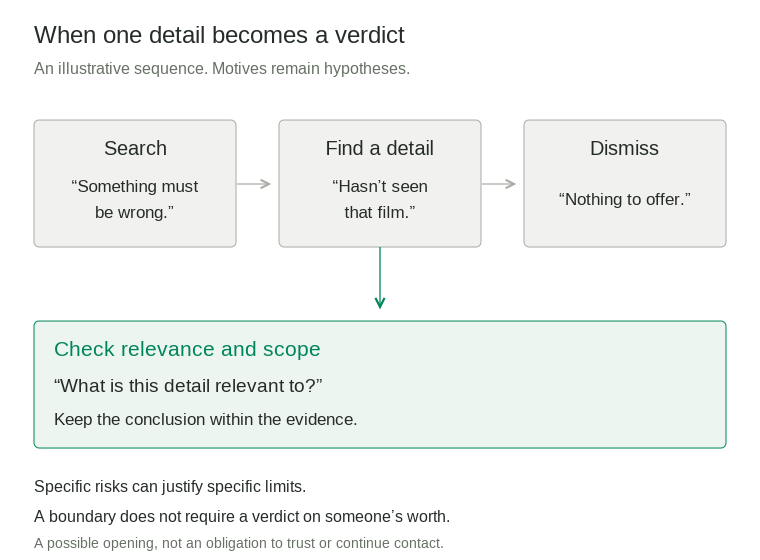
Attention narrows towards finding something wrong. Once a suitable detail appears, the search ends. Other information loses weight. A limited observation becomes a broad conclusion.
In Jonah’s encounter, we can observe the question, Amira’s answer, his withdrawal, and his repeated emphasis afterwards. We cannot establish from those events that he felt inferior or feared intimacy.
A possible immediate function is reducing uncertainty: I have found the reason I can keep my distance. Longer-term costs may include missed relationships, contempt, and a social circle organised around increasingly narrow tests.
Others can contribute by rewarding the discovery with laughter or supplying additional faults. The person being assessed may begin defending themselves against an expanding set of criteria.
That does not make them equally responsible. Nobody has to establish flawlessness to deserve respectful treatment.
Openings for change
Berne’s short entry gives no separate antithesis, or prescribed counter-response. The suggestions here are Patternverse adaptations, not established solutions from Berne or validated treatments for this game. Original entry, “Party Games,” §2
Keep the conclusion within the evidence
A gap in film knowledge establishes a gap in film knowledge. It may matter to choosing a film-discussion partner. It says little about someone’s generosity, competence elsewhere, or capacity for friendship.
Jonah could respond with curiosity: “It means a lot to me. What films have stayed with you?”
He need not turn every difference into common ground. The opening is simply to let new information remain possible instead of treating the first disappointment as a completed assessment.
Where a decision genuinely matters, the relevant question concerns its requirements: what does this detail tell us about the particular choice? One serious concern may be sufficient. Several irrelevant imperfections may tell us very little.
Address the judgment without diagnosing the judge
Jonah’s friend initially says, “You only pick people apart because you’re insecure.”
He becomes defensive and lists occasions when his first impressions were correct. The conversation has become another contest over someone’s character.
Later, the friend revises: “You’ve mentioned one film several times. I don’t understand how that supports the conclusion that she has little to offer.”
This gives Jonah something specific to reconsider without requiring him to accept an explanation of his motives.
After reflecting, he says he had felt impressed by Amira’s work and uncomfortable comparing it with his own. Finding something she did not know had felt reassuring.
That admission provides information in this fictional encounter. His friend could not have established it merely by noticing criticism.
Express the underlying need more directly
At another gathering, Jonah catches himself preparing a question designed to expose a gap. He changes course and asks about Amira’s experience instead.
The conversation is less competitive. He still discovers differences in taste, and they do not become close friends. He no longer needs to treat those differences as evidence against her.
If the actual need is distance, that can also be acknowledged. Someone may be unavailable for friendship, uncertain about collaboration, or unwilling to pursue a relationship without constructing a case that the other person is defective.
Where comparison or vulnerability repeatedly drives distress, voluntary therapeutic exploration might help the person understand it. Accepting the game label need not be a condition of that work.
Decline an endless qualification test
Someone targeted by fault-finding can answer a relevant question without entering a comprehensive defence:
“I haven’t seen it. I’m happy to talk about films, but I don’t want the conversation to become a test of whether I’m educated.”
A colleague can ask for feedback tied to the work: “Which part needs correcting, and what standard are we applying?”
If the criteria keep shifting, a boundary may be more useful than further explanation. The person can stop the discussion, seek appropriate support, or decline further contact where feasible. No particular sentence guarantees cooperation.
When criticism is doing its job
Alina sits on an interview panel for a role requiring independent account reconciliation.
A candidate is personable and experienced in other areas, but their work sample contains substantial errors. Alina checks the instructions, asks the agreed follow-up questions, and considers the explanation. The evidence still does not establish the competence needed for this role.
Another panel member says she is concentrating on flaws.
Her concern is nevertheless relevant to the appointment. The panel can decline the candidate without deciding that they are generally incapable or unworthy.
Structured assessment offers a useful distinction from improvised fault-finding. US Office of Personnel Management guidance describes job-related questions and consistent rating standards. Such methods are assessment tools, not treatments for “Blemish.” OPM, Structured Interviews
Criteria still need to be defensible and applied in an accessible, fair process. Consistency alone cannot make an irrelevant standard appropriate.
Pitfalls and limits
“Blemish” can itself become a blemish: You criticise people, therefore you are insecure and should be dismissed.
The model should not be used to discredit someone who identifies abuse, discrimination, dishonesty, or unsafe conduct. A specific warning sign can warrant a firm boundary. Nobody owes continued exposure while searching for redeeming qualities.
Berne includes racist, class-based, and sexual criteria among his examples. These illustrate that a supposed defect may reveal prejudice in the evaluator rather than a failing in the person judged. His proposed explanation involving sexual insecurity should not be treated as established causation. Original entry
Poverty, disability, cultural unfamiliarity, distress, and unequal educational opportunity must not become evidence of inferior worth.
Later TA ethics explicitly emphasises dignity and rejects allowing bias and prejudice to shape professional relationships. Respect for someone’s worth remains compatible with assessing conduct, limiting trust, or declining a particular role. ITAA, Code of Ethics
This framework cannot establish hidden motives or diagnose a person. Evidence about TA generally would not demonstrate the effectiveness of these adaptations.
Connections
Ain’t It Awful: Berne links “Blemish” with shared negative judgments that provide social connection. Here, the focus is finding the disqualifying feature. Original entry
Separating observation from judgment distinguishes a specific fact from the larger conclusion attached to it.
Relevant criteria connect an assessment to the decision actually being made.
Boundaries without contempt permit distance without requiring a verdict on human worth. These connections do not imply that corresponding Patternverse entries already exist.
Sources and attribution
Historical description and placement: Eric Berne, Games People Play (1964), “Party Games,” §2, checked against the full entry and estate-hosted excerpt. Later TA and assessment guidance are distinguished where used.
All encounters are fictional. The examples, explanatory diagram, and practical responses are original Patternverse adaptations.