
When the chase—and being caught—become part of the pattern
A familiar scene
Eli has again used the community workshop outside his booked hours. Another member arrives to find their session delayed.
When coordinator Jo asks what happened, Eli gives an evasive answer. Later, he jokes, “You’ll never work out when I’m here.”
“Just watch me,” Jo replies.
Over the following weeks, their exchanges become increasingly personal. Jo spends evenings checking records. Eli drops hints about another unbooked session, then complains about being watched.
Eventually, Jo establishes another breach and suspends Eli’s access under the workshop’s policy.
“Typical,” Eli tells a friend. “I always end up being the one who gets thrown out.”
He spends much of the evening describing how nearly he got away with it. Meanwhile, the other members still need reliable access to the equipment.
The practical problem has become a contest. Whether Eli wanted its ending remains an open question.
The core pattern
Eric Berne places “Cops and Robbers” first in the “Underworld Games” chapter of Games People Play (1964). He distinguishes offending primarily for material gain from a proposed psychological game involving pursuit, escape, and eventual capture. His developmental analogy is hide-and-seek: the child enjoys hiding but also needs the search to end in discovery. Berne estate: “Cops and Robbers”
The distinctive hypothesis is not simply that rule-breaking can be exciting. It is that being caught helps complete the interaction, despite the apparent effort to escape. Berne associates that ending with reassurance of a familiar identity as someone who loses. Games People Play, analysis
Within transactional analysis, or TA, a game has an apparent purpose and a hypothesised psychological function. Here, obtaining something and avoiding detection are the apparent purposes; pursuit and discovery supply the proposed psychological significance.
The opening uses an everyday Patternverse analogy. Berne’s entry concerns crime. A workshop dispute and criminal offending have different stakes.
Repeated discovery does not establish a wish to be caught. Nor does concealment prove that someone secretly wants discovery. The interpretation becomes worth exploring when a person themselves recognises that provoking pursuit or recreating a familiar ending matters alongside the stated objective.
How the interaction may sustain itself
The following is a Patternverse explanation of a possible recurring sequence.
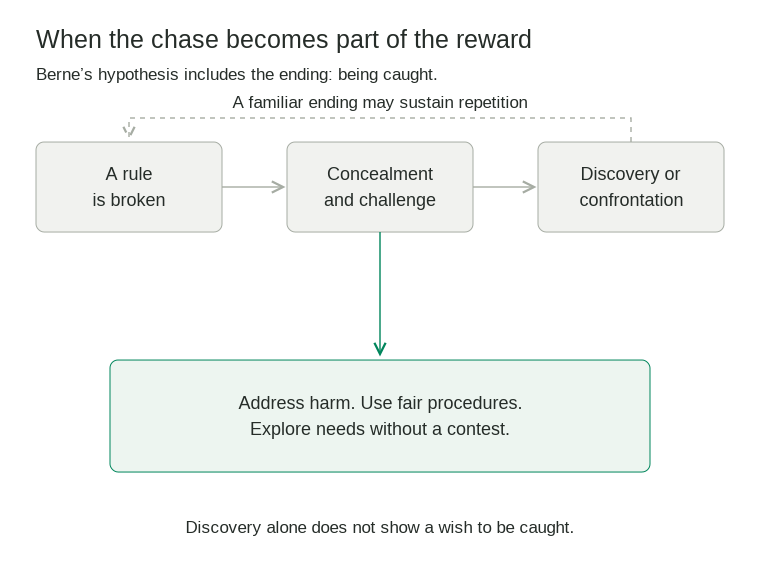
A rule is broken. Concealment follows, but so do challenges, hints, or confrontations that draw renewed attention. The person responsible for oversight becomes increasingly invested in catching the individual.
Discovery produces consequences and a story: “They finally got me,” “I almost outsmarted them,” or “This always happens to me.” Afterward, the sequence may begin again.
Possible immediate functions include excitement, recognition, relief from uncertainty, or confirmation of a familiar expectation. Someone enforcing a rule might become invested in demonstrating competence or defeating defiance. These are hypotheses, not motives established by the sequence.
Material benefits may also remain important. A psychological interpretation should not make stolen property, lost time, intimidation, or other harm disappear.
The roles are not equal merely because both people participate. Legitimate oversight is a responsibility. An authority’s personal hostility is a separate matter. A person harmed by misconduct need not acquire a supposed “payoff” for the model to explain their presence.
Openings for change
Establish what Berne actually proposed
In discussing hide-and-seek, Berne calls not being caught an antithesis. His formal antithesis section, however, leaves the problem to qualified criminologists. He explicitly says that police and judicial responses can occupy their expected places in the sequence rather than interrupt it. He supplies no established conversational cure. Games People Play, antithesis
The responses below are original Patternverse adaptations, not Berne’s prescriptions or validated interventions.
Return to the conduct and its consequences
An authority can maintain appropriate oversight while declining a personal duel.
Jo initially tells Eli, “I knew you’d slip up.”
That invites another argument about who has outsmarted whom. She revises her approach:
“Two bookings were disrupted. My responsibility is to keep access reliable. We’ll follow the published review process, and you can give your account.”
The change concerns how Jo carries out her responsibility. It does not erase the breach or guarantee Eli’s cooperation.
Where rules are unclear, inaccessible, or inconsistently applied, those problems also need examination. Predictable consequences require a fair process, not a psychological label.
Make the actual need discussable
Eli might begin with something he can report about himself:
“I needed more workshop time. I also liked the argument about whether you could catch me. I wasn’t thinking about the people waiting.”
That acknowledgement need not settle whether he wanted suspension.
He can ask directly about additional sessions, accept that availability is limited, and address the disruption he caused. Jo can consider the request without making compliance dependent on admitting a hidden motive.
If someone wants challenge, recognition, or contact, those needs can be explored directly. They do not justify obtaining them through harm.
Separate support from concealment
A friend can offer help without becoming another participant in the contest:
“I’ll help you work out what to say at the review. I won’t help you hide another breach.”
In therapy, a recurring expectation such as “I always end up excluded” might become a topic for collaborative exploration. The ITAA’s later core-concepts summary emphasises explicit agreements about the outcome a client wants. That principle supports defining a useful goal rather than treating admission of a game as the goal. ITAA: The Core Concepts
Accept an incomplete outcome
Eli rejects Jo’s explanation and calls her obsessed. Jo does not argue about his intentions. She maintains the suspension, provides the review information, and ends the exchange.
Eli eventually requests a review but does not acknowledge enjoying the contest. Jo cannot resolve that uncertainty for him.
Progress here means a clearer process and less personal escalation. It does not necessarily mean restored access, agreement, or reconciliation.
A contrast: repeated difficulty has a practical explanation
Leila repeatedly arrives late for mandatory workplace training. Her supervisor describes her as testing whether anyone will enforce the start time.
Leila has already explained that the accessible transport available to her arrives fifteen minutes after training begins. Her emails have gone unanswered.
When another manager checks the arrangements, the difficulty becomes clear. They move her session and confirm the change in writing. Leila attends on time.
There was repetition, a rule, and an authority’s intervention. None established a wish to be caught or disciplined. The explanation concerned access.
The same caution applies when behaviour reflects poverty, coercion, disability, distress, confusing requirements, or an unfair rule. Understanding the circumstances is part of accountability.
Evidence and limits
A small study catalogued in 1978 compared twenty incarcerated male bank robbers with twenty other incarcerated men. The bank-robbery group more often reported childhood chase games and identification with criminal figures. This retrospective comparison did not establish a desire for capture or test an intervention. Wilson and Bulmer: historical research report
Berne’s broad distinction between people seeking gain and people needing capture therefore remains an interpretation here. Carelessness, boasting, poor planning, or discovery can have many explanations. An arrest does not reveal a psychological wish, and a conviction does not establish a life story chosen in childhood.
Later TA criticism also challenges the substitution of game explanations for actual power and material consequences. Julie Hay’s 2022 discussion distinguishes victimization and genuine efforts to help from psychological game participation. It provides a general corrective, not a tested antithesis for this entry. Hay: “Game changing dynamics”
Discriminatory enforcement, coercion, and abuse must not be explained as interactions that affected people invited. Equally, recognising a possible psychological function does not excuse someone’s harmful conduct.
The sources cited here do not establish the effectiveness of the proposed responses. Evidence about TA generally would not validate this particular account of crime or capture.
Connections
Hide-and-seek. Berne’s analogy highlights discovery as part of the desired ending. Ordinary childhood play is not evidence of future offending.
Accountability without humiliation. Conduct, harm, and consequences can be addressed without making someone’s character the object of a contest.
Familiar expectations. “I always get excluded” may be worth exploring as a belief, while checking whether exclusion has real external causes.
Sources and attribution
Berne supplies the historical formulation and antithesis. Later perspectives draw on ITAA concepts, Hay’s critique, and the limited historical study discussed above. The fictional encounters, illustration, everyday analogy, and practical responses are original Patternverse adaptations.