
When someone’s words become a reason to close off repair
A familiar scene
Mina and Theo have planned an evening walk. While putting on her shoes, Mina mentions the bathroom repair they keep postponing.
“Can we have one evening without your list?” Theo says.
“If that’s your attitude, go without me.”
“Fine. You said it.”
He leaves. Mina wanted him to acknowledge the sharp remark before they went out. Theo had wanted an evening alone but had not said so. Now he can leave while telling himself that she cancelled.
Later, she says he abandoned their plans. He replies that he followed her instructions.
This is the third evening to end this way. The practical disagreement disappears beneath an argument about whose words made the separation inevitable.
The core pattern
“Corner” opens the Marital Games chapter of Berne’s Games People Play (1964). His central example moves from an agreed outing through provocation, offence, and separation. He interprets the crucial move as an insincere refusal to participate in a familiar relational exchange: someone adopts an apparently innocent, literal position while withholding an understood opportunity for reconciliation. Berne’s estate-hosted excerpt
This is narrower than simply feeling trapped. The distinctive claim is that taking someone’s words literally becomes a means of cornering them while keeping oneself apparently blameless.
Within transactional analysis, a game is a recurring interaction with an apparent social purpose, an inferred psychological level, and a familiar ending or payoff. Here, the apparent purpose might be respecting a stated decision; Berne hypothesises that the interaction also provides an excuse to avoid intimacy. ITAA, Core Concepts
That hypothesis requires caution. Accepting a refusal is not evidence of manipulation. Nobody is obliged to infer a hidden invitation beneath another person’s “no.”
How the corner forms
The sequence begins with something apparently shared: an outing, a conversation, an attempt to cooperate. A sensitive subject enters, followed by a rebuff or accusation. One person withdraws or issues a conditional refusal. The other treats those words as settling the entire matter.
In Mina and Theo’s fictional encounter, their later accounts reveal wishes neither expressed directly. In an actual relationship, an observer could see the exchange and its repetition, but could not simply know those wishes.
Possible immediate functions include avoiding a vulnerable apology, obtaining distance without requesting it, or protecting a sense of being the wronged party. The ending can be painful while still serving one of those functions. Payoff does not necessarily mean pleasure or conscious planning.
The longer-term cost is that repair becomes harder to attempt. Changing one’s mind feels like admitting defeat; apologising feels like surrendering the entire dispute.
Responsibility remains specific. Theo’s sharp remark is his to address. Mina can clarify her wishes. Neither becomes responsible for reading the other’s mind.
Berne’s antithesis—and a necessary revision
Berne’s proposed antithesis, or counter-response, is explicitly gendered: the wife changes her mind and accompanies her husband; the husband may coax her into going. He also describes family dilemmas in which children are criticised whichever response they choose, and a therapy-group variant addressed by prohibiting logical paradoxes. Original entry, “Marital Games,” §1
These are historical proposals, not established solutions. Smiling and accompanying someone does not resolve disrespect, and coaxing must not become pressure.
A voluntary change of mind remains possible. So does maintaining a refusal. Sexual consent, particularly relevant to Berne’s interpretation, must be freely given and ongoing; a theory about hidden wishes cannot override it. RAINN, Consent 101
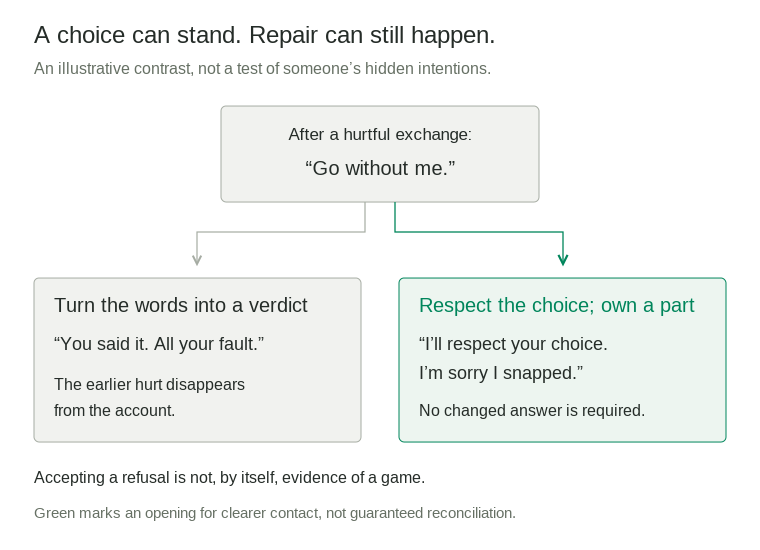
The suggestions below are Patternverse adaptations, not Berne’s prescriptions or validated treatments for “Corner.”
Openings for change
Address the conduct without demanding a different answer
Theo could say:
“I’ll respect that you don’t want to come. I’m sorry I snapped about the repair.”
The apology concerns his remark. It does not purchase Mina’s company or require her to change her decision.
Mina could make her position more precise:
“I’m upset by how you answered. I still want a walk together, but I’d like us to address that first.”
Or she might genuinely want to stay home. Clearer communication permits either answer.
Recognising the pattern is useful when it makes these distinctions available. It becomes counterproductive when someone announces, “You don’t really mean what you said.”
Replace the test with a direct request
The following week, Mina begins, “Perhaps you’d rather go alone, as usual.”
Theo answers defensively. They start arguing about the previous evening.
Mina stops and revises: “I want to spend time together. Are you available tonight?”
Theo says he wants an hour alone. Mina is disappointed, but they agree on breakfast together the next morning and a separate time to discuss repairs.
The change is modest: the wish for contact and the wish for solitude become answerable requests. Their agreement will matter only if they follow through.
Make room for an honest stopping point
Someone can withdraw from the familiar argument without pretending everything is settled:
“I don’t want to continue this conversation while we’re speaking sharply. I’m stopping now. I can return to the repair question tomorrow.”
A proposed return time is an offer, not a guarantee. If the other person declines, the unresolved issue remains visible. Repeated refusal to discuss shared obligations may itself require a firmer boundary or outside support.
Later TA writing emphasises direct expression of wants and explicit agreements about desired change. Applied here, a voluntary therapeutic goal might concern recognising the sequence and communicating withdrawal clearly—not ensuring that a couple always stays together or completes its plans. ITAA, Core Concepts
When every available response is criticised
Berne also includes a family variation involving incompatible demands. A similar structure can help describe a workplace difficulty without assuming a shared game.
A manager tells Jules to show initiative. When Jules resolves a routine problem, the manager objects that approval was required. When Jules asks for approval next time, the manager criticises the lack of independence.
Jules initially tries to anticipate the manager’s preferences. The criticism continues.
Instead, Jules asks which decisions require approval and proposes written examples. The manager gives no usable answer. Jules records the contradictory instructions and seeks support from a more senior colleague.
There is no neat conversational escape. The manager controls the expectations and the evaluation. The useful recognition concerns an unworkable arrangement; it does not make Jules equally responsible for maintaining it.
When similar words mean something else
After a demanding shift, Elin tells her friend, “Go without me. I need to rest.”
Her friend accepts. Elin remains disappointed to miss the evening, but she appreciates being believed. They arrange another meeting.
Disappointment does not make her refusal insincere. Neither does a later wish that circumstances had been different.
A genuine boundary, disability-related limitation, financial constraint, or lack of desire needs no hidden psychological explanation. A single awkward exchange provides little basis for applying this model.
Pitfalls and limits
The dangerous misuse is claiming authority over what another person “really” wants. That can turn a framework about communication into a justification for ignoring refusals.
Berne’s gendered expectations about reassurance and reconciliation should not become duties assigned to women, partners, or children. Nor should coercion or abuse be redescribed as an interaction the person harmed invited. Where speaking plainly risks retaliation, safety and independent support take priority over repairing the exchange.
The entry also advances causal and treatment claims involving schizophrenia and asthma. These should not be carried forward as clinical knowledge. Current medical accounts describe complex health conditions; symptoms are not evidence of participation in a game. NIMH, Schizophrenia, NHLBI, Asthma: Causes and Triggers
The sources establish the model’s provenance, not the effectiveness of these adaptations. Evidence about TA generally would not, by itself, validate a particular response to “Corner.”
Connections
Double bind: Berne associates a family variant with contradictory demands. This is a neighboring interaction concept, not a diagnosis or explanation of medical illness.
“Now I’ve Got You, You Son of a Bitch”: another person’s fault licenses a wider attack. “Corner” focuses on using an apparently defensible position to foreclose repair. Berne’s original entries
Direct requests make wishes answerable without requiring someone else to decode a test.
Repair with boundaries allows an apology and a continuing refusal to coexist. These last two are response concepts, not claims about existing Patternverse entries.
Sources and attribution
Historical account and antitheses: Eric Berne, Games People Play (1964), “Marital Games,” §1, checked against the full entry and estate-hosted excerpt. Later TA, consent, and medical sources are linked where discussed.
All encounters are fictional. The examples, explanatory diagram, and practical responses are original Patternverse adaptations.