
When getting help becomes a contest for a verdict
A familiar scene
At their friend Ruth’s kitchen table, Maya turns towards her.
“Tell Leon you can’t invite people for the whole weekend without asking.”
Leon interrupts. “Tell her what actually happened. My parents asked whether they could visit. I said probably.”
“You told them they could stay.”
“And you called me selfish before I could explain.”
Ruth tries to be fair: “You both have a point.”
Neither feels understood. Maya supplies an earlier example. Leon corrects her account and adds another. Soon both are speaking mainly to Ruth, watching her face after each detail.
By the time they leave, Ruth knows considerably more about their arguments. They still have no agreement about the visit.
Each hopes her eventual judgment will settle something between them.
The core pattern
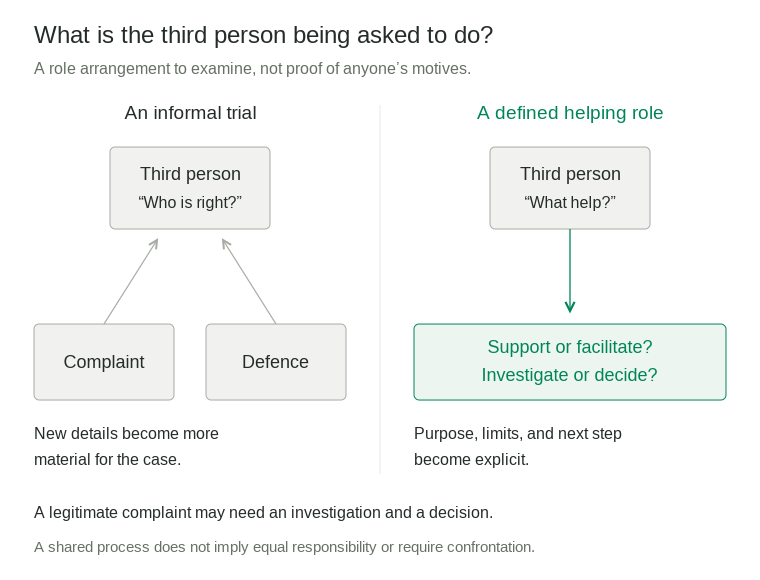
Berne placed “Courtroom” in the Marital Games chapter of Games People Play (1964). Its defining arrangement has three positions: someone presents a complaint, another person defends themselves, and a third is recruited as judge. An audience may become a jury. Berne particularly discusses couples counselling, including the helper’s involvement in sustaining the exchange. Berne’s estate-hosted excerpt
In transactional analysis, a game is a recurring interaction with an apparent social purpose, an inferred psychological function, and a familiar ending or payoff. Here, an apparent request for help can become a repeated effort to secure authoritative confirmation of being right. ITAA, Core Concepts
Berne interpreted this as a search for reassurance against an underlying sense of being wrong. That is his historical clinical hypothesis—not something established by making a complaint, defending oneself, or wanting validation. Original entry, “Marital Games,” §2
The useful question is whether the conversation’s purpose keeps shifting from addressing the problem to winning the third person’s verdict. Seeking support, investigation, or a fair decision is not inherently a game.
How the hearing sustains itself
A complaint invites a defence. The defence introduces qualifications, context, or a counter-complaint. Each new detail becomes material for another rebuttal.
The helper may unintentionally extend the hearing by requesting more examples, weighing personalities, or offering judgments that invite appeals. A provisional verdict rarely closes matters if what people need remains unspoken or the practical dispute remains unresolved.
Possible immediate functions differ. One person may seek reassurance that their hurt is legitimate. Another may fear being condemned without a hearing. The helper may feel useful, authoritative, or responsible for preventing conflict. These are possibilities to explore, not motives to assign.
The familiar ending may be temporary vindication, renewed resentment, or a promise to present a better case next time. Meanwhile, attention moves away from a specific agreement, boundary, or responsibility.
The arrangement does not imply equal fault. Someone drawn into defending themselves may be responding to a public accusation they never agreed to discuss.
Berne’s antithesis—and its limits
Berne proposed first agreeing with the complainant, asking about their reaction, and then reversing the apparent verdict. He also proposed, after sufficient clinical exploration, a group rule requiring people to speak about themselves or address one another directly instead of presenting accounts about the other person. Original entry
These are historical techniques, not established universal solutions. A reaction to an unexpected reversal does not demonstrate concealed guilt. Nor should a grammatical rule prevent someone from reporting events or obtaining confidential support.
Direct address can sometimes change an exchange. It is inappropriate as an automatic requirement where intimidation, coercion, or retaliation makes confrontation unsafe.
The following suggestions are Patternverse adaptations, not Berne’s prescriptions or validated treatments for “Courtroom.”
Openings for change
Clarify the helper’s role
Ruth can revise her initial response:
“My ‘both have a point’ answer didn’t help. I haven’t established what happened. Would you like me to listen, help clarify the weekend arrangements, or help you find someone better placed to handle this?”
These are different tasks. Listening does not require a verdict. Helping with arrangements requires agreement about the scope. Investigating a serious allegation requires competence, authority, and a suitable process.
A person seeking help can also name the request:
“I need support because I felt dismissed. I’m not asking you to decide our whole relationship.”
Or:
“I want a decision about whether this agreement was breached.”
The second request may be entirely legitimate. The question is whether this particular helper can responsibly provide it.
Bring one issue into view
Maya and Leon agree that Ruth can help clarify the visit.
Maya says she needs an apology before discussing logistics. Leon starts listing times she made plans without consulting him.
Ruth pauses: “We can stop if this isn’t useful. For this conversation, can we establish what was communicated to your parents and what still needs deciding?”
Leon acknowledges that he offered the spare room before checking. He apologises and agrees to contact his parents about possible dates.
Maya remains angry that this has happened before. They do not settle that history. They agree that neither will confirm overnight guests without consulting the other.
The improvement is limited but concrete: one action is acknowledged, one repair is assigned, and a future agreement becomes explicit. Ruth does not need to decide which person is generally more considerate.
Allow support without total endorsement
A helper can recognise an experience while remaining careful about facts:
“That sounds upsetting. I can listen, but I can’t determine everything that happened from this account.”
Where harmful conduct is clear, specificity remains possible: “That insult was unacceptable” need not become “You are right about every part of the relationship.”
Someone receiving criticism can acknowledge a particular action without accepting an entire indictment: “I confirmed the visit without asking. I’ll address that. I disagree with the claim that I never consider you.”
Address the recurrence
Later TA writing places explicit agreements about the client’s desired outcome at the centre of therapy. Applied here, an agreed goal might concern expressing hurt, taking responsibility, or setting limits on repeated adjudication. This is a Patternverse application, not a published antithesis for this game. ITAA, Core Concepts
If another person declines a different process, the helper can stop the informal hearing while offering appropriate support or referral. A participant can decline further public argument without abandoning the underlying complaint.
When a hearing is exactly what is needed
Nadia reports repeated disability-related remarks by her supervisor. She brings dated messages and asks for a formal investigation.
A colleague calls this “Courtroom”: she is gathering evidence and asking an authority to judge someone.
But those features also belong to legitimate accountability. The employer needs to examine the evidence, hear relevant accounts, consider protection and accessibility, and reach an appropriate decision. Nadia does not need to confront her supervisor privately first.
Acas guidance on workplace grievances describes evidence review, further investigation where needed, records, and consideration of adjustments. Such procedures cannot be replaced by an interpretation about someone’s psychological payoff. Acas, The grievance meeting
An allegation still requires fair assessment. Recognising its legitimacy as a complaint does not predetermine the findings.
Pitfalls and limits
“You just want someone to say you’re right” can dismiss a person whose experience has repeatedly been denied. Repetition may reflect unresolved harm or failed responses rather than a wish to prolong conflict.
Power matters. Children, employees, dependent partners, and people experiencing abuse may need third-party protection precisely because direct negotiation is ineffective or unsafe. Their distress, communication style, or disability does not reveal hidden guilt.
Berne’s gendered examples and psychiatric terminology should not become contemporary diagnoses. His claim about the complainant’s underlying belief should remain attributed, not used as a test of honesty.
The sources establish the model’s history and concepts. They do not demonstrate that these adaptations reliably interrupt this game. Evidence about TA generally would not establish that either.
Connections
Triangulation: Bowen family-systems theory describes how tension can shift through a three-person relationship. It is a broader, separate framework; “Courtroom” specifies the invitation to adjudicate. Bowen Center, Triangles
Validation without a verdict distinguishes recognising distress from endorsing every factual or moral conclusion.
Specific accountability keeps attention on conduct, impact, and an appropriate response. These two are neighboring response concepts, not claims about existing Patternverse entries.
Sources and attribution
Historical description and antithesis: Eric Berne, Games People Play (1964), “Marital Games,” §2, checked against the full entry and estate-hosted excerpt. Later TA and neighboring frameworks are identified where used.
All encounters are fictional. The examples, explanatory diagram, and practical responses are original Patternverse adaptations.