
A critical reading of a historical pattern around affection, expectation, and conflict
A familiar scene
After several weeks of little physical contact, Nora kisses Adam on the sofa. He responds warmly and reaches for more intimate contact.
“Not tonight,” she says.
He stops. Then: “Why start something, if you don’t want anything?”
“I wanted to kiss you. Everything has to become sex.”
“And everything I want is apparently wrong.”
The argument expands into old grievances. Eventually they sit in separate rooms. Neither needs to explain what kind of closeness they wanted, feared, or could offer.
A similar evening happened last month. Nora has become cautious about initiating affection; Adam has become cautious about responding.
Her refusal needed to be respected. The accusations surrounding it are a separate matter worth understanding.
The historical pattern
Berne included “Frigid Woman” in the Marital Games chapter of Games People Play (1964). The title is gendered and stigmatising. It is preserved here for historical identification, not as a description to apply to someone or a current diagnosis.
His account moves through sexual approaches, refusals, withdrawal, renewed behaviour he interprets as provocative, another approach, and an escalating argument. His distinctive claim is that the argument—“Uproar”—replaces sexual contact and provides vindication. Berne’s historical description
Berne also hypothesised that the husband feared sexual intimacy and benefited from the arrangement. These are historical interpretations, not facts established by the sequence. Clothing, nudity, flirtation, affection, or a changed mind cannot establish covert consent or manipulation. Original entry, “Marital Games,” §3
Within transactional analysis, a game means a recurring exchange with an apparent purpose, an inferred psychological function, and a familiar ending or payoff. That framework invites interpretation; it does not give an observer privileged access to motives. ITAA, Core Concepts
The potentially useful focus is the repeated conversion of an encounter into accusations and distance. Refusing sex is not the problem this interpretation may legitimately address.
What can—and cannot—be observed
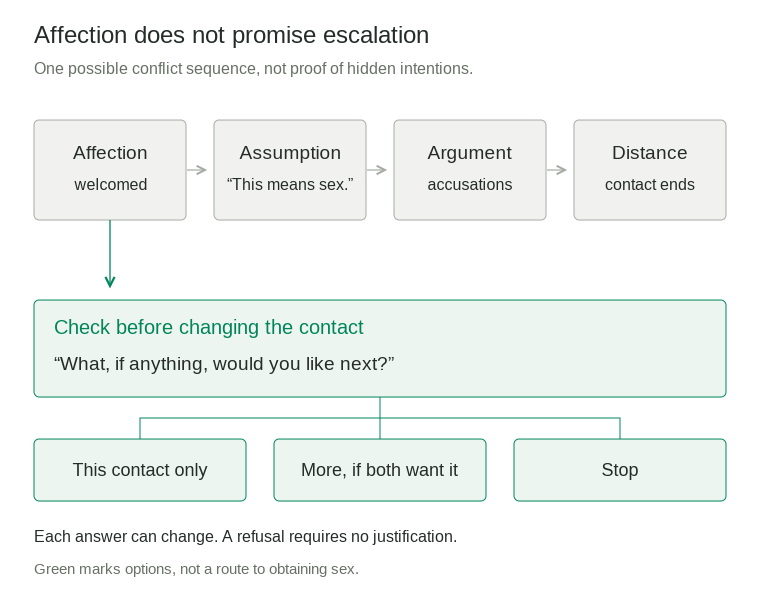
In Nora and Adam’s encounter, we can identify affection, an attempted change in contact, a refusal, stopping, accusations, and withdrawal.
We cannot infer from those events that Nora intended to lure Adam into rejection, that Adam secretly preferred conflict, or that either person wanted the familiar ending.
One possibility is that uncertainty becomes difficult to tolerate. “What does this contact mean?” turns into “You only want sex” or “You never want me.” The argument ends the immediate uncertainty while leaving the underlying difference unresolved.
That ending might protect someone from embarrassment or a difficult conversation. Calling this a possible payoff does not mean the person enjoys it, planned it, or bears equal responsibility for everything that happened.
Nor does repetition distinguish this interpretation from ongoing pressure, incompatible preferences, pain, or a boundary repeatedly being challenged.
Berne’s proposed response—and its limits
Berne emphasises declining “Uproar” and favours transactional marital-group work, potentially followed by individual therapy. He also discusses infidelity as a dangerous counter-move. Most troublingly, he predicts that avoiding the argument could make the wife more compliant. His analysis includes speculative psychoanalytic explanations such as “penis envy.” Original entry
These ideas should not become instructions for obtaining sex. Creating frustration to produce compliance is an unacceptable goal. Ending an argument can be worthwhile because it reduces harmful conflict; it does not create an obligation to resume sexual contact.
The following responses are Patternverse adaptations, not Berne’s prescriptions or validated treatments for this game.
Openings for change
Stop the proposed activity without turning the refusal into a trial
Adam stopped when Nora declined. He can also take responsibility for what followed:
“You were allowed to want a kiss without wanting more. My comment made your affection sound like a promise. I’m sorry.”
Nora can address a sweeping accusation separately:
“I meant that I felt pressure in that moment. Saying everything is about sex described you unfairly.”
Neither apology requires further touch, forgiveness, or agreement about their relationship. Consent applies to the particular activity and can change. A previous “yes” does not establish permission for something else. RAINN, Consent 101
Make the scope of affection discussable
Later, Nora asks whether Adam would like to cuddle without further sexual contact.
He says yes, but soon asks whether she might reconsider. She pulls away.
Their first attempt has not created the experience she requested. Adam acknowledges that his question reopened a decision she had already made. They stop for the evening.
On another occasion, he can accept the limit—or decline the cuddle himself if it would be uncomfortable. Neither person has to provide contact they do not want.
Clear language can help: “I’d like a hug, with nothing further tonight.” It is an option, not a duty to anticipate every misunderstanding. Affection never requires a disclaimer to preserve the right to refuse more.
Discuss the relationship outside the encounter
Adam can express a genuine concern without making Nora responsible for resolving it through sex:
“I miss our sexual relationship. Could we find a time to talk about what each of us wants and whether our needs fit?”
Nora may agree, decline, or need time. He can decide what relationship he can freely remain in; he cannot require her to meet a sexual demand.
A pause can also be explicit: “I’m upset and need some space. I respect your answer.” Space should not be presented as punishment that ends only when the other person complies.
Understand the recurring difficulty over time
Where both want help and can participate safely, a qualified professional might explore communication, desire, health concerns, and relationship expectations. The goal needs their agreement; it need not be increased sexual frequency.
The ITAA’s later ethical framework names respect, protection, empowerment, and responsibility. It does not make Berne’s historical explanations authoritative. ITAA, Code of Ethics
A separate sexual-medicine perspective is also useful. A 2020 European Society for Sexual Medicine statement recommends avoiding automatic pathologising of differences in desire. Its authors explicitly describe their recommendations as opinion-based because evidence was limited. This neither validates Berne’s game nor establishes the effectiveness of the dialogue suggested here. ESSM position statement
A similar encounter with another explanation
Since having a baby, Leila has wanted less sexual contact. She still enjoys kissing her partner, Sam.
One evening, she asks him to stop when he moves beyond kissing. He stops and asks whether she wants to continue kissing or finish altogether. She chooses to stop and sleep.
Later, she says she is concerned about the change in her desire and wants medical advice. Sam agrees to take more of the evening childcare, without treating that contribution as earning sex.
There is no need to hypothesise a game. The NHS identifies multiple possible contributors to lower desire, including stress, having a baby, medicines, and health conditions. An individual assessment may matter when someone is concerned. NHS, Low sex drive
Even without an explanation, Leila’s refusal would remain valid.
Pitfalls and limits
This title can become an accusation that makes someone defend their sexual boundaries. It should never be used that way.
Low desire, asexuality, disability, pain, trauma, and a preference for nonsexual intimacy must not be recast as character flaws. A mismatch does not automatically identify a disordered partner.
Pressure, intimidation, or abuse also changes the appropriate response. Appeasement or withdrawal under threat does not establish mutual participation. Joint counselling is not a routine solution in an abusive relationship; disclosures can be used for retaliation. Specialist guidance prioritises the safety of the person harmed. National Domestic Violence Hotline, Couples therapy and abuse
This interpretive framework cannot diagnose sexual difficulties or establish hidden intent. Evidence supporting TA generally would not, by itself, demonstrate that these particular adaptations work.
Connections
Uproar: Berne’s crucial neighbouring game, in which escalating conflict ends contact. Here, its hypothesised function is central to his account.
Corner: examines an apparently defensible position that closes off repair. Neither model overrides a refusal. Berne’s original entries
Consent specificity: agreement concerns particular contact, not an assumed sequence.
Desire discrepancy: a separate sexual-medicine concept describing differences between partners’ desires, without presuming manipulation. These connections do not imply that corresponding Patternverse entries already exist.
Sources and attribution
Historical account and antithesis: Eric Berne, Games People Play (1964), “Marital Games,” §3, checked against the full entry. Later TA ethics, sexual-medicine guidance, and safeguarding sources are distinguished where used.
All encounters are fictional. The examples, explanatory diagram, and practical responses are original Patternverse adaptations.