
When doing everything becomes the standard—and exhaustion becomes the familiar ending
A familiar scene
By four, Imogen is preparing dinner for friends, answering work messages, and watching the time for her daughter’s collection. A school-group message asks for cakes tomorrow. She offers to make some.
Her partner, Dan, suggests ordering dinner.
“No, I told them I’d cook.”
He puts out plates, assuming she has the rest covered. She notices that the bathroom needs cleaning and starts that too.
Later, Dan collects their daughter and orders food. The meal is late, the cakes are unfinished, and Imogen is crying upstairs.
“I can’t do anything properly.”
Dan says she should have asked sooner. She promises herself that next time she will organise things better.
Nothing has been removed from next time’s expectations.
The core pattern
Berne included “Harried” in the Marital Games chapter of Games People Play (1964). He describes a housewife expected to perform numerous conflicting roles, while interpreting some recurring overload through internalised demands and a critical relationship. His account recognises exhausting social expectations but also makes problematic assumptions about women’s responsibilities and choice of partners. Berne’s estate-hosted excerpt
The distinctive sequence in the full entry is accepting demands, sometimes adding more, attempting incompatible roles, becoming unable to continue, and responding with self-reproach. Original entry, “Marital Games,” §4
In transactional analysis, a game is a recurring interaction with an apparent purpose, an inferred psychological function, and a familiar ending or payoff. Here, apparent efforts to meet everyone’s needs might also preserve a familiar position: the person who must do everything and is nevertheless inadequate. That is an interpretation, not a fact revealed by exhaustion. ITAA, Core Concepts
The potentially useful focus is how demands repeatedly accumulate and get reinstated. Being busy, tired, generous, or unable to refuse does not establish a game.
How the load restores itself
In Imogen’s encounter, we can observe several commitments, additional volunteering, incomplete tasks, distress, and a promise to improve her organisation.
A Patternverse reading might explore whether accepting another task briefly protects her from disappointing someone. Doing everything herself might also feel safer than negotiating standards or trusting another person’s approach. These are possibilities to investigate with her, not explanations to impose.
The ending can reinforce the starting rule: I failed because I wasn’t good enough; therefore I must try harder. The arrangement survives scrutiny because attention settles on performance rather than feasibility.
Others can help maintain it by assuming availability, criticising only what remains unfinished, or offering small pieces of assistance while leaving coordination untouched. Their convenience may depend on work they barely notice.
Any immediate psychological function can coexist with genuine suffering. Exhaustion is not necessarily wanted or planned. Children’s needs are not game moves, and an unequal division of adult responsibility does not become equal simply because several people are involved.
Berne’s antithesis—and its limits
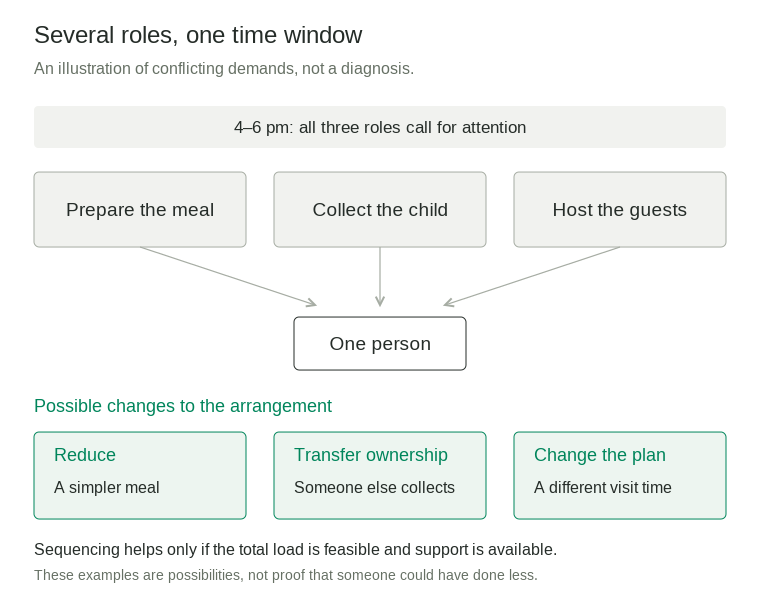
Berne’s explicit antithesis, or proposed counter-response, is to perform roles successively rather than simultaneously. His example separates hosting responsibilities from childcare. He also recognises resistance from partners and the wider social environment. Original entry
Sequencing can clarify a conflict. It cannot create sufficient hours, affordable care, or a cooperative partner. Inability to follow this advice is not proof of a hidden commitment to being overwhelmed.
The responses below are Patternverse adaptations, not Berne’s prescriptions or validated treatments for “Harried.”
Openings for change
Interrupt the next commitment
An opening can occur before the next automatic agreement:
“I can’t take on the cakes this week.”
The refusal need not contain a comprehensive defence. Where some flexibility exists, it can specify a smaller commitment: “I can bring bought fruit, but I can’t bake.”
Existing commitments also need attention. Imogen can tell her friends that dinner will be simpler or ask to rearrange. Acknowledging that a promise exceeds capacity may disappoint someone; continuing towards predictable breakdown has consequences too.
Dan can act before asking her to produce a perfect delegation plan: “I’ll handle collection and the arrangements around it. Let’s decide together whether dinner still works.”
Transfer responsibility, including the organising
At first, Imogen asks Dan to “help more.” He agrees, then asks what to buy, when to collect their daughter, and whether the guests have dietary requirements.
She is still managing the evening.
They revise the arrangement. Dan takes responsibility for dinner, including checking requirements and communicating the changed plan. Imogen handles collection. They postpone the cakes rather than fitting them into another hour.
Imogen feels uncomfortable when Dan chooses a simpler meal than she would. They discuss which requirements matter and which are preferences. She lets his approach stand.
Their guests eat adequately, the collection happens on time, and one contribution is not made. Imogen still feels guilty. The practical change has not instantly changed the standard she applies to herself.
This distinction between execution and coordination has a separate research basis. In interviews with members of 35 couples, Allison Daminger identified household cognitive labour: anticipating needs, finding options, deciding, and monitoring. That qualitative study does not validate “Harried,” but it helps explain what a task handover can overlook. Daminger, 2019
Replace global self-criticism with a specific limit
“I’m hopeless” gives nobody a clear problem to address.
“This afternoon contained more than I could manage” allows examination of commitments, standards, and available help. It does not deny mistakes. If Imogen missed an important message, she can address that particular consequence without treating the whole afternoon as evidence of personal failure.
Dan also has something within his control: noticing and owning shared work instead of waiting until distress makes it urgent.
If he refuses, Imogen’s options may concern which optional commitments she stops accepting and what outside support is accessible. She cannot make his cooperation happen by explaining more skilfully.
Understanding the recurrence
Over time, the difficulty may involve learned expectations about being useful, reliable, or beyond criticism. It may instead—or also—involve an arrangement that rewards others for leaving someone overloaded.
Later TA writing connects permission to change with protection and support. Applied here, “You may set a limit” needs the accompanying question of what makes that limit safe and practical. This is a Patternverse application of the concept, not an established antithesis for this game. ITAA, Core Concepts
Voluntary therapeutic exploration might address guilt or repeated overcommitment. Redistribution, resources, and accountability may be equally necessary.
When the problem is insufficient capacity
Asha is covering reception alone after a colleague leaves. She must answer calls, admit visitors, and process urgent records. She has declined optional projects and repeatedly asked her manager to prioritise the remaining work.
One afternoon, a record is delayed. Her manager says she always makes herself overwhelmed.
The evidence points to incompatible demands and insufficient cover. Another lesson in saying no would miss what she has already done.
Asha records the competing requirements and requests a workload review. No replacement is immediately available. The short-term outcome is an explicit record of unresolved capacity, not a solved problem.
HSE guidance treats achievable workloads and compatible role requirements as organisational responsibilities. These offer a more appropriate starting point than hypothesising a psychological payoff. HSE, Demands, HSE, Role
Pitfalls and limits
“You need to be needed” can dismiss someone who has repeatedly requested relief. Rejecting an offered solution may reflect cost, accessibility, unreliable help, or additional coordination—not attachment to exhaustion.
Berne’s claims that the woman selected a critical husband, and his attribution of the central problem to internalised maternal influences, should not become contemporary explanations of abuse or women’s distress. People do not cause their own coercion by fulfilling a psychological role. Original entry
Poverty, disability, discrimination, insecure employment, and essential caregiving can severely constrain choice. Limits must not depend on abandoning someone’s necessary care. Where refusal brings retaliation, safety and independent support take priority.
The model cannot diagnose exhaustion or establish hidden motives. The suggested responses are plausible adaptations; evidence about TA generally would not demonstrate their effectiveness for this particular pattern.
Connections
Role conflict concerns incompatible requirements, whether or not any game interpretation is useful.
Cognitive labour makes planning and monitoring visible alongside physical tasks.
Whole-task ownership means taking responsibility for an agreed result, including coordination, within clear limits.
Permission and protection is a TA connection: changing a familiar rule may require practical support as well as encouragement. These connections do not imply that corresponding Patternverse entries already exist.
Sources and attribution
Historical account and antithesis: Eric Berne, Games People Play (1964), “Marital Games,” §4, checked against the full entry and estate-hosted excerpt. Later TA, household-labour research, and occupational guidance are distinguished where used.
All encounters are fictional. The examples, explanatory diagram, and practical responses are original Patternverse adaptations.