
When a restriction may also shelter a fear
A familiar scene
Simon brings home a leaflet for a Thursday choir.
“If it weren’t for you, I’d have joined something like this years ago.”
Lea points to their usual arrangement: school nights are evenings at home. She values their time together and treats the routine as settled.
“So that’s another thing I can’t do.”
He puts the leaflet in a drawer. Later, he tells a friend that Lea would never accept him going out every Thursday.
A similar argument happened over a photography class last year. Neither enrolment happened. Neither conversation established whether their arrangements could change—or what joining would actually mean to Simon.
The restriction remains the explanation, and the wished-for activity remains safely hypothetical.
The core pattern
Berne includes “If It Weren’t For You” among the Marital Games in Games People Play (1964), having introduced it earlier as a worked example of game analysis. In his case, a woman complains that her husband’s restrictions prevented dancing lessons. When those restrictions ease, she encounters a fear of dance floors. Berne interprets the restriction as also protecting her from confronting that fear. Berne, original case and analysis
The distinctive idea is a complained-of barrier that may also perform a protective function. It is more specific than blaming someone or being reluctant to act.
In transactional analysis, a game is a recurring interaction with an apparent social purpose, an inferred psychological function, and a familiar ending or payoff. Here, a complaint about restricted freedom might also preserve reassurance: the obstacle appears entirely outside oneself. That psychological level remains a hypothesis. ITAA, Core Concepts
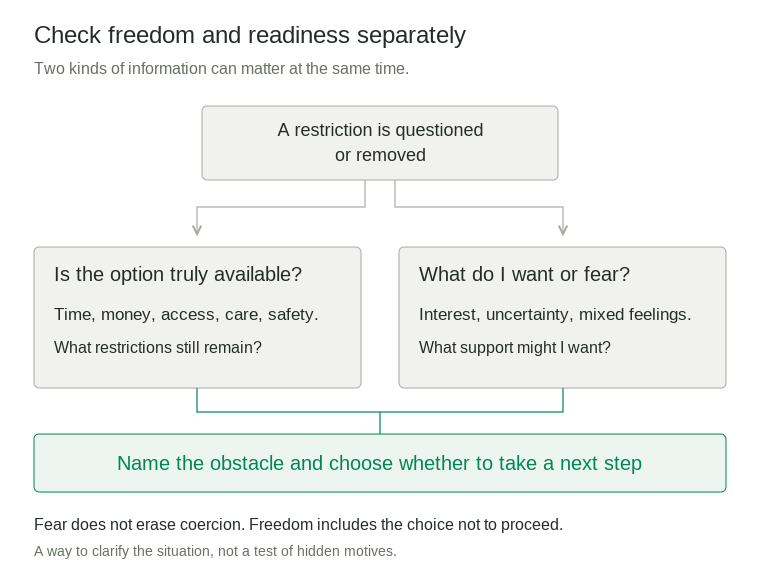
A person can face a real restriction and also feel frightened about acting. Discovering the fear does not erase the restriction.
How the arrangement sustains itself
In Simon and Lea’s fictional encounter, the observable sequence is a proposed activity, an appeal to the established routine, protest, and no change.
A possible Patternverse interpretation is that Simon avoids a difficult question about becoming a beginner. Lea avoids reconsidering a routine she relies on. Their argument allows each concern to remain indirect.
Simon may obtain temporary relief from uncertainty while still resenting the lost opportunity. Lea may retain predictable companionship while feeling unfairly blamed. Neither function needs to be consciously intended.
Over time, the cost can include resentment, restricted experience, and an increasingly rigid account of who prevents whose life.
The useful inquiry concerns what each person actually does, what choices are available, and what they themselves report feeling. Repetition alone cannot establish hidden motives. Nor does a person’s fear make another person’s controlling conduct necessary, helpful, or justified.
Berne’s antithesis—and its limits
Berne names “permissiveness” as the antithesis: the prohibitive partner stops forbidding the activity, allowing the underlying fear to become apparent. Original antithesis
That is his proposed counter-response, not a validated diagnostic test. Someone’s hesitation after circumstances change does not prove that their earlier complaint was insincere.
The language of permission also needs revision. An adult partner should not have to obtain another adult’s authorisation for ordinary independent activities. Shared responsibilities may require negotiation; personal autonomy is not a reward one partner grants.
The responses below are Patternverse adaptations, not Berne’s prescriptions or established treatments for this game.
Openings for change
Establish what is actually preventing action
Simon can replace the global accusation with a specific proposal:
“I want to try the choir. Can we revisit Thursdays and work out the arrangements?”
Lea can identify her concern without converting it into a prohibition:
“I’m disappointed about losing that evening together. I’d like us to plan time elsewhere.”
They still need to establish transport, cost, and any household responsibilities. A verbal “go ahead” changes little if the practical work remains uncovered or retaliation is expected.
When a proposal cannot work, identifying the actual constraint matters. It might concern money, access, care, or incompatible commitments rather than either person’s psychology.
Notice what remains after the arrangement changes
Lea agrees to revise Thursdays. The arrangements are covered, and Simon can attend a taster session.
He delays contacting the organiser. Eventually he says he is frightened of singing where others can hear him.
“So it was never really me,” Lea replies.
He shuts down. The new information becomes evidence against him.
Later, she revises: “I did treat the routine as non-negotiable. That mattered. Being nervous about singing can matter too.”
Simon acknowledges that blaming Lea had helped him avoid admitting the fear. That is something he recognises in this fictional case; it is not a conclusion Lea could establish simply because he hesitated.
Choose a next step without making it a test
Simon decides to ask whether he can observe a session before participating. The organiser agrees.
He attends, listens for most of the evening, and joins one short section. Afterwards, he is interested but still apprehensive. He has more information about the activity and his response to it.
He could also decide not to continue. Changed circumstances do not create a debt to fulfil every previously expressed ambition. A person may discover that they want something different—or that the available version does not suit them.
The purpose is a more accurate choice, not proving courage or disproving an excuse.
Let each person own their part
The person who has restricted an activity can reconsider that conduct without demanding immediate progress:
“I won’t use our old routine as a reason you can’t explore this. I’d still like us to discuss shared commitments.”
The person who feels constrained can express both the wish and the uncertainty:
“I want to try it, and I’m worried about being inexperienced. I’d like support, not a decision made for me.”
If the other person refuses to reconsider, the restriction remains relevant. Further explanation cannot guarantee cooperation. Boundaries, independent advice, or safer support may become necessary.
Understanding the recurrence
Where this sequence repeatedly appears, voluntary exploration might distinguish a wished-for identity from an activity someone actually wants, or examine fear, disappointment, and the meaning of independence.
Later TA writing pairs permission to change with protection and support. A Patternverse application is to ask what makes a different choice safe and feasible, rather than merely announcing that someone is free. These are conceptual principles, not evidence that this particular approach reliably works. ITAA, Core Concepts
Persistent or distressing fear may deserve professional attention on its own terms, without requiring acceptance of a game label.
When the restriction is coercive control
Rosa says she cannot attend an evening course because of her partner. He has threatened her when she discusses studying, taken her keys, and restricted access to money.
A friend suggests that perhaps she is afraid of the course and finds the restriction convenient.
That interpretation diverts attention from evidence of control. Rosa may also feel anxious about studying; it would not make the threats less consequential.
She seeks confidential support before deciding what is safe. She does not need to challenge her partner or attempt attendance to demonstrate sincerity.
Domestic-abuse guidance identifies controlling activities and obstructing work or education as warning signs. These require attention to power and safety, not an assumption of mutual psychological benefit. National Domestic Violence Hotline, Red Flags of Abuse
Pitfalls and limits
Berne’s suggestion that a woman selected a domineering husband to protect her from fear should not become an explanation of why people experience abuse. His gendered assumptions require historical distance. Original account
Poverty, disability, discrimination, care obligations, and inaccessible opportunities can remain barriers after another person changes their position. Previous punishment can also make a new assurance difficult to trust. Non-participation does not identify which explanation applies.
A helper should not manufacture a confrontation or remove support to expose someone’s supposed payoff. The person concerned must retain a choice about exploration.
This model offers an interpretive possibility, not a diagnosis. Berne’s case does not establish a generally effective intervention, and evidence about TA overall would not validate these particular adaptations.
Connections
Avoidance can describe moving away from something feared without explaining whether external barriers are real.
Ambivalence allows wanting an opportunity and feeling reluctant about it to coexist.
Permission and protection is the later TA connection: change may require support as well as an opening.
Specific negotiation replaces a global accusation with an identifiable request, constraint, or boundary. These connections do not imply that corresponding Patternverse entries already exist.
Sources and attribution
Historical description and antithesis: Eric Berne, Games People Play (1964), Chapter 5’s worked example and “Marital Games,” §5, checked against the full text. Later TA and safeguarding guidance are distinguished where used.
All encounters are fictional. The examples, explanatory diagram, and practical responses are original Patternverse adaptations.