
When an interaction seems to confirm an expectation of rejection
A familiar scene
At a community theatre meeting, Niko discovers that three members discussed the next production over coffee without him.
“Good to know the important decisions happen somewhere else.”
Jo, the coordinator, explains that they happened to meet after rehearsal. Nothing was decided. She asks what Niko thinks of the proposed play.
“Does it matter? You’ve already got your little committee.”
Jo tries to return to the agenda. Niko makes another remark about favourites. Eventually she snaps: “If you think we’re all so awful, leave.”
He does. Outside, he messages a friend: “Same as every other group. They never really wanted me.”
Niko wanted inclusion and feared humiliation. Jo wanted to finish a difficult meeting. His repeated accusations mattered; so did her dismissive response. Neither fact tells us everything about the other.
The core pattern
Eric Berne included “Kick Me” among the Life Games in Games People Play (1964). He described increasingly provocative conduct followed by rejection and the familiar complaint that misfortune keeps recurring. He also suggested that someone might obtain a sense of distinction through their misfortunes. These are Berne’s historical interpretations, not established explanations of why a particular person experiences rejection. Berne’s estate-hosted excerpt
Within transactional analysis, a game means a recurring interaction with an apparent social purpose, an inferred psychological level, and a familiar ending or payoff. Here, a conversation apparently about participation or fairness might also reinforce a conviction such as “People always push me out.” That second level is a hypothesis, not something an observer can simply see. ITAA, Core Concepts
The potentially useful question is whether someone’s response to anticipated rejection sometimes contributes to an ending they dread.
A complaint, an angry remark, or an unsuccessful relationship does not establish this pattern. Repeated mistreatment can also produce an entirely accurate expectation of rejection.
How the interaction sustains itself
In Niko’s encounter, the observable sequence is straightforward: he learns about the coffee meeting, makes several accusations, receives an increasingly irritated response, and leaves after Jo’s rebuke.
The interpretation requires more care. Perhaps he understood an ambiguous event as evidence that he was unwanted. Perhaps sarcasm protected him from asking a vulnerable question. Once Jo became hostile, uncertainty disappeared: now there was an unmistakable rejection.
That ending might reinforce an existing belief even while hurting him. In this interpretation, payoff means a psychological function, such as confirming what feels familiar. It need not mean pleasure, conscious planning, or wanting harm.
Jo may experience a different immediate relief: the disruptive exchange ends. But dismissing Niko personally also replaces a manageable question about conduct with a dispute about whether he belongs. Both leave with less room to understand what happened.
Related research offers a narrower comparison. In two studies of dating couples, Downey and colleagues examined whether anxious expectations of rejection were associated with relationship difficulties. They found a conflict pathway involving negative behaviour and partners’ rejecting responses among women, but not men, in those samples. This does not validate Berne’s game, establish a universal gender difference, or demonstrate that people seek mistreatment. Downey et al., 1998
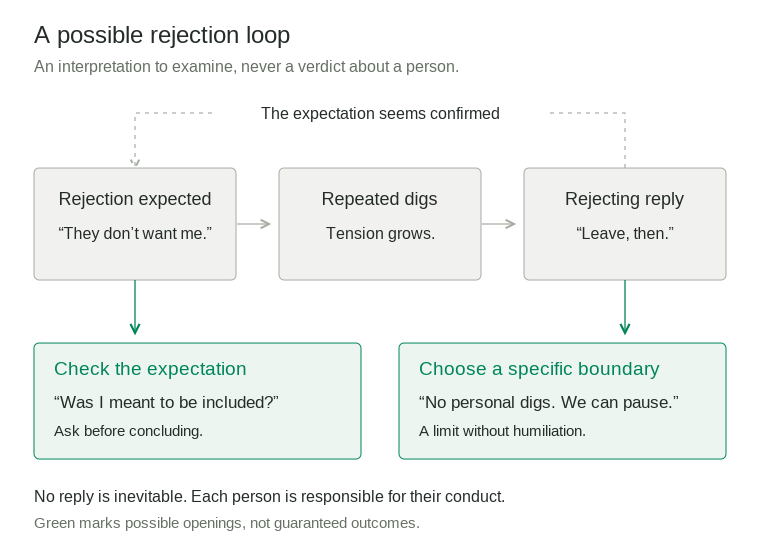
Openings for change
Berne’s short “Kick Me” entry does not provide a separate antithesis, or prescribed counter-response. The suggestions below are Patternverse adaptations, not Berne’s established solution or validated treatments for this game. Original entry, “Life Games,” §3
Interrupt the immediate exchange
The person expecting rejection can make the uncertainty explicit before turning it into an accusation:
“I’m worried decisions are happening without me. Was that an informal conversation, or should I have been included?”
This gives the other person something answerable. It also allows unwelcome information to emerge: perhaps the meeting really was exclusionary.
If the digs have already started, a repair can remain specific:
“That was a personal remark. I’m sorry. My actual concern is how we make decisions.”
An apology for one’s conduct does not require accepting someone else’s insults.
The recipient can address what is happening without claiming to know its hidden purpose:
“You’ve made several remarks about favouritism. I’ll discuss the concern, but I need the personal digs to stop.”
A boundary may include pausing or ending the conversation. Nobody must absorb repeated hostility to demonstrate that they are accepting.
Replace an indirect test with a direct request
Suppose Jo later says, “You’re just testing whether we’ll reject you.”
Niko hears another accusation. The explanation becomes part of the conflict.
Jo revises her approach: “I shouldn’t have told you to leave like that. I do need the remarks to stop. Can we agree how production discussions get shared?”
Niko acknowledges the sarcasm but remains doubtful about the group. They arrange to circulate notes from informal discussions. He takes a week away before deciding whether to return.
Recognition has not repaired their trust. It has produced a clearer agreement and separated two questions: how the group includes people, and how members raise objections.
Later TA writing, including the ITAA’s account, emphasises communicating wants and feelings more directly instead of expressing them through covert exchanges. That is a conceptual connection, not evidence that these particular sentences will work. ITAA, Core Concepts
Work with the recurrence over time
After another cancelled dinner, Priya starts typing to her friend Sam: “Don’t worry. I know where I rank.”
She recognises the familiar move and changes the message: “I’m disappointed. Do you want to reschedule, or do you have less room for meeting lately?”
Sam answers that caring responsibilities leave little capacity. He cannot offer a new date.
Priya still feels rejected. She decides to stop holding evenings open and lets him initiate the next plan. A clearer request has revealed a real limitation; it has not secured reassurance.
Where this sequence recurs, voluntary therapeutic exploration might examine expectations, earlier experiences, and ways of expressing hurt. The aim would be an agreed difficulty the person wants to understand—not persuading them to accept a game label.
When the resemblance misleads
Maya repeatedly asks her manager whether she is being excluded from client work. Her questions become sharper after vague reassurances.
A colleague calls this “Kick Me”: perhaps her defensiveness makes people avoid her.
But assignment records show that Maya’s responsibilities changed after she disclosed a disability. Meeting messages include jokes about her reliability. Another colleague confirms that invitations stopped.
Her repeated questions are a response to an actual problem. Treating them as an invitation to rejection would obscure the evidence and protect those with greater authority.
The useful next steps concern the assignments, messages, workplace support, and accountability. Acas identifies persistent put-downs, exclusion, and misuse of power as possible bullying behaviours. A game interpretation must not displace investigation of such conduct. Acas, Bullying at work
Pitfalls and limits
The title is particularly easy to misuse. Berne’s language sometimes presents retaliation as effectively compelled by provocation. That framing is unacceptable as an explanation or excuse for abuse. He also offered a gendered counterpart, “Threadbare,” with assumptions about women and poverty that should not be treated as current knowledge. Original entry
Disability, distress, unfamiliar communication conventions, discrimination, and coercion can all change what an encounter means. Someone’s manner does not establish a covert motive. Repeated victimisation does not establish repeated invitation.
Nor are responsibilities necessarily equal. A coordinator can set participation rules; an employer controls opportunities and working conditions. Greater authority brings responsibilities that a story about mutual interaction must not erase.
The framework is most useful when it supports tentative, voluntary examination of specific behaviour. It becomes harmful when “You’re playing Kick Me” replaces listening, evidence, or accountability. The examples here illustrate possibilities; they do not establish effectiveness.
Connections
Rejection sensitivity concerns anxious expectations and reactions to possible rejection. It is a related research concept, not another name for this game.
Separating observation from interpretation helps distinguish “They met without me” from “They want me gone,” while leaving room to discover genuine exclusion.
Direct requests make concerns and needs answerable. They also make another person’s limits clearer.
Boundaries without humiliation separate a limit on behaviour from a verdict about someone’s worth. They remain available even when cooperation or reconciliation does not.
Sources and attribution
Historical account: Eric Berne, Games People Play (1964), “Life Games,” §3, checked against the complete text and estate-hosted excerpt. Later TA framing: ITAA, Core Concepts (2000). Research comparison and workplace guidance are linked where discussed.
All encounters are fictional. The explanatory diagram, examples, and practical responses are original Patternverse adaptations.