
When the apparent accomplice discovers they are the target
A familiar scene
Leon tells Rafi about a buyer who supposedly knows very little about collectibles.
“Joey will pay far more than these are worth—as long as we don’t tell him what they really are.”
Rafi knows the proposed description would be misleading. But Leon presents the arrangement as a shared opportunity: two knowledgeable people getting ahead of someone with more money than sense.
Rafi contributes money to the deal.
Then another payment is needed. Joey is apparently ready; everything depends on getting this last part sorted out. Rafi hesitates, but sending more seems easier than accepting that his first payment may be gone.
The promised sale never happens. Leon’s account disappears. The buyer’s messages were fabricated.
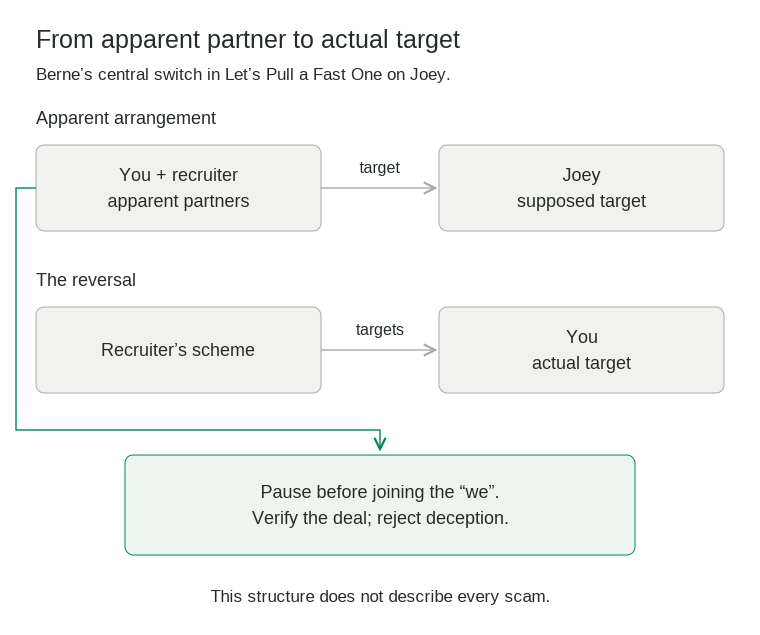
Rafi thought he was joining Leon against Joey. He was the person Leon intended to deceive.
Now Rafi feels ashamed twice over: he lost money, and explaining what happened means admitting what he had agreed to do.
The core pattern
Eric Berne places “Let’s Pull a Fast One on Joey” third in the “Underworld Games” chapter of Games People Play (1964). He abbreviates it as FOOJY and identifies the large confidence trick called “The Big Store” as its prototype.
The opening invites someone to help exploit a supposedly unsuspecting third person. The arrangement then reverses: the would-be accomplice loses, while the supposed target comes out ahead. Berne estate: “Let’s Pull a Fast One on Joey”
The distinctive mechanism is a false alliance: “You and I will deceive them” conceals “I am deceiving you.”
Within transactional analysis, or TA, a game involves an apparent exchange and an underlying purpose or psychological function. Here, the apparent cooperation conceals exploitation of the recruited person. The deception may be deliberate fraud; the TA label adds no certainty about anyone’s unconscious motives.
This is narrower than fraud generally. A bargain, an unsuccessful venture, or a disagreement over value does not establish the pattern. Nor does losing money establish that someone intended to cheat another person.
How the arrangement sustains itself
The following is a Patternverse explanation of possible involvement.
The recruiter offers both an opportunity and a position: you are an insider, not one of the people being fooled. Accepting that position may feel flattering. Questions can begin to feel like disloyalty or an admission that one does not understand the opportunity.
The supposed third person remains distant. Information about them comes through the recruiter, who also explains delays and requests further commitment.
Once money, reputation, or an agreement has been invested, withdrawal becomes harder. The person may want to recover a loss, preserve their image of competence, or avoid acknowledging their part in the proposed deception.
Those are possibilities, not necessary explanations. The recruiter may also use threats, dependence, or pressure that substantially limits the target’s choices.
The final reversal changes the roles. Someone expecting to profit from another person’s misunderstanding discovers that their own understanding was manufactured. Secrecy that initially felt advantageous can now obstruct asking for help.
Responsibility remains specific. Agreeing to deceive someone is a choice worth examining. It does not make subsequent fraud deserved, erase the recruiter’s responsibility, or create an obligation to remain silent.
Openings for change
Decline the proposed alliance
Berne provides no separate antithesis section for this entry. His opening implies an alternative: refuse involvement or warn the intended victim. He also suggests that targets with a sense of humour disrupt the con. That observation is not an established protective technique. Games People Play, complete entry
The suggestions below are original Patternverse adaptations, not Berne’s prescriptions or validated treatments.
An early response can address the arrangement directly:
“If this depends on misleading the buyer, I’m not participating.”
It does not require proving that the recruiter also intends to deceive you. The proposed treatment of the third person is sufficient grounds to decline.
Someone making a legitimate offer should be able to describe it without requiring you to regard another person as a fool.
Check the arrangement outside its own story
The recruiter’s account of the buyer, product, or opportunity is a claim to examine.
“I’ll consider a transparent transaction. I’m going to verify the parties and the terms independently.”
If every route to verification leads back to the recruiter, the uncertainty remains. More explanations from the same source do not resolve it.
A person can stop participating without winning an argument about the proposal:
“I’m not proceeding. I won’t send another payment.”
Interrupt the attempt to recover the loss through another gamble
Rafi’s first response is to propose tricking Leon back. He wants to stop feeling like the person who was fooled.
His friend refuses to join another covert arrangement.
“Let’s work out what happened and what can still be protected.”
They collect the messages, receipts, and a timeline. Rafi contacts his payment provider through its established contact details and explains the transaction accurately.
The US Federal Trade Commission advises contacting the company used to send the money promptly and asking whether a payment can be reversed or refunded. Recovery depends on the circumstances; a request is not a guarantee. FTC: what to do after a scam
The CFTC similarly recommends stopping further payments, preserving information, and reporting investment fraud through appropriate channels. These are practical fraud-response recommendations, not evidence validating TA’s interpretation. CFTC: steps after discovering fraud
Rafi does not immediately recover his money. He does stop treating another risky scheme as the route back to dignity.
Make honest help possible
A direct request might be:
“I agreed to something I’m embarrassed about. I need help understanding what happened and what to do next.”
A trusted person can help separate the facts from self-condemnation. Independent legal advice may be useful where someone is concerned about their own conduct; it should come from a source they select independently.
Unexpected offers to recover lost money for an upfront fee deserve particular caution. The FTC describes recovery scams that target people after an earlier loss. FTC: refund and recovery scams
Over time, someone might explore what made the insider position attractive: financial pressure, resentment, belonging, or the hope of feeling unusually clever. That exploration can support responsibility without turning deception into a defect of identity.
A contrast: no invitation to cheat
Mina receives a convincing delivery message while arranging a parcel for her father. It asks for a small payment to complete delivery.
She pays. Later, she discovers the message was fraudulent and contacts her card provider.
A relative says, “People only fall for scams when they want something for nothing.”
That explanation does not fit. Mina wanted an ordinary delivery completed. Nobody invited her to deceive a third person, and she accepted no such role.
Her concern for her father and a busy day help explain the context. They do not make the fraud her fault. The appropriate response concerns the payment and any exposed information, not searching for concealed dishonesty.
Pitfalls and limits
Berne asserts that this game cannot succeed without dishonesty in the target. Applied to fraud generally, that is a false and victim-blaming generalisation. Even within a particular case, willingness to participate must be established from evidence rather than inferred from the loss.
People may misunderstand an offer, be coerced, encounter language or accessibility barriers, or face urgent financial pressure. Disability, distress, discrimination, and unequal authority can affect their options. Shame should not become another barrier to support.
Later TA criticism challenges game explanations that displace actual exploitation and material consequences. Julie Hay’s 2022 discussion distinguishes real victimization from psychological game participation. It supplies a general corrective, not a tested replacement antithesis for this entry. Hay: “Game changing dynamics”
Nor should fraud be treated as a mutually agreed contest whose supposed rules bind the target. Berne’s descriptions of con artists’ expectations are historical observations, not ethical obligations.
The cited sources do not demonstrate that a particular phrase prevents this pattern. Regulator guidance addresses practical protection and recovery; it does not establish the effectiveness of TA-based responses.
Connections
False alliances. An apparent shared enemy can distract from examining the person offering partnership.
Sunk-cost pressure. Previous expenditure can make another payment feel necessary. The new decision still needs independent assessment.
Let’s You and Him Fight. Both arrangements recruit someone into a situation whose apparent alignment conceals another outcome; this entry centres on the recruited person becoming the target.
Sources and attribution
Berne supplies the historical formulation and discussion of responses. Later perspectives draw on Hay’s critique and current FTC and CFTC guidance. The fictional encounters, illustration, explanatory interpretation, and conversational suggestions are original Patternverse adaptations.