
When two people are drawn into a contest that will not decide the outcome
A familiar scene
At a party, Alex draws Ben aside.
“I’d like to go out with you. But Rob keeps saying you’re afraid of him.”
Later, Alex tells Rob, “Ben thinks you only talk big. I like someone who stands up for themselves.”
Ben confronts Rob. Each believes the other has been making humiliating remarks. Their conversation becomes an argument about who is insecure, dishonest, or trying to impress Alex.
While they argue, Alex leaves with Sam.
The next morning, Ben messages Rob: “Alex said we were going to leave together.”
“That’s more or less what I was told,” Rob replies.
Both feel embarrassed. Each had understood the confrontation as a way to establish something: courage, credibility, a possible relationship. Now they wonder whether their contest ever had anything to do with Alex’s choice.
They know what was said and what happened afterward. They do not know how much Alex planned.
The core pattern
Eric Berne places “Let’s You and Him Fight” in the “Sexual Games” chapter of Games People Play (1964). He distinguishes three versions: a manoeuvre, where someone encourages two suitors to compete and chooses the winner; a ritual, where custom imposes the contest; and a game, where the person arranging the competition leaves with a third suitor. Games People Play, “Let’s You and Him Fight”
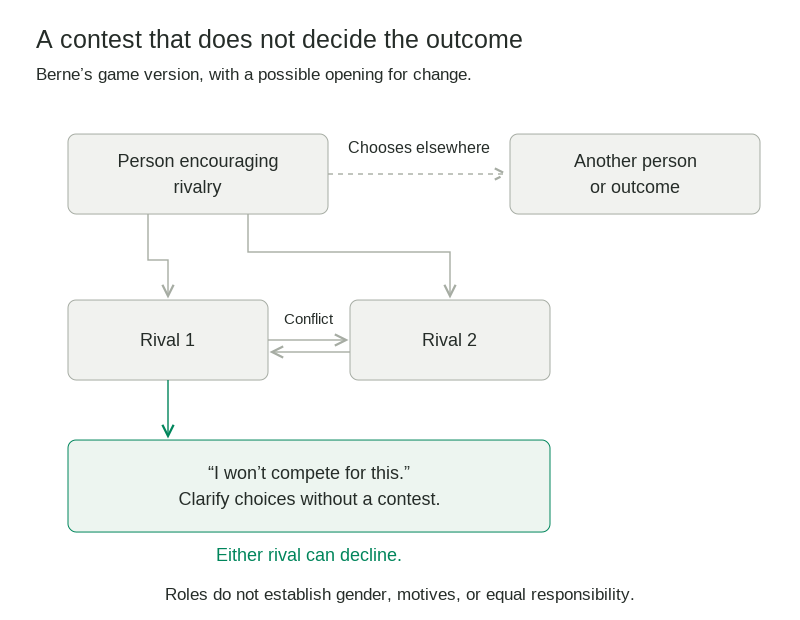
The distinctive feature of the game is the switch: the rivals act as though their contest determines the outcome, while a different arrangement emerges elsewhere. Berne interprets its payoff as confirming contempt for supposedly honest competition. That is his historical account, not established knowledge about anyone’s motives.
In transactional analysis, or TA, a game is an interaction understood to contain an apparent purpose and an underlying psychological function. Here, the apparent purpose is settling who deserves the desired outcome. The proposed underlying function involves drawing others into a contest whose premise is misleading.
The name should not cover every triangle, disagreement, or request for support. Changing one’s mind, declining a date, or leaving with someone else does not establish a game. Nobody becomes entitled to another person by winning an argument.
Recognition becomes useful when misleading assurances and invitations to rivalry recur—not simply because someone feels rejected.
How the arrangement sustains itself
The following is a Patternverse interpretation of how a contemporary version might unfold.
First, a desired relationship, opportunity, or recognition appears to depend on defeating someone else. The invitation may be indirect: “They think you won’t dare,” or “If you cared, you’d challenge them.”
The recruited person begins watching the rival rather than examining the invitation. The rival responds, perhaps after receiving a similar message. Their argument gathers its own momentum. Meanwhile, the person encouraging the contest retains room to choose elsewhere.
The rivals may gain a temporary sense of purpose: uncertainty becomes an apparently clear task. They can demonstrate loyalty, defend their standing, or try to avoid humiliation. Whoever encourages the rivalry might receive attention, postpone a direct refusal, or feel powerful while others compete. These are hypotheses to explore, not facts implied by the arrangement.
The costs can be substantial: damaged relationships, intimidation, wasted effort, or violence. Responsibility remains specific. Encouraging conflict matters; choosing to threaten or assault someone remains the responsibility of the person doing it. Someone deceived into an argument is not thereby equally responsible for its setup.
Openings for change
Berne’s short entry supplies no separate antithesis. The suggestions below are original Patternverse adaptations, not his established prescriptions or validated treatments.
Interrupt the recruitment
A person can decline the proposed test without deciding whether anyone intended manipulation:
“I’m interested in seeing you. I’m not going to argue with Rob to prove that.”
Or, outside a romantic setting:
“If there’s an opportunity available, tell me the actual criteria. I’m not going to undermine someone else for it.”
This separates the desired outcome from the demanded confrontation. It may also reveal that no clear offer exists.
Check the message without escalating it
Where contact is safe and appropriate, the apparent rivals can compare what they were actually told.
Ben initially messages Rob, “We should confront Alex together.”
That could become another contest: two people demanding an explanation from a third. Rob declines.
“I’ll tell you what I heard. I’m not joining a showdown.”
They exchange their accounts. Ben apologises for insulting Rob at the party. Rob accepts the apology but says he does not want further messages about Alex.
They do not become friends. They do stop treating each other as the obstacle.
Direct contact is not always appropriate. Where there are threats, harassment, unequal authority, or confidentiality concerns, a supported process may be safer than comparing messages privately.
Make the actual choice explicit
The person encouraging rivalry can stop issuing competitive tests and communicate their own decision:
“I’ve been implying that your argument would affect my choice. That was misleading. I’m choosing something else.”
They can also acknowledge uncertainty directly: “I haven’t decided,” or “I don’t want this relationship.”
A clearer statement may disappoint someone. It does not require creating a rival who must first be defeated. Repair may include correcting misleading claims and accepting that trust or contact will change.
If the other person refuses clarity, a participant can withdraw from the contest anyway. They cannot compel an honest explanation.
Examine the recurring difficulty
Over time, someone might explore what makes direct preference, refusal, or uncertainty difficult. Another person might examine why challenges to their status so readily recruit them into confrontation.
These are questions about one’s own experience. They do not establish that everyone shares the same motives or freedom to act.
Current ITAA ethics emphasise dignity, empowerment, protection, and responsibility. Those principles provide a basis for examining choices and power; they are not evidence that these particular responses will work. ITAA Code of Ethics
When involving someone else is protection
At a music venue, Nia tells her friend Jules that another guest has repeatedly followed her after she asked to be left alone.
“Please stay with me while I find a staff member.”
Jules accompanies her. They describe what happened, and staff arrange for Nia to wait somewhere quieter while they address the guest’s behaviour.
Nia has involved another person in a conflict. She has not offered affection as a prize, manufactured rivalry, or created a contest whose result supposedly determines her choice. Her request is specific: company and help reaching support.
If someone dismisses this as “Let’s You and Him Fight,” the interpretation obstructs protection.
Bystander guidance offers ways to support someone experiencing harassment, including distraction and delegation, rather than requiring a direct confrontation. That guidance serves a different purpose from TA game analysis. Right To Be: bystander intervention
Pitfalls and limits
Berne describes the psychology as inherently feminine and presents women as organisers of male rivalry. That generalisation is sexist. It should not be carried forward as knowledge about gender.
Later TA publications have explicitly reconsidered the wording. An editorial note accompanying Stephen Lankton’s 2021 “The Game Grid” changes the gendered reference to “you and them.” This is a documented revision in that publication, not proof of universal agreement across TA. International Journal of Transactional Analysis Research: “The Game Grid,” p. 5
The model is particularly dangerous when used to dismiss reports of abuse, discrimination, or coercion. Seeking an advocate, interpreter, manager, or trusted companion can be necessary. People facing disability, distress, financial dependence, or unequal authority may have limited access to direct communication.
Nor does jealousy prove that someone else deliberately created it. Rivals can invent a competition without encouragement. A person can withdraw consent or choose another partner without having engineered anyone’s response.
The sources establish a historical formulation and later discussion. They do not validate a method for detecting hidden intentions or demonstrate the effectiveness of the responses proposed here. Evidence about TA generally would not establish those specific claims.
Connections
Triangulation. A broad description of tension involving a third person. This game is narrower: it includes an encouraged contest and a misleading relationship between that contest and the outcome.
Direct requests and refusals. These make preferences discussable without requiring someone else’s defeat.
Supported advocacy. An ally helps someone pursue safety or a clear request. Their involvement is not evidence of an ulterior game.
Sources and attribution
The title, classification, and three historical versions come from Berne’s Games People Play. Later commentary comes from “The Game Grid” and ITAA ethics; the protection example draws on Right To Be’s guidance. The fictional encounters, illustration, broader applications, and practical responses are original Patternverse adaptations.