
When an assumed prelude and the actual wish are different
A familiar scene
Mara and Robin, both adults, keep having the same disappointing evening.
Robin asks for sexual roleplay. Mara sometimes enjoys it, but does not want it to dominate every intimate encounter.
“It helps me get ready for the other things we both like,” Robin says.
Mara agrees. Later, when she suggests something different, Robin withdraws.
“Why does it always have to lead somewhere?”
“Because you keep telling me that’s what we’re doing.”
Robin feels judged for having a particular interest. Mara feels that she has agreed to something without understanding what was being proposed. They stop, upset and distant.
Robin’s decision to stop requires no justification. Mara is also free to decline roleplay. Their unresolved difficulty concerns the arrangement between them: something presented as a preliminary seems to be the experience Robin actually wants, while neither feels able to say that plainly.
What the historical entry describes
Eric Berne includes “Perversion” as the second entry in the “Sexual Games” chapter of Games People Play (1964). He pathologises fetishism, sadism, and masochism, and proposes that an apparently preliminary activity can supply the real satisfaction while intercourse becomes an unwelcome obligation. He also describes appeals to a supposedly powerful sexual drive as excuses for conduct. These are historical interpretations, not current diagnostic conclusions. Games People Play, “Perversion”
Unlike some entries, this short discussion does not provide a detailed sequence of roles and moves. It combines several claims that should not be treated as one established mechanism.
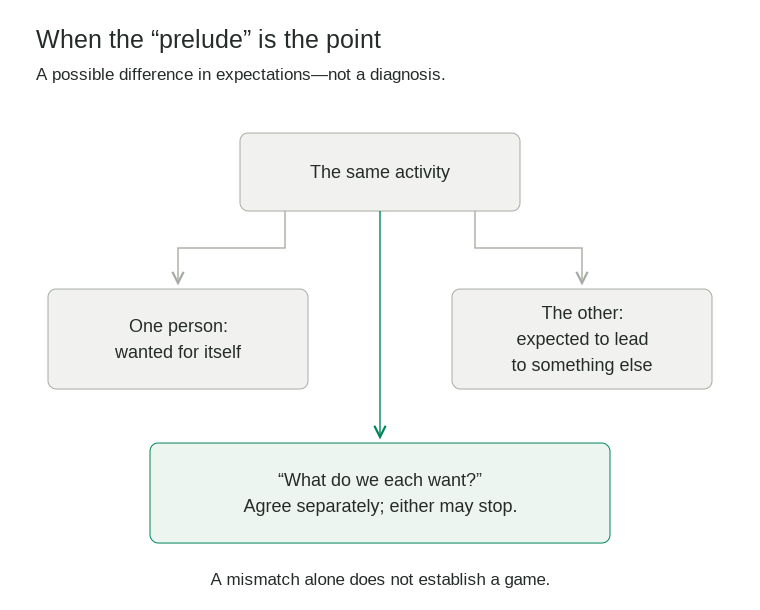
Within transactional analysis, or TA, a game involves an apparent exchange and a proposed underlying psychological function. The potentially useful distinction here is between what an activity is said to be for and what someone actually wants from it.
Patternverse’s narrower adaptation concerns recurring, misleading arrangements around desire and obligation. It does not classify a sexual interest as a game.
Wanting an activity for itself is not deception. Discovering a preference during an encounter is not deception. Neither is changing one’s mind or declining further activity. The relevant question is whether people can understand and freely choose the arrangement—not whether their interests are conventional.
How an unclear arrangement can sustain itself
The following sequence is an original Patternverse interpretation, rather than a reconstruction of a complete sequence supplied by Berne.
Someone wants an experience but feels unable to request it directly. They describe it as preparation for something they believe their partner values. The partner participates partly because of that understanding.
When the expected next step arises, their different expectations become visible. One feels pressured to continue; the other feels misled. They argue about selfishness or rejection rather than examining the initial agreement.
Possible immediate protections include avoiding shame, preserving a preferred image of oneself, or postponing a difficult discussion about compatibility. Another person might avoid stating their own limits because they fear disappointing a partner. These are hypotheses to explore, not motives that can be read from behaviour.
Over time, the arrangement can turn intimacy into an accounting exercise: “I did this, so now you should do that.” Consent to one activity never creates a debt requiring another. RAINN’s guidance emphasises that consent is ongoing, specific to the activity, and withdrawable. RAINN: consent and boundaries
The responsibilities are not automatically equal. Someone who pressures, threatens, or ignores a refusal is responsible for that conduct. Appeasement under pressure should not be redescribed as willing participation in a shared game.
Openings for change
Separate stopping from explaining
The immediate priority is to respect a pause or refusal. A discussion about recurring expectations can happen later, outside the encounter.
“Let’s stop. We don’t have to settle what this means tonight.”
Nobody needs to disclose every reason for stopping. A later conversation should not become a condition for having a boundary respected.
Examine Berne’s proposed antithesis carefully
Berne’s antithesis combines ordinary courtesy with abandoning the activities he condemns and restricting sex to conventional intercourse. He predicts that this will expose the supposedly preliminary activity as the real attraction. Games People Play, antithesis
That prescription is not adopted here. Removing an activity to reveal a partner’s “true nature” is not a sound basis for mutual understanding. Conventional intercourse is not a required endpoint or a test of psychological health.
The responses below are Patternverse adaptations, not Berne’s prescriptions or validated treatments.
Name the wish without promising an outcome
Robin could say:
“The roleplay is often what I want, rather than preparation for something else. I’ve been embarrassed to say that.”
Mara could answer:
“Thank you for explaining. Sometimes I want that too. Sometimes I don’t. I need to choose it knowing what you mean.”
An honest request may receive a refusal. Clarity helps people make choices; it does not guarantee compatible wishes.
The person expecting a later activity can also name that expectation without making it a claim:
“I was hoping for something different afterward. That doesn’t mean you owe it to me.”
Revise the response when it becomes a test
After their argument, Mara initially says, “Then we’ll only have normal sex from now on.”
Robin hears a judgement that the interest itself is defective. They withdraw from the conversation.
Mara revises her approach the next day.
“I called it normal, and that wasn’t helpful. I don’t want every encounter organised around roleplay. I also don’t want either of us agreeing to something just to obtain something else.”
Robin acknowledges using the promise of a later activity to make the request easier. Mara acknowledges that she has sometimes treated participation as a bargain.
They agree to ask directly and stop making promises about where an encounter will lead. At their next opportunity, Mara declines roleplay. Robin accepts the refusal, but both feel disappointed.
They have clarified the choice. Whether their relationship offers enough satisfying overlap remains unresolved.
If a partner continues pressuring or refuses to respect limits, another conversational formula may accomplish little. Ending the encounter, limiting contact, or seeking independent support can be appropriate.
A contrast: the activity is openly the point
Lee and Morgan enjoy consensual sexual roleplay. Before an evening together, Lee says, “I’d like that experience, but I don’t want intercourse afterward.”
“That works for me,” Morgan replies.
Partway through, Morgan wants to stop. Lee stops. Later, they discuss what each enjoyed and what they would change. Neither treats stopping as a failure to complete the evening.
There is no reason to infer a game from their preference. Current WHO guidance distinguishes atypical interests from disorders: consensual adult interests are not automatically pathological. Its relevant diagnostic requirements include additional considerations such as marked distress beyond social rejection or significant risk of injury or death. Consent matters, but does not by itself eliminate every health risk. WHO: ICD-11 clinical requirements, pp. 588–589
Pitfalls and limits
The historical title is retained for identification. It should never become a label for a person.
Berne also treats homosexuality as a game and attributes some resulting difficulties to provocative conduct. That account is homophobic and risks blaming people for discrimination. Sexual orientation does not establish an interpersonal game.
Later TA literature has challenged this legacy. Graham Perlman’s 2000 review explicitly identifies a contradiction between Berne’s treatment of homosexuality and TA’s affirmation of people’s worth, and describes affirmative contributions in subsequent literature. The accessible abstract supports that account; the full article was restricted. Perlman: “Transactional Analysis and Homosexuality”
Pain, disability, trauma, fatigue, medication effects, or changing desire may affect what someone wants. A partner does not need to prove one of these explanations to justify a refusal. Nor should distress caused by prejudice be mistaken for evidence that the interest or orientation is inherently disordered.
Current ITAA ethics emphasise dignity, protection, empowerment, and responsibility. Those principles support inquiry without humiliation; they do not validate the historical game description. ITAA Code of Ethics
No source cited here establishes the effectiveness of these particular conversational adaptations. TA remains an interpretive framework here, not a method for detecting concealed motives.
Connections
Means and ends. An activity understood as preparation by one person may be the desired experience for another.
Explicit agreements. Clarifying wishes reduces reliance on assumptions, while leaving everyone free to change their mind.
Desire differences. Two valid preferences may have limited overlap. Understanding that difference need not produce either a diagnosis or a compromise involving unwanted activity.
Sources and attribution
The historical formulation and antithesis come from Berne’s Games People Play. Later perspectives draw on Perlman, ITAA ethics, WHO classification, and RAINN’s consent guidance. The fictional encounters, illustration, narrower interpretation, and response suggestions are original Patternverse adaptations.