
Pursuit, humiliation, and the danger of assuming motives
A familiar scene
At a friend’s party, Casey tells Noor, “You should ask me out properly.”
They have been flirting for much of the evening. Noor feels encouraged.
“Would you like to have dinner on Saturday?”
Casey turns toward two friends. “Told you I could get them to ask.”
The friends laugh. Noor starts explaining: “You kept saying—”
That produces another joke. Noor leaves the conversation, embarrassed and angry.
Casey may have wanted admiration, an audience, or an amusing moment without considering its cost. Noor wanted to express interest without becoming entertainment. The observable problem is the invitation followed by public ridicule.
Casey remains free to decline a date. Noor can object to the ridicule without claiming that the earlier encouragement created an obligation.
What Berne called “Rapo”
Eric Berne places “Rapo” as the third entry in the “Sexual Games” chapter of Games People Play (1964). He distinguishes three degrees: mild flirtation ending after pursuit is secured; a more hostile version centred on humiliating rejection; and a severe version involving supposedly fabricated accusations of assault and potentially catastrophic consequences. His interpretation attributes revenge, avoidance of intimacy, and a sense of innocence to the latter version. Games People Play, “Rapo”
That grouping requires substantial criticism. Flirtation, rejection, deliberate humiliation, coercion, and assault are different phenomena. They should not be treated as points on an established progression.
Within transactional analysis, or TA, a game is understood to have an apparent exchange and an underlying psychological function. In Berne’s account, apparent romantic availability conceals a different aim: obtaining pursuit, then gratification through rejection or condemnation.
That is an interpretation, not something established by observing a refusal. Flirting and subsequently declining contact does not demonstrate a game. Neither does reporting assault.
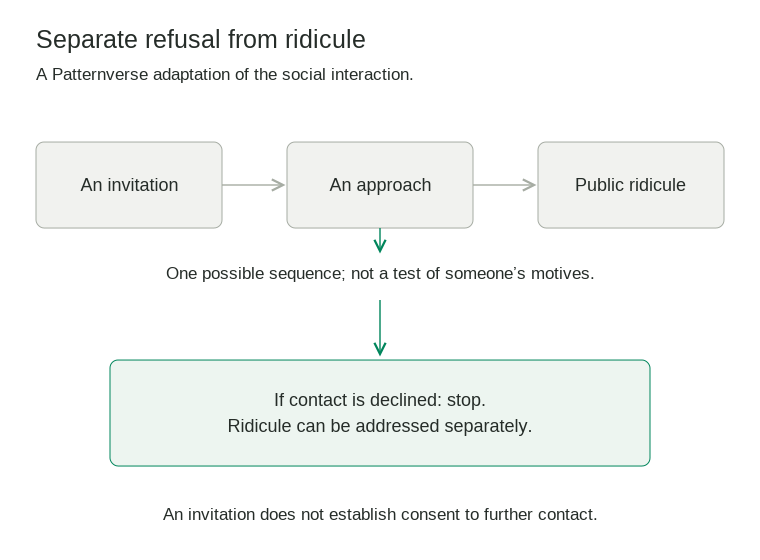
The historical title is retained here for identification. Patternverse’s practical adaptation concerns the narrower, nonviolent interaction illustrated above: an apparent invitation becomes an occasion for humiliation.
How the narrower interaction can sustain itself
In this Patternverse interpretation, an invitation encourages someone to express interest. Once they do, the exchange changes: their interest becomes evidence against them or material for ridicule.
The person approached moves from appearing interested to judging the pursuer. The pursuer moves from hopeful participant to embarrassed defendant, trying to prove that the approach was reasonable.
That defence can prolong the encounter. “But you encouraged me” may be heard—or deliberately represented—as “You owe me.” An audience can amplify the embarrassment, while friends’ approval rewards the ridicule.
Possible immediate satisfactions include feeling attractive, gaining social standing, or avoiding the vulnerability of admitting genuine interest. Those possibilities remain hypotheses. The person approaching may simply have trusted an invitation; there is no need to invent a hidden benefit from being humiliated.
Longer-term costs can include mistrust, shame, retaliatory behaviour, and a habit of treating attraction as a contest. Each person remains responsible for their conduct. Humiliation does not justify harassment or retaliation; an unwanted approach does not automatically establish an intention to humiliate.
Openings for change
Respect the boundary before interpreting the encounter
If contact is declined, stop. There is no need to decide whether the earlier interest was sincere.
“Okay. I won’t pursue this.”
This is a response to the present boundary, not a judgement about the preceding conversation. Consent must be voluntary, specific, and ongoing; earlier flirting or agreement does not establish permission now. RAINN: consent and boundaries
Address observable conduct separately
Berne’s proposed antithesis depends on distinguishing genuine feeling from game moves. For a particularly threatening scenario, he offers escape rather than a dependable countermeasure. This does not establish a reliable method for identifying deception. Games People Play, antithesis
The following responses are original Patternverse adaptations, not Berne’s prescriptions or validated treatments.
Someone can object to ridicule without disputing another person’s right to refuse:
“You can say no. Making my invitation into a joke for your friends was hurtful.”
Or they can simply leave. Addressing the conduct is optional; dignity does not depend on producing the perfect reply.
Noor initially drafts an angry message: “After encouraging me all evening, you owe me a chance.”
A friend points out that the message demands something Noor cannot rightly claim. Noor revises it:
“I accept that you don’t want a date. I’m upset that you encouraged me to ask and then made it public entertainment. I’m stepping back.”
Casey replies, “It was only a joke.”
Noor does not continue arguing for an admission. The outcome is limited: the hurt remains, but Noor has stopped pursuing both a date and a public vindication.
Make interest and limits more direct
Someone who recognises their own conduct can acknowledge it without treating attraction as the problem:
“I encouraged you because I liked the attention, then embarrassed you in front of my friends. That was unkind.”
They can clarify what they actually want—conversation, flirting without further plans, a date, or no continued contact—while accepting that the other person may disengage.
A bystander can interrupt the ridicule without endorsing entitlement:
“Noor asked a reasonable question. Let’s stop making them the joke.”
Understand repetition over time
If similar exchanges recur, a person might explore what happens when admiration becomes real interest, why an audience matters, or why direct refusal feels difficult. Another might examine whether they keep pursuing reassurance after an interaction has become hostile.
Those are invitations to self-understanding. They do not prove a particular childhood cause or require accepting Berne’s account. If intimidation, persistent unwanted contact, or retaliation occurs, protection and outside support may matter more than discussing the interaction.
A contrast: interest changes
After a pleasant evening together, Ruth and Mika kiss. Ruth then pulls away.
“I don’t want to continue.”
Mika stops. Ruth does not offer a detailed explanation, and Mika does not demand one. They arrange to travel home separately.
Later, a friend tells Mika, “Sounds like you were set up.”
Mika thinks about what actually happened. There was mutual interest, then a refusal. There was no ridicule, demand, threat, or admission of deception. Disappointment does not supply the missing evidence.
They may never know why Ruth’s wishes changed. They do know that the earlier kiss did not require continued contact. RAINN explicitly distinguishes consent from flirting, past encounters, bodily arousal, silence, or lack of resistance. RAINN: what consent does and does not mean
Later developments and serious limits
Later TA writing has challenged both the name and the framework’s application. A 2021 editorial note replaces “Rapo” with “Rebuff.” Renaming does not make every rebuff a psychological game. “The Game Grid,” editorial note, p. 5
Julie Hay’s 2022 critique goes further: it challenges applying game language to rape and actual victimization, and distinguishes people suffering persecution from participants in a psychological exchange. This is a documented critical position within TA, not a claim of universal agreement. Hay: “Game changing dynamics”
Berne’s treatment is sexist and contains victim-blaming assumptions. Its account of alleged false accusations cannot establish whether any real report is true or false. Flirtation, a relationship, or previous consensual activity does not invalidate a report of assault.
Power also matters. Someone facing coercion, discrimination, financial dependence, disability-related barriers, or fear may have limited freedom to express a clear refusal. Distress, freezing, or appeasement must not be interpreted as an invited interaction or a hidden payoff.
Current ITAA ethics emphasise respect, protection, empowerment, and responsibility. Those principles support examining harm without presuming equal responsibility. ITAA Code of Ethics
These sources document a historical model, later criticism, and consent guidance. They do not validate game analysis as a credibility test or demonstrate that the suggested conversational responses reliably change relationships.
Connections
Consent and changing one’s mind. These determine whether contact may continue, independently of anyone’s interpretation of earlier signals.
Humiliation and repair. Ridicule can be acknowledged and addressed without requiring romantic or sexual access.
Direct communication. Expressing interest or declining it plainly can reduce ambiguity, while preserving everyone’s right to stop.
Sources and attribution
Berne supplies the historical name, formulation, and antithesis. Later perspectives draw on Hay, the cited TA journal editorial, and ITAA ethics; consent guidance comes from RAINN. The fictional encounters, illustration, narrower interpretation, and response suggestions are original Patternverse adaptations.