
When an apology is expected to erase the consequences
A familiar scene
At Maya’s dinner party, Evan knocks a glass of wine onto a stack of prints.
“Oh, no. I’m so sorry.”
Maya lifts the wet sheets. She made them for an exhibition.
“You’re not angry with me, are you?” Evan asks.
Everyone is watching. “It’s fine,” she says, although she cannot yet tell what is ruined.
Later, despite Maya’s request to hang coats in the hallway, Evan leaves his wet jacket on an upholstered chair. When she notices the mark, he looks stricken.
“I’ve done it again. You must think I’m terrible.”
Maya finds herself reassuring him while another guest fetches towels. By the evening’s end, Evan has been told several times that he is welcome and forgiven. Nobody has discussed the prints, the chair, or what should happen differently.
Maya remembers the broken serving dish from his previous visit. She had reassured him then, too.
Evan may be embarrassed and afraid of losing a friend. Maya wants to be kind without pretending that nothing matters. Somehow, their conversation keeps settling his distress while leaving the damage with her.
The core pattern
Eric Berne places “Schlemiel” among the “Party Games” in Games People Play (1964). His example follows a guest who repeatedly damages a host’s possessions, apologises, and receives forgiveness. Berne interprets the exchange as aggression protected by apparent accident and the host’s obligation to remain gracious. The distinctive payoff is obtaining absolution, rather than merely enjoying destruction. This is his historical interpretation, not an established explanation of clumsiness. Berne estate: “Schlemiel”
In transactional analysis, a game involves an apparent exchange and a proposed underlying psychological function. Here, the apparent exchange is apology and reconciliation; the hypothesised function is securing release from blame while the damaging arrangement continues.
That hypothesis goes beyond what anyone can directly observe. We can observe a spill, repeated reassurance, an unaddressed cost, or a refusal to discuss precautions. We cannot observe a secret wish to destroy something.
For Patternverse, the useful question is: Does the apology open a conversation about what happened, or create pressure to close it?
An accident followed by regret is insufficient evidence. So is repeated difficulty with coordination. Even an awkward request for reassurance may express understandable shame rather than a recurring game.
How the interaction sustains itself
The following is a Patternverse reading of how such an exchange might continue.
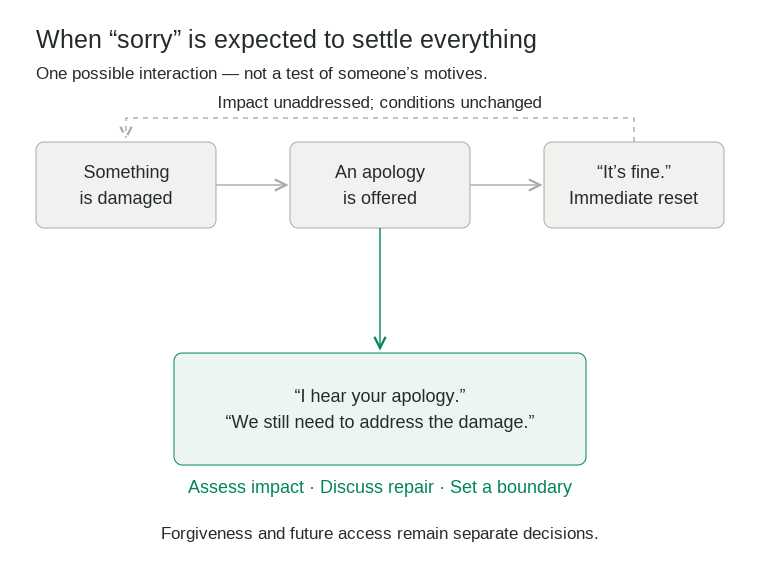
Damage occurs. The person apologises, then seeks confirmation that everything is all right. The affected person feels caught between expressing the impact and appearing unforgiving. They offer reassurance before assessing what needs attention.
That reassurance becomes the ending. Cleanup, replacement, inconvenience, and prevention remain unspoken. When something similar happens again, both people return to their familiar positions.
For the person apologising, immediate reassurance might relieve shame or protect their sense of belonging. For the recipient, graciousness might preserve the gathering, avoid an argument, or express a valued identity as a generous friend. These are possibilities to investigate, not motives to assign.
The costs can accumulate unevenly. One person receives relief; another loses time, possessions, or confidence that requests will be respected. Their participation does not make them equally responsible for the damage. Someone may reassure because challenging the other person feels socially or physically unsafe.
Openings for change
Interrupt the automatic reset
Berne does offer an antithesis: withholding demanded absolution. His suggested response ironically permits further damage while asking the guest to stop apologising. He warns of possible retaliation. He also describes the host as taking responsibility for having invited the guest. These are historical prescriptions, not recommendations adopted here: inviting someone does not make their harmful conduct your responsibility. Games People Play, “Schlemiel,” antithesis
The responses below are original Patternverse adaptations, not validated treatments or quotations from Berne.
An immediate interruption can be modest:
“I hear that you’re sorry. I need a moment to see what’s damaged.”
This acknowledges the apology without supplying a verdict about the whole relationship. Where necessary, stop the activity first: put the borrowed object away, move the gathering, or ask someone to leave a fragile item alone.
Make room for repair
It helps to distinguish four decisions: acknowledging an apology, forgiving someone, addressing damage, and deciding what access or trust is appropriate afterward.
They need not happen together. You can forgive someone and stop lending them something. You can discuss repair while still feeling upset.
The person who caused harm can reduce the demand for reassurance:
“I’m sorry I damaged this. You don’t have to tell me it’s fine. Can we work out what needs doing?”
Repair might involve cleaning, replacing something, contributing what is feasible, or changing an arrangement. Money and capacity matter; an unaffordable offer is not a workable agreement. Neither is a promise that leaves the affected person organising everything.
Change the recurring arrangement
Returning to Maya and Evan, Maya initially says, “Sometimes I think you do this on purpose.”
Evan protests. They argue about his character, and the prints disappear from the conversation again.
Maya revises her approach the following day:
“I don’t know why it happened. I do know I reassured you before checking the damage. Two prints are spoiled. I want to discuss those, and I need the coat request respected.”
Evan offers to replace the paper. Maya explains that the lost work also matters. They agree that he will contribute to materials and help prepare another printing session.
Then Evan asks whether he can borrow her camera for the weekend.
“No,” Maya says. “I’m not comfortable lending it.”
He is hurt. Their agreement has not restored everything. Still, they have addressed something concrete without requiring either person to prove what was secretly intended.
If cooperation is declined, the affected person can change their own participation: stop lending possessions, meet elsewhere, or end the exchange. They cannot make another person apologise sincerely or carry out a repair.
Over time, someone might explore why acknowledging harm feels unbearable, or why expressing disappointment feels forbidden. Later TA’s ethical framework emphasises dignity, protection, empowerment, and responsibility. Those principles provide a different emphasis from competitive accounts of who “wins”; they do not establish that these particular responses work. ITAA Code of Ethics
When similar behaviour means something else
At a community workshop, Jo drops a cup and later catches a sleeve on a drying rack. A volunteer jokes, “You’re a walking disaster.”
Jo has dyspraxia. Difficulties with movement and spatial awareness can involve dropping objects or bumping into things; repetition does not establish concealed aggression. NHS: dyspraxia in adults
Jo apologises and asks for help creating more space beside the workstation. The organiser clears a narrow route, relocates drinks, and agrees where wet work should go. A print is still damaged. They discuss what can be salvaged without turning Jo into a character type.
The adjustments do not guarantee that nothing will ever break. The relevant response is practical access and proportionate attention to consequences. There is no reason to introduce the game interpretation.
Pitfalls and limits
“Schlemiel” can become a contemptuous label for someone whose movements, distress, or social responses are misunderstood. Preserve it as a historical game name, rather than calling a person one.
Berne’s account includes speculative psychoanalytic explanations. They should not be presented as current knowledge about why someone spills, breaks, or apologises.
Nor should the interpretation excuse cruelty toward a person who makes a mistake. Clear accountability does not require humiliation. A furious reaction to a boundary also proves nothing about hidden motives.
Power changes the situation. An employee may reassure a manager because their livelihood feels threatened. A person whose partner destroys possessions may appease them to avoid further harm. That is not evidence that they invited, wanted, or equally sustained the abuse. Confronting the supposed game may increase danger; protection and outside support can matter more than discussing it.
The sources used here establish Berne’s formulation and contemporary ethical principles, not the effectiveness of these adaptations. Recognising a possible pattern is a prompt for closer observation, not a diagnosis.
Connections
Sweetheart. Berne also describes hostility protected by an expectation of affectionate acceptance. Its vehicle is the socially cushioned put-down; “Schlemiel” centres on damage and absolution. Games People Play, “Sweetheart” and “Schlemiel”
Apology and repair. An apology can acknowledge a rupture. Repair concerns what happens afterward. Keeping them distinct makes room for both remorse and consequences.
Boundaries after forgiveness. Forgiveness need not restore borrowing privileges, unrestricted access, or the previous arrangement. A boundary can address a continuing risk without deciding that someone is irredeemable.
Sources and attribution
The game name, classification, historical interpretation, and antithesis come from Eric Berne’s Games People Play. Contemporary ethical framing draws on the ITAA; the disability contrast draws on NHS information. The fictional encounters, illustration, distinctions, and practical responses are original Patternverse adaptations.