
When influence becomes an excuse to hand over responsibility
A familiar scene
Jon is preparing a presentation at the kitchen table. Mara asks whether he can collect their daughter at six. She has asked twice already and needs to confirm her own plans.
He turns sharply, catches his coffee cup, and spills it across the printouts.
“See what you made me do? I can’t get five minutes’ peace.”
Mara apologises, fetches a cloth, and says she will manage the collection herself. Jon returns to work.
He needed uninterrupted time. She needed an answer about a shared responsibility. The spill becomes the reason neither issue gets discussed.
Next time, Mara hesitates before approaching him. Jon gets more quiet, while she takes on more of the arrangements.
The core pattern
Berne included “See What You Made Me Do” among the Life Games in Games People Play (1964). His initial example involves an interruption, a work mishap, and anger directed at the person who interrupted. He also describes a version in which someone leaves decisions to another person, then blames them when the outcome disappoints: “You Got Me Into This.” Berne’s estate-hosted excerpt
The distinctive move is a transfer of responsibility: another person’s involvement becomes grounds for treating them as responsible for one’s mistake, decision, or conduct.
In transactional analysis, a game is a recurring exchange with an apparent social purpose, an inferred psychological level, and a familiar ending or payoff. Here, an apparent complaint about interference or advice may also secure distance, vindication, or exemption from responsibility. Those functions are interpretations to investigate, not observable facts about someone’s motives. ITAA, Core Concepts
An interruption can genuinely contribute to an error. Advice can be poor. Recognising this pattern requires examining how responsibility is being assigned, rather than denying that people affect one another.
How the interaction sustains itself
In Jon and Mara’s encounter, the observable sequence is: a question, a spill, an accusation, an apology, and withdrawal.
A possible interpretation is that Jon finds it difficult to ask directly for time alone—or to negotiate that need alongside family obligations. After the spill, his anger makes the withdrawal happen without negotiation.
Mara’s apology settles the immediate tension. Over time, however, avoiding his reactions may require her to anticipate needs he has not expressed and absorb responsibilities they have not agreed to transfer.
In the delegated-choice version, the arrangement can appear generous: someone repeatedly lets another person choose. The difficulty emerges when authority and accountability separate. The person who accepted the choice enjoys successful outcomes but assigns disappointing ones to the adviser.
Possible immediate benefits include escaping embarrassment, avoiding a difficult decision, or obtaining space. Longer-term costs include guarded communication, reluctance to offer ideas, and uncertainty about who actually owns a decision. None of these possibilities establishes a deliberate plan.
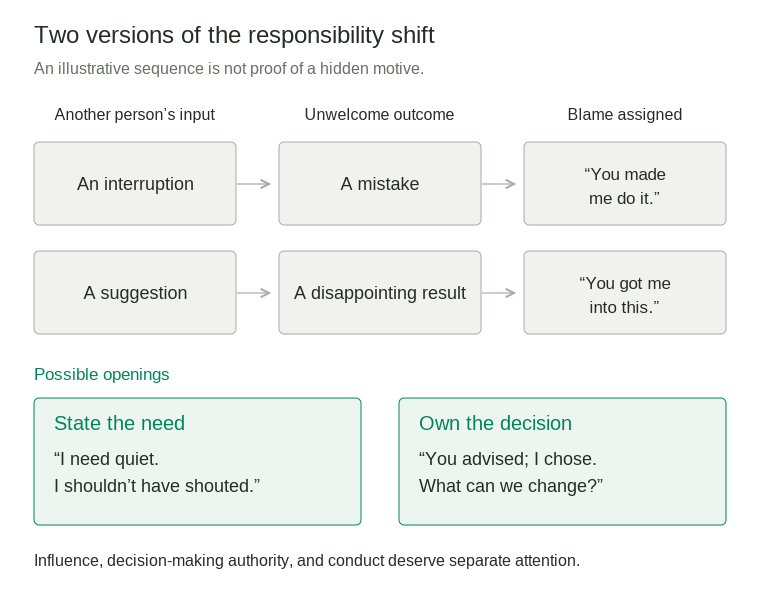
What Berne proposed
Berne’s stated antithesis, or counter-response, differs by version. For the interruption version, he recommends leaving the person alone; for delegated decisions, returning the decision to them. He places responses to dangerous forms in competent professional hands. Games People Play, “Life Games,” §5
These are historical suggestions, not guaranteed solutions. Leaving someone alone may respect a reasonable request for concentration, but it can also leave shared obligations unresolved. Returning a decision may clarify responsibility, but could provoke retaliation where power is unequal.
The following responses are Patternverse adaptations, not Berne’s prescriptions or validated treatments for this game.
Openings for change
Separate the incident from the accusation
The person making the accusation can acknowledge influence without assigning total responsibility:
“I lost my concentration when you spoke. I knocked the cup over, and I shouldn’t have shouted.”
This leaves room to discuss interruptions. It also makes the outburst available for repair instead of presenting it as something the other person produced.
The recipient can acknowledge a specific contribution without accepting the whole accusation:
“I interrupted while you were working. We can discuss timing. The spill doesn’t make it okay to shout at me.”
That language may help where disagreement is safe. It is not a test anyone must pass during intimidation or danger.
Make the need explicit—and negotiable
Later, Jon says, “You know not to interrupt when I’m busy.”
Mara points out that he works at the table most evenings, leaving no reliable opportunity to settle family arrangements.
Jon revises his request: twenty uninterrupted minutes, followed by a conversation about tomorrow. Mara agrees, provided urgent matters remain possible and the conversation actually happens.
That evening, he stops at the agreed time. They divide the collections. The useful change includes a direct request, a limit on that request, and follow-through on the shared obligation.
A need for quiet, an accessibility adjustment, or relief from an excessive workload deserves consideration in its own right. Naming a pattern should not erase it.
Clarify who advises, who decides, and what needs reviewing
At work, Asha asks Daniel to recommend a delivery schedule. He proposes the cheaper option; she approves it. When a delay disrupts the launch, she tells the team, “Daniel got us into this.”
Daniel initially responds, “Then I won’t recommend anything again.” That protects him from another accusation but leaves planning harder.
In a later review, he is more specific: “I recommended that schedule and should have checked the supplier’s availability. You approved it. Can we review both the estimate and the approval process?”
Asha accepts that approval was hers, but they disagree about how foreseeable the delay was. They record that disagreement and add a supplier check before future approvals.
The aim is accurate accountability. Advice can carry responsibility for its quality without transferring every decision or consequence to the adviser.
Work with the recurrence
Where the pattern repeats, useful questions concern what repeatedly goes unspoken: a limit, resentment about making decisions, fear of being wrong, or an unequal workload.
Later TA practice emphasises explicitly negotiated goals and agreements. The ITAA’s current ethical framework also names responsibility, protection, and respect as principles. These provide a different emphasis from using game labels to allocate blame; they do not establish the effectiveness of the suggestions here. ITAA, Core Concepts, ITAA, Code of Ethics
If another person refuses discussion, a boundary might limit giving informal advice or end a hostile exchange. Where refusal risks retaliation, outside support and safer arrangements matter more than the wording.
When another person really did cause the problem
At a pottery workshop, an instructor moves an unsecured table while Elena is pouring glaze. Her work tips over.
“Moving the table caused the spill,” she says. “Please wait until I’ve put this down.”
This is a specific account of physical interference, followed by a practical request. The instructor acknowledges it, secures the table, and helps address the damage.
Calling Elena’s response a game would obscure a real cause. Responsibility should follow the evidence, including inadequate instructions, unsafe conditions, misinformation, and authority—not a blanket rule that every outcome belongs solely to the person nearest it.
Pitfalls and limits
The most serious misuse is treating abuse as a jointly maintained conversational game. “You made me hurt you” does not transfer responsibility for violence to the person harmed. Appeasing, withdrawing, or complying under threat does not establish equal participation. Domestic-abuse guidance explicitly identifies blame shifting as a way responsibility can be displaced onto survivors. National Domestic Violence Hotline, Mutual Abuse
Children are not responsible for managing a parent’s temper. Employees do not acquire a manager’s authority merely because they offer suggestions.
Berne’s entry also contains gendered assumptions, speculative sexual explanations, and stigmatising psychiatric language. These should not be treated as established explanations of contemporary relationships. Original entry
The model can draw attention to a responsibility shift. It cannot determine hidden motives or establish a diagnosis. Evidence about TA generally would not, by itself, validate these particular responses.
Connections
“You Got Me Into This” is Berne’s closely related variation: delegated choice becomes grounds for blaming the chooser.
“Now I’ve Got You, You Son of a Bitch” uses another person’s fault as justification for a wider attack. Here, the central move assigns them responsibility for one’s own action or decision. Berne’s original entries
Direct requests and negotiated boundaries make needs discussable before a mishap supplies an accusation.
Decision ownership distinguishes contributing advice from holding authority. These last two are neighboring response concepts, not claims about existing Patternverse entries.
Sources and attribution
Historical description and antithesis: Eric Berne, Games People Play (1964), “Life Games,” §5, checked against the full entry and estate-hosted excerpt. Later TA and safeguarding sources are linked where discussed.
All encounters are fictional. The examples, explanatory diagram, and practical adaptations are original Patternverse contributions.