
When attention becomes an argument about what other people are thinking
A familiar scene
At her first meeting of a reading group, Dani notices a ladder in her stocking.
“Does anyone know how to stop this getting worse?”
She lifts her leg slightly to show it. Several people glance where she indicates. Someone suggests a nearby shop.
“You’re all very interested in my legs,” Dani says.
Kai, the organiser, looks confused. “I thought you wanted help with the stocking.”
“It’s only a stocking. You’re the one making it strange.”
An awkward laugh goes around the table. Dani takes that as further evidence that the group has sexualised an ordinary problem. Kai starts defending everyone’s intentions. The discussion they came for disappears.
Dani may have felt unexpectedly exposed. Kai may have missed something about the group’s response. Neither knows exactly what the others experienced. Yet they have quickly moved from a practical question to confident claims about one another’s minds.
The historical pattern
Eric Berne places “The Stocking Game” fourth in the “Sexual Games” chapter of Games People Play (1964). His example involves a woman drawing attention to a damaged stocking. He interprets her action as intended to provoke sexual interest and resentment, followed by declarations of innocence or counter-accusations when challenged. The hypothesised aim is to confirm that other people have sexual motives. Berne estate: “The Stocking Game”
The distinctive mechanism is the proposed switch: an apparently practical reason for attracting attention becomes an occasion to condemn the attention received.
Within transactional analysis, or TA, a game involves an apparent exchange and a proposed underlying psychological function. Here, the apparent exchange concerns a clothing problem; the hypothesised function is confirming a familiar belief about other people.
The difficulty is that Berne treats inferred intentions as though they were directly observable. They are not. We can observe a request, a gesture, a look, or a comment. We cannot establish deliberate provocation from clothing, posture, anatomy, or someone’s embarrassment.
Patternverse therefore uses this entry cautiously: as a possible lens on a recurring exchange, particularly our own contribution—not as a way to identify people who are secretly inviting sexual attention.
How the exchange can sustain itself
The following is a Patternverse interpretation, not an established account of hidden motives.
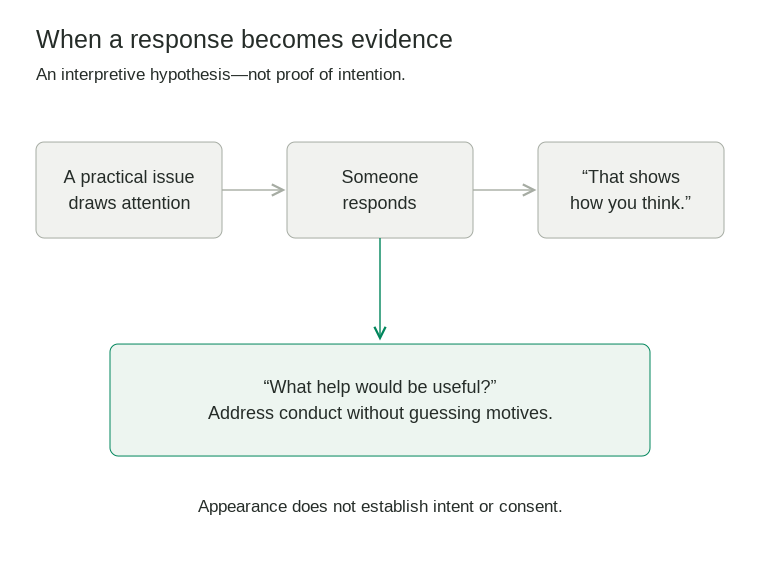
A practical issue directs attention toward someone. Another person responds. The response is then interpreted as evidence of sexual interest, judgement, or improper curiosity.
The person responding protests: “You asked me to look.” That protest may sound like an attempt to justify unwanted attention. The original speaker protests in turn: “I was only asking for help.” Soon both are defending their character rather than clarifying what happened.
Possible immediate functions include obtaining attention without requesting it directly, protecting against feeling exposed, or confirming an expectation of being objectified. For others, defending their innocence may protect their standing in the group. These are possibilities to investigate, not conclusions supplied by the sequence.
The longer-term costs may include mistrust, withdrawal, gossip, and increasing vigilance. A group can also become so invested in disproving the accusation that it overlooks an actual inappropriate remark.
Participation does not establish equal responsibility. Someone who makes a sexual comment remains responsible for that comment. Someone who feels uncomfortable is not obliged to accept an explanation that everything was innocent.
Openings for change
Respond to the practical request
Berne’s antithesis discusses ignoring or countering the game in a therapy group, warns that the person may leave, and distinguishes interruption from retaliation. He assigns particular responsibility for countering it to women. This is a historical proposal containing gender assumptions, not an established solution adopted here. Games People Play, antithesis
The responses below are original Patternverse adaptations, not validated treatments.
A practical question can receive a practical answer:
“Would you like help finding somewhere to change, or are you looking for a shop?”
This offers assistance without commenting on attractiveness, inspecting someone unnecessarily, or making their body the group’s business. It also leaves room for “No help needed.”
Ignoring a suspected game should never mean ignoring distress, an access need, or an objection to harassment.
Separate impact from claims about intention
If someone feels stared at, an argument about their “real” reason for attracting attention is unlikely to clarify the immediate request.
A response might be:
“I understand that the attention felt uncomfortable. I’ll stop looking.”
Where conduct needs clarification, ask about it without demanding proof of discomfort:
“Was there a particular comment you want us to address?”
The person raising the concern can also describe the conduct directly: “Please stop commenting on my legs,” or “I wanted help with the clothing problem, not remarks about my appearance.”
Nobody needs to agree about the game interpretation for a boundary to be respected.
Revise a response that becomes an accusation
Kai initially tells Dani, “You can’t ask everyone to look and then complain.”
Dani hears that as permission for any kind of attention. The conversation becomes more heated.
Kai stops defending the whole group.
“I’m assuming too much. You asked for help, then said the attention was uncomfortable. We can stop discussing the stocking. If someone made an inappropriate remark, we should address that separately.”
Dani says the laughter felt directed at her. Another participant explains that they laughed from awkwardness, then acknowledges that it could have felt mocking.
Later, Dani tells Kai she felt conspicuous as a newcomer and became embarrassed when people looked. That account changes their understanding without proving that she had been playing a game.
They agree to raise any further concerns privately rather than debate everyone’s motives around the table. The evening remains uncomfortable. The useful change is a clearer stopping point.
Examine recurrence without forcing agreement
Over time, someone might explore whether they repeatedly seek attention and then feel endangered by receiving it. Another might notice a habit of interpreting ordinary bodily behaviour as a sexual signal.
Either exploration concerns one’s own experience. Neither should become a compulsory confession.
If someone declines further discussion, that does not validate the theory. A facilitator can maintain consistent expectations about interruptions and respectful speech, or end a discussion that has become hostile. They cannot compel agreement about hidden intentions.
A contrast: an ordinary adjustment
At a workshop, Rina repeatedly adjusts a medical garment that has become uncomfortable. Another attendee makes a sexual joke.
Rina asks them to stop.
A third person suggests that she should not have drawn attention to herself. The organiser interrupts: “Adjusting clothing doesn’t invite comments about someone’s body.”
They offer Rina a private space and ask whether she wants any practical assistance. She declines and stays in the workshop.
There is no reason to introduce a game interpretation. The relevant facts concern discomfort, a remark, and a request for it to stop. Rina should not have to disclose medical details to establish that boundary.
More generally, clothing and bodily appearance do not establish sexual consent. RAINN explicitly cautions against treating clothing, flirting, or previous encounters as permission. RAINN: consent and boundaries
Pitfalls and limits
Berne’s entry contains sexist generalisations and speculative explanations involving bodily features, maternal influence, and bereavement. These are not sound grounds for diagnosing anyone or determining their intentions. Games People Play, “The Stocking Game”
Disability, pain, distress, cultural differences, and ordinary clothing problems can explain behaviour an observer finds conspicuous. Unequal authority can make it difficult to object without appearing defensive. Harassment and abuse must not be reframed as attention that the affected person secretly arranged.
Later TA criticism provides an important limit. Julie Hay’s 2022 discussion challenges using game theory as an explanation that displaces actual victimization and material consequences. It is a general critique, not a researched replacement antithesis for this particular entry. Hay: “Game changing dynamics”
Current ITAA ethics emphasise dignity, protection, empowerment, and responsibility. Those principles support careful inquiry; they do not validate Berne’s interpretation or these adaptations. ITAA Code of Ethics
The cited sources do not demonstrate that a particular conversational response reliably changes this interaction. TA remains an interpretive framework here, with substantial room for misreading.
Connections
Observation and interpretation. “They looked when I pointed” and “They were sexually interested” are different kinds of statements.
Direct requests. Naming the help wanted can reduce ambiguity without requiring anyone to explain their entire emotional experience.
Boundaries without motive claims. “Please stop that comment” can stand independently of a theory about why it happened.
Sources and attribution
The historical formulation and antithesis come from Berne’s Games People Play. Later perspectives draw on Hay and ITAA ethics; consent guidance comes from RAINN. The fictional encounters, illustration, narrower interpretation, and practical responses are original Patternverse adaptations.