
When asking for help becomes a contest over whether help is possible
A familiar scene
“I keep saying I’ll start drawing again,” Leila tells her friends. “But I never get started. Any ideas?”
“Why don’t you join an evening class?” Tom asks.
“Yes, but they’re expensive.”
“There are free lessons online.”
“I’ve tried those. I just watch them.”
“Could you draw for ten minutes before work?”
“Yes, but I’d spend the whole time thinking about leaving.”
A second friend suggests keeping a sketchbook beside the sofa. Leila explains why that would not work either. Tom begins searching for local workshops on his phone.
Eventually, the suggestions stop.
“See?” Leila says. “Nothing helps.”
Tom feels unexpectedly defeated. Leila feels misunderstood. Nobody has asked what makes beginning difficult, or what she hoped her friends would provide. The following week, they have almost the same conversation.
The core pattern
Eric Berne includes “Why Don’t You—Yes But” in the “Party Games” chapter of Games People Play (1964). He describes it as the original stimulus for his concept of games. His example concerns unsuccessful household repairs: several people offer solutions, and the person presenting the problem finds an objection to each. Berne estate: “Why Don’t You—Yes But”
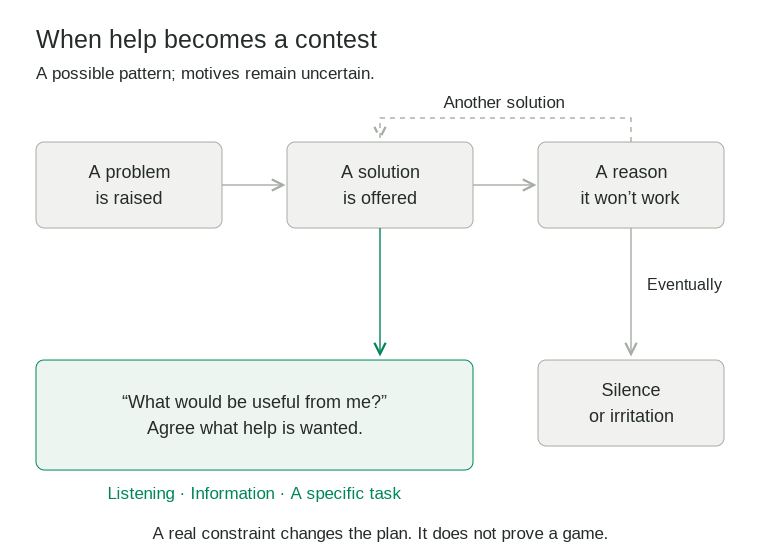
The distinctive feature is the ending. In Berne’s interpretation, the apparent search for help becomes a demonstration that the advisers cannot produce an acceptable answer. Their exhausted silence supplies the payoff: reassurance through defeating their attempts to help. He treats the underlying exchange as generally unconscious, rather than necessarily a deliberate trick. Games People Play, “Why Don’t You—Yes But”
Within transactional analysis, or TA, a game is a recurring interaction understood to have both an overt purpose and an underlying psychological function. Here, those would be finding a solution and obtaining reassurance through an exchange that defeats solutions.
That second layer is an interpretation. We can observe repeated suggestions, objections, and frustration. We cannot directly observe a hidden need to defeat anyone.
A useful clue is whether objections help refine the search. In ordinary problem-solving, “That costs too much” establishes a budget. In the possible game, the conversation repeatedly returns to proving that nothing offered will do.
How the exchange sustains itself
The following is a Patternverse explanation of how this interaction might continue.
Someone presents a difficulty. Another person takes responsibility for finding the answer. Each objection makes the adviser search harder, while the person with the difficulty becomes the judge of the next proposal.
Their positions gradually change. The apparently resourceful adviser becomes helpless; the apparently helpless person becomes the authority who can defeat every suggestion.
Several things might sustain this. The person raising the problem may want companionship, recognition, or reassurance without knowing how to ask. Rejecting advice might protect them from feeling controlled, risking failure, or accepting an obligation. The adviser may enjoy being useful, dislike uncertainty, or feel personally tested by each refusal.
These possibilities require conversation, not mind-reading. Sometimes the adviser simply keeps offering unsuitable ideas.
The immediate exchange provides attention and structure. Its longer cost can be resentment: “Nobody understands me” on one side, “They never want help” on the other. Neither person learns much about the difficulty itself.
Openings for change
Stop supplying the next answer
Berne’s proposed antithesis is to decline the complementary role of endlessly helpful adviser. Depending on the opening, he suggests acknowledging the disappointment or asking what the person intends to do. He also allows that a friendly, harmless social version need not always be interrupted. These are historical proposals, not demonstrated treatments. Games People Play, antithesis
The responses below are original Patternverse adaptations.
An adviser can describe the observable exchange:
“I’m offering ideas, and none seems useful. Let’s pause.”
This stops the sequence without accusing the other person of secretly wanting failure. The next move need not be another question. Acknowledging “That sounds discouraging” may be sufficient.
The person raising the difficulty can also interrupt:
“I asked for ideas, but I’m noticing that I’m arguing with every one. I think I need something different.”
Neither response requires agreement about whether a game was occurring.
Establish what help is wanted
A question such as “What would be useful from me?” can distinguish listening, information, practical assistance, and collaborative thinking.
An answer might be specific:
“Could you listen for a few minutes? I’m disappointed, and I’m not ready to plan.”
Or:
“Help me compare these two options. I don’t need more possibilities.”
This is compatible with later TA’s emphasis on explicit agreements. The ITAA’s core-concepts account describes therapeutic contracts that identify the outcome a client wants. Applying that principle to a conversation between friends is an adaptation, not a claim that friendship requires a therapy contract. ITAA: The Core Concepts
Make uncertainty discussable
The next week, Tom tells Leila, “Maybe you don’t actually want to draw.”
She hears an accusation of dishonesty. Their conversation becomes an argument about whether she means what she says.
Tom revises his approach.
“I don’t know what’s stopping you. I do know we keep ending with both of us frustrated. Would company help more than suggestions?”
Leila says she feels embarrassed producing beginner drawings after years of talking about being artistic. They agree to spend half an hour sketching together, with no instruction or critique.
She cancels their first session. Tom resists reorganising her entire week.
“I can do next Saturday. After that, you’ll need to suggest a time.”
They eventually meet. Leila draws for twelve minutes and dislikes the result. The difficulty remains, but it has become something they can discuss without requiring Tom to invent an unbeatable solution.
Allow a boundary or stopping point
Clarifying the request may not produce cooperation. Someone may continue demanding answers while dismissing every attempt.
An adviser can limit their participation:
“I don’t have another suggestion. I can listen for ten minutes, but I’m stopping the search for solutions tonight.”
Someone receiving unwanted advice can be equally clear:
“I’ve explained why that option isn’t available. Please stop recommending it.”
Over time, recurring exchanges may warrant exploring fear, shame, dependence, or expectations about helping. The relevant question is what each person recognises in their own experience—not which hidden motive an observer can assign.
When “yes, but” contains essential information
At work, Priya tells her manager that a proposed rota is unworkable.
“Why don’t you take the earlier bus?”
“It arrives after the shift starts.”
“Then arrange childcare earlier.”
“The nursery doesn’t open before seven.”
“Could your partner cover?”
“My partner works nights.”
The manager begins to think Priya rejects everything. Then he checks the actual constraints rather than offering another household arrangement.
He discovers that the rota change created the conflict. He can authorise a later start; Priya cannot change the nursery’s opening time. They arrange temporary cover while reviewing staffing. The cover is inconvenient, and the longer-term problem remains unresolved.
Her objections were necessary information. Asking her what she intended to do would have misplaced responsibility for a decision controlled by management.
Pitfalls and limits
The game name must never become a shortcut for dismissing inconvenient facts. Poverty, disability, fatigue, discrimination, inaccessible services, and coercive relationships can make apparently simple suggestions unusable. A refusal may be accurate, protective, or justified.
Repeated objections do not establish equal responsibility. Someone facing pressure from a manager, clinician, or partner may have little freedom to end the discussion. A person experiencing abuse does not invite it by declining unsafe advice.
Berne’s original discussion contains gender stereotypes and speculative psychoanalytic explanations. Those should not be treated as established knowledge about contemporary help-seeking.
Current ITAA ethical principles emphasise respect, empowerment, protection, and responsibility. They support examining power and dignity; they do not validate any particular interpretation of this conversation. ITAA Code of Ethics
The sources here establish the model and its proposed responses. They do not establish that these particular adaptations reliably change relationships. Evidence about TA generally would not, by itself, demonstrate that a specific conversational response works.
Connections
I’m Only Trying to Help You. Berne explicitly connects the games. This neighboring pattern directs attention toward the adviser’s investment in helping, rather than placing the entire problem with the person rejecting advice. Games People Play, antithesis
Validation. Recognising someone’s difficulty can make their experience discussable without agreeing that nothing can change.
Explicit agreements. Defining the kind and limits of help reduces the need to guess what participation means.
Constraint checking. An objection can improve a plan. Its value depends on what it reveals, not whether it begins with “yes, but.”
Sources and attribution
The name, historical formulation, and antithesis come from Berne’s Games People Play. Later TA framing draws on the ITAA sources linked above. The fictional encounters, illustration, and practical responses are original Patternverse adaptations.