
A customer import works perfectly with Alice, Bob, and Carol. Then a supplier sends a company name containing a comma, an address containing a newline, and two visually identical names represented by different Unicode sequences. The pipeline splits records, loses characters, or creates unexpected duplicates.
The tests passed because their text was easier than the text the system actually receives.
Representative Text Fixtures preserve a small, deliberate collection of text inputs and their expected outcomes. They exercise the language, structure, formatting, and irregularities that matter to a particular pipeline.
The purpose is to make realistic text behavior repeatable. A good fixture explains both what the system encounters and what correct handling means.
Represent the conditions that change behavior
A fixture is more than a sample string. It pairs input with an expectation at a particular processing boundary.
For an importer, that might mean exact file bytes, an encoding, a CSV dialect, and expected records. For a normalizer, it means the original character sequence and the expected normalized value. For a document extractor, it means a complete document and the structure that should be extracted.
“Representative” does not necessarily mean proportional to production frequency. A rare embedded newline may deserve a permanent fixture because it can break record boundaries. A common ordinary sentence may add little after that behavior is already covered.
A useful collection combines three kinds of cases:
- Ordinary cases that establish normal behavior.
- Boundary cases involving consequential variations, such as long fields, combining marks, or unusual whitespace.
- Regression cases that preserve previously discovered failures.
Include relevant interactions. Testing a non-English name and a quoted field separately may miss a bug that appears when they occur together.
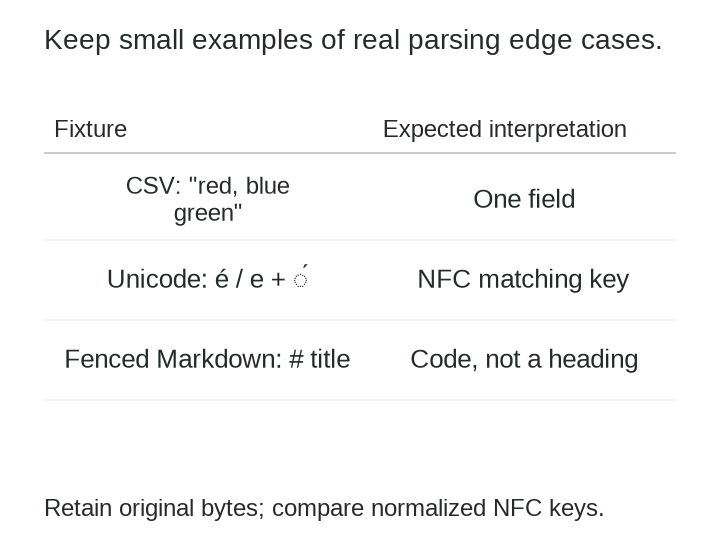
Preserve the newline that breaks the importer
Consider this illustrative CSV fixture:
customer_id,note
C17,"red, blue
green"
The expected result is one data record with two fields. The note contains a comma and an actual newline.
A parser built from “split into lines, then split each line on commas” cannot handle this correctly. A fixture containing only single-line text would never expose that mistake.
The expectation should check the parsed note itself, not merely that ingestion completed. A pipeline that silently replaces the newline with a space might preserve the record count while changing the content.
Run the fixture through the same file-reading boundary used in production. Supplying an already parsed list of strings bypasses the encoding, newline handling, and parser configuration that the test needs to exercise.
Python’s standard csv module provides a concrete implementation example: its documentation specifies opening file objects with newline='' so the module handles newlines correctly. It also documents an important round-trip limitation: the default writer converts None to an empty string.
That distinction belongs in the contract. If missing values and empty text must remain distinguishable, the export format needs an explicit representation. A fixture cannot recover information that the format has discarded.
Make visually identical text visibly different
A matching pipeline receives two forms of the word “Café”:
| Fixture | Character sequence |
|---|---|
| Precomposed accent | Caf\u00E9 |
| Combining accent | Cafe\u0301 |
The escape notation makes the difference visible: the second form contains an e followed by a combining acute accent.
Suppose the contract requires NFC-normalized matching keys while retaining original source text. The expected behavior is then precise: the derived matching keys are equal, and each original value remains available unchanged.
This tests a chosen normalization policy. It does not establish that the two records describe the same business entity. Many unrelated businesses can share a name, and broader transformations such as accent removal can merge distinctions the application needs.
The Unicode Consortium uses this pattern directly. Its Unicode Character Database documentation describes NormalizationTest.txt, which pairs input strings with expected normalization results and includes difficult algorithmic cases. Applications can supplement those conformance cases with their own source-specific fixtures.
Choose the equality rule explicitly: exact bytes, exact code points, normalized text, or a domain-specific matching key. Comparing everything after aggressive cleanup can make a broken transformation appear correct.
Personal names also need broader coverage than a collection of Western two-part names. The W3C’s guidance on personal names documents differences in composition, ordering, spacing, and writing systems. Fixtures should challenge assumptions relevant to the application without turning cultural examples into universal parsing rules.
Keep structural context around the text
A document pipeline extracts headings to build a search index. Its tests contain only straightforward headings, so a regular expression that finds lines beginning with # appears sufficient.
Now introduce this fixture:
# Order notes

~~~
# Cancelled
~~~
The expected structure contains one heading, “Order notes,” and one code block containing # Cancelled. The second marker is content inside code.
This exposes why representative fixtures sometimes need complete documents. Extracting # Cancelled into an isolated string removes the context that determines its meaning.
Under CommonMark’s fenced-code rules, the fenced content remains literal text. The reference implementation, cmark, reports passing CommonMark conformance tests and maintaining additional pathological cases in its test suite.
For the ingestion pipeline, assertions might cover extracted heading text, block types, and preserved code content. Checking only the final plain-text output could miss a structural error that later changes chunking or indexing.
Keep the evidence intact
Text fixtures are unusually easy to damage while maintaining them.
An editor may normalize characters, remove trailing whitespace, or change line endings. A fixture copied through a spreadsheet may lose leading zeros or reinterpret text. An escaped display such as \n is not an actual newline unless the test deliberately decodes it.
Store exact files when byte-level behavior matters. Record the intended encoding and relevant parser settings. Use escaped or hexadecimal displays to explain invisible differences, while ensuring the test still reads the intended original input.
Expected results need an independent basis: a specification, an agreed business rule, or a reviewed interpretation. Saving whatever the implementation currently produces creates a snapshot, but does not establish correctness. Automatically accepting every changed snapshot can preserve new bugs.
Malformed inputs also need explicit outcomes. Invalid byte sequences might require rejection, quarantine, or a documented replacement policy. “Does not crash” is often too weak an assertion.
Preserve realism without copying sensitive content
Production examples can reveal combinations that invented samples miss, but copying entire customer messages or documents into a repository creates unnecessary exposure.
Prefer constructed examples that retain the relevant mechanism: punctuation, writing system, spacing, repetition, length, or document structure. Where real examples are necessary, sanitize them deliberately and review the resulting fixture for sensitive content.
Sanitization can destroy the failure. Replacing every name with Test User removes the very properties a name-processing fixture should retain. Replacing an entire message may erase the context needed to reproduce an extraction error.
Synthetic text also has limits. Fluent generated prose can underrepresent abbreviations, transcription errors, mixed languages, and fragments. Realism should be assessed against observed input characteristics.
Maintain a collection people can understand
This pattern is especially useful when changing parsers, encodings, normalization policies, extraction rules, or text-processing dependencies. A compact collection gives reviewers concrete evidence of the intended behavior.
Its recurring costs are curation, expectation review, and maintenance as source formats evolve. Large documents increase storage and execution time; enormous snapshots make meaningful changes harder to inspect. Keep small explanatory cases alongside a few complete documents where context matters.
A curated collection cannot establish production failure rates or model accuracy. Deliberately oversampling difficult cases changes the distribution. Use separately designed evaluation datasets when estimating performance, and broader operational tests when investigating scale.
Property-Based Data Tests explore beyond the fixed collection and can contribute new regression fixtures. Preserve Raw Inputs supports faithful reproduction of source problems. Deterministic Transformations make expected outputs repeatable, while Schema Validation at Boundaries checks structural requirements that representative text examples alone cannot enforce.