
A colleague says, “They never listen, so there’s no point raising it again.” You could offer reassurance, agree, or challenge the conclusion. But several details are still missing: who “they” refers to, what listening would look like, which attempts have failed, and what makes a further attempt seem pointless.
The Meta Model is a family of questions developed by Richard Bandler and John Grinder and introduced in The Structure of Magic I (1975). Its three broad categories are deletions, generalizations, and distortions: information left out, rules extended across situations, and inferred relationships or meanings. This article explains the categories before exploring their individual question types. ANLP workshop source
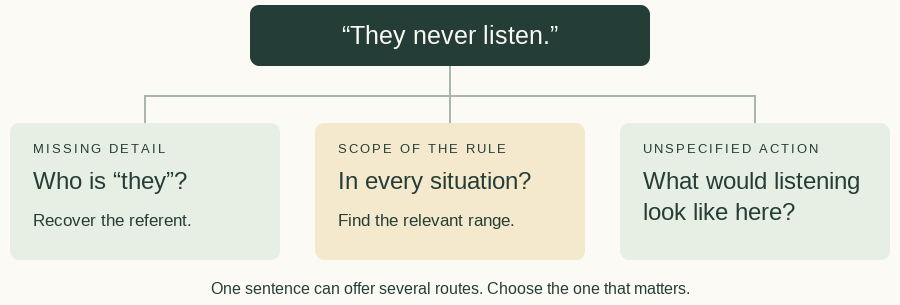
Everyday language compresses experience. Compression helps conversation move; it becomes a problem when a missing distinction changes what you believe or what you can do. A useful question brings that distinction back into view.
Overview: the three broad categories
The Meta Model organizes its questions around three broad processes. Deletion leaves something out; generalization extends a pattern or rule; distortion shapes experience through an inferred connection or meaning. Each calls for a different kind of clarification. INLPTA overview
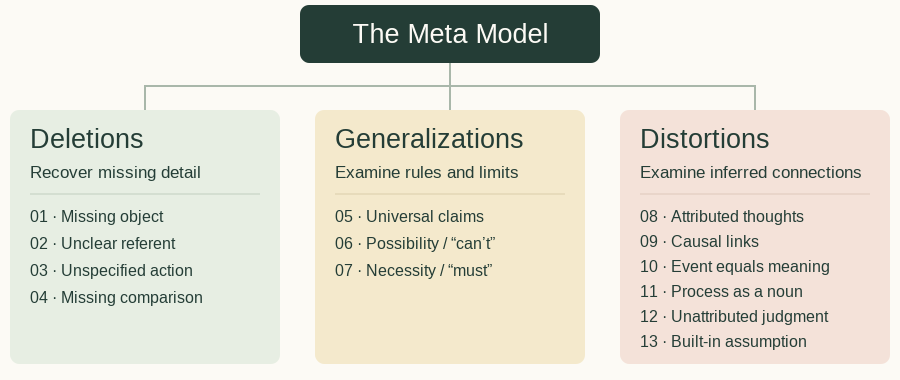
Deletions: something is left out
“They rejected it” leaves the people and the proposal unspecified. That may be enough if both speakers know the context. If you do not, ask “Who rejected which proposal?” The question restores information needed to understand the event. Deletion is about the detail you still need.
Generalizations: a pattern becomes a rule
“They reject every proposal” extends the claim across a set of occasions. Ask “Which proposals have they rejected? Have any been accepted?” You are examining the rule’s reach. The answer may reveal conditions or exceptions, or confirm a consistent pattern.
Distortions: a connection shapes the meaning
“They rejected my proposal, so they don’t respect me” links a decision to a conclusion about respect. Ask “What about the response leads you to that conclusion?” The purpose is to understand the link and its evidence. The context may support the interpretation.
All three processes are ordinary features of language and thought. A sentence can contain more than one. Start with the category that helps clarify the concern, then choose a specific question.
Deletions: recover the missing detail
In the model’s terminology, deletion means information has been left out. You may need a person, an action, an object, or a comparison to understand the claim. Supply these from the speaker’s account, rather than silently filling them in yourself. Hoag’s pattern inventory
1. Find what is missing
Conventional term: simple deletion
“I’m disappointed.” The feeling is clear; its object is missing.
“What are you disappointed about?”
The answer might concern a missed opportunity, someone’s behavior, or a gap between expectation and reality. Each suggests a different conversation. If the person needs company first, acknowledge the disappointment before asking for detail.
2. Identify the people or things
Conventional term: unspecified referential index
“They’ve decided I’m unreliable.” The pronoun leaves you guessing who has formed that view.
“Who are you referring to?”
Perhaps one client questioned a deadline; perhaps several managers gave formal feedback. Clarifying the referent prevents the listener from imagining an entire organization where the speaker means one person.
3. Describe the action
Conventional term: unspecified verb
“She undermined my presentation.” The verb can cover many behaviors.
“What did she say or do during the presentation?”
Interrupting repeatedly, asking a necessary question, and contradicting an agreed figure call for different responses. A concrete account helps establish what happened. It does not require the person to withdraw their judgment that it was undermining.
4. Restore the comparison
Conventional term: comparative deletion
“This proposal is better.” Better than which alternative, and against which criterion?
“Better than what, and in what respect?”
One proposal may be cheaper to start but slower to maintain. Once the comparison and criterion are explicit, people can disagree about the actual tradeoff instead of using the same adjective for different priorities.
Generalizations: examine the rule and its reach
Generalization carries a conclusion beyond one instance. It helps us learn and make rules, but a rule may be applied too broadly. These questions investigate its range, source, and conditions. They may confirm that the constraint is real. INLPTA overview
5. Check the range
Conventional term: universal quantifiers
“Every discussion ends in an argument.” Words such as every, always, and never extend a claim across a whole set.
“Which discussions does this happen in? Are any different?”
Maybe arguments cluster around money and occur when both people are tired. That narrower pattern suggests a different time or setting. One calm conversation does not cancel a persistent problem: an exception helps locate the pattern’s boundaries.
6. Investigate “can’t”
Conventional term: modal operators of possibility
“I can’t ask for a different deadline.” The sentence leaves the nature of the limitation open.
“What makes asking difficult or impossible here?”
The answer may be a contract, a feared reaction, lack of authority, or a previous refusal. Asking is not always available or safe. The useful result is a clearer account of the obstacle and, where possible, what would need to change.
7. Investigate “must”
Conventional term: modal operators of necessity
“I must answer every message immediately.” A requirement is present; its source and consequences remain unclear.
“What requires an immediate reply? What happens if you wait?”
A genuine emergency duty differs from a preference, a team convention, or an assumption about being liked. Clarifying the requirement can reveal room for a response window. It can also show that staffing or expectations need to change.
Listen for the kind of limit. An obligation, a prediction, a preference, and a physical barrier may sound similar in casual speech. Understanding which one is present changes the available response.
A word is a clue, not a diagnosis. “I can’t lift that box” may be a complete and accurate description of a present limitation.
Distortions: make the inference visible
Distortion is the tradition’s broad label for ways experience is represented through inferred relationships and meanings. The term can sound accusatory. Here it is an invitation to check how a conclusion follows, while keeping the observation and its impact in view. Hoag’s pattern inventory
8. Check attributed thoughts
Conventional term: mind reading
“My manager thinks I’m incompetent.” You have a claim about someone else’s judgment.
“What have they said or done that leads you to that conclusion?”
An explicit comment, a formal review, and an unanswered email have different evidential weight. If the manager said it directly, accept that information. If the view is inferred, consider what could confirm it without pretending you already know the manager’s mind.
9. Unpack the causal link
Conventional term: cause and effect
“Last-minute changes make us miss deadlines.” This links one event to another.
“How do the changes lead to the delay? Which part gets held up?”
The link may run through rework, approvals, or a missing buffer. Understanding the pathway helps choose an intervention. This question should never erase responsibility: another person’s threats or harmful behavior can have real effects.
10. Separate an event from its meaning
Conventional term: complex equivalence
“She disagreed with my proposal, so she doesn’t respect me.” An event is treated as proof of a larger meaning.
“What makes disagreement a sign of disrespect in this case?”
Someone can disagree respectfully. They can also disagree through ridicule or exclusion. Look at the behavior and context before deciding what the event demonstrates.

Distortions: bring abstractions back to earth
11. Recover the ongoing process
Conventional term: nominalization
“There’s no trust in this team.” A process of trusting has become a noun that can sound like a fixed object.
“Who needs to be able to rely on whom, and for what?”
A team might rely on colleagues to flag a delay early, keep a confidence, or check a figure before sharing it. “More trust” becomes easier to discuss when the people and behaviors are visible. Abstract nouns are useful; recover the process when the abstraction prevents a practical conversation. Lewis, 2012
If two people use “trust” differently, the clarification may reveal a real disagreement about expectations. A more precise description does not automatically settle that disagreement.
12. Locate the judgment and criterion
Conventional term: lost performative
“It’s unprofessional to ask for help.” An evaluation is presented without its source or standard.
“Whose standard is that? What makes asking unprofessional here?”
Perhaps the speaker absorbed an old workplace norm. Perhaps the issue is how a request is made or when it interrupts someone. Locating the criterion lets people examine the standard instead of accepting an unattributed verdict. Richardson’s teaching map
A standard can remain justified after its source is made explicit. Safety requirements and commitments deserve examination on their merits; finding an author does not invalidate them.
13. Surface the built-in assumption
Conventional term: presuppositions
“When will you stop ignoring my messages?” The question takes it for granted that messages are being ignored.
“Which messages haven’t had a reply? Can we check what happened?”
Replying only with a date would accept the premise. Clarifying the messages creates room to distinguish unread messages, a different response expectation, deliberate avoidance, or another explanation. The answer may confirm the premise. Hoag on presuppositions
Presuppositions are common features of language. Their presence does not establish manipulation. The question is whether an assumption matters and whether it has been established. These linguistic assumptions are also distinct from NLP’s general philosophical “presuppositions.”
About the map. Manuals group and count these patterns differently. This article uses thirteen teaching distinctions, separates “can’t” from “must,” and places assumptions with inferred meanings. The grouping is a practical aid, not a definitive taxonomy.
From a verdict to an addressable issue
“They never take my ideas seriously. There’s no point speaking in meetings.”
A listener could immediately look for an exception to “never.” But that may feel like arguing with the speaker’s experience. Start by understanding what the concern refers to.
Listener: “That sounds discouraging. What happened in the last meeting?”
Speaker: “I suggested changing the handover. Jo moved to the next item without discussing it.”
Listener: “What would taking it seriously have looked like?”
Speaker: “Asking a question, or saying why we couldn’t do it. I don’t need everyone to agree.”
Listener: “Does this happen with all your suggestions, or mainly in these meetings?”
Speaker: “Mainly in the weekly meeting. Jo used one of my suggestions in a smaller planning session.”
Listener: “So the issue may be how suggestions are handled in the weekly meeting. Does that describe it?”
Speaker: “Yes. I’d like a clear way to get a response, even if the answer is no.”
The first question recovered an incident. The second made “seriously” observable. The third examined the range of the generalization. The final statement checked the listener’s understanding instead of announcing a diagnosis.
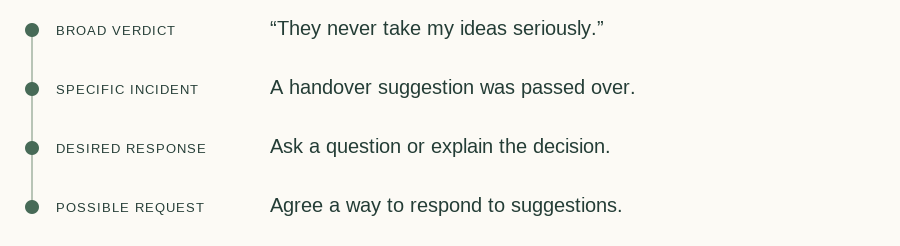
The outcome is a testable issue: how suggestions receive a response in a particular meeting. A next step could be a request to Jo, an agenda change, or observation of the next meeting. None has been carried out simply by discussing it.
If the answer had confirmed the concern: suppose the speaker described repeated dismissive comments across several settings. The listener should update accordingly. The next conversation may concern documenting the pattern, seeking support, or setting a boundary.
Sometimes the limit is real
Sam says, “I can’t finish this by Friday.” A literal-minded listener might respond, “What would happen if you could?” That skips the work and the deadline. A useful question investigates the obstacle.
Listener: “What is still needed, and what blocks it?”
Sam: “I need a legal sign-off. The reviewer is away until Monday.”
Listener: “Is there an approved alternative reviewer?”
Sam: “No. But I can finish the analysis by Friday and mark the sign-off as pending.”
Sam’s original statement correctly described the full deliverable. Clarification separated the blocked component from the part that could proceed. The resulting action is to negotiate scope and communicate the dependency.
If the analysis were also impossible by Friday, the conclusion should remain impossible under the current conditions. Better language can clarify a constraint; it cannot create time, authority, access, or safety.
Choose the question by its purpose
When you cannot picture what happened
Recover one concrete incident: “What happened most recently?” Then clarify the relevant person or action.
When a rule closes every route
Explore its source and range: “What makes this a requirement?” or “Under what conditions would it be different?”
When a conclusion outruns the evidence
Ask for the bridge: “What leads you from that event to that conclusion?” Remain open to a well-supported answer.
When precision changes nothing
Stop. If more detail will not affect understanding, a decision, or the next step, another question may only add burden.
Listen → acknowledge → ask → check. Listen to the whole account. Acknowledge its impact. Ask one relevant question. Check that your understanding fits the answer. Classification happens in the background.
The order is flexible. Someone who is distressed may need to be heard before exploring details. In a planning meeting, both people may want direct questions immediately. Shared purpose, timing, and tone matter as much as the wording.
Thirteen openings for a useful question
Use these as prompts to adapt. Ordinary conversation rarely needs the technical labels spoken aloud.
| What you notice | Example | A possible question |
|---|---|---|
| Deletion / Recover detail | ||
| 01 · Missing object | “I’m disappointed.” | “About what?” |
| 02 · Unclear referent | “They don’t approve.” | “Who are you referring to?” |
| 03 · Unspecified action | “She undermined me.” | “What did she say or do?” |
| 04 · Missing comparison | “This is better.” | “Better than what, in which respect?” |
| Generalization / Examine rules and limits | ||
| 05 · Universal claim | “Every meeting goes badly.” | “Which meetings? Are any different?” |
| 06 · “Can’t” | “I can’t ask.” | “What makes asking difficult or impossible?” |
| 07 · “Must” | “I must reply now.” | “What requires that? What happens if you wait?” |
| Distortion / Examine inferred relationships and meanings | ||
| 08 · Attributed thoughts | “They think I’m incapable.” | “What leads you to that conclusion?” |
| 09 · Causal link | “Changes cause delays.” | “How do the changes produce the delay?” |
| 10 · Event equals meaning | “Disagreement means disrespect.” | “What makes it disrespectful in this case?” |
| 11 · Process as a noun | “There’s no trust.” | “Who needs to rely on whom, for what?” |
| 12 · Unattributed judgment | “Asking is unprofessional.” | “By whose standard? Based on what?” |
| 13 · Built-in assumption | “When will you stop ignoring me?” | “Which messages haven’t had a reply?” |
One statement, several possibilities
“Everyone knows I’m bad at leadership” contains a universal claim, an attribution of knowledge to others, and a vague evaluation. You could ask who has given feedback, what happened in one incident, or which leadership behavior needs attention.
Choose the question with the greatest relevance to the person’s concern. Collecting every possible label can make an ordinary conversation exhausting.
A good answer can confirm the original claim. The goal is an account that fits the available information and supports a proportionate response.
Precision needs judgment
Question the distinction that matters. Correcting every “always” and demanding examples for every feeling can turn curiosity into cross-examination. “That sounds painful; would it help to look at what happened?” may be a better opening than a technically exact challenge.
Keep context and responsibility visible. A person describing exclusion does not have to prove every incident to deserve support. Questions about meaning should not be used to dismiss harm, move responsibility onto the person affected, or pressure someone to lower a boundary.
Treat answers as reports, then verify where needed. A fuller description may still be mistaken, incomplete, or contested. Clarification does not establish truth. Decisions about contracts, safety, employment, or health may need records, expertise, or other evidence.
Keep the historical theory in context. Early explanations used transformational grammar and “surface” and “deep” structure. This article uses the practical questioning distinctions without assuming that a sentence gives access to a complete hidden representation of experience. The historical linguistic account has been revised and debated. Lewis, 2012
Separate teaching tradition from effectiveness. The sources document how practitioners describe the model. A 2012 systematic review found limited, low-quality evidence for NLP interventions on health outcomes. It excluded studies of individual NLP techniques, so it does not establish whether these particular question types are effective. This article makes no treatment claims. Sturt et al., 2012
Clarify what works, too
“The workshop went brilliantly” can be worth unpacking. “What happened that made it work so well?” might reveal that participants saw an example before receiving instructions. “Which groups did that help?” could show where the approach transfers and where it needs adapting. The same questions can make a successful practice easier to explain and repeat.
Optional practice: make one sentence more workable
The accompanying self-guided practice takes about 8-12 minutes. Begin with one everyday statement, then say why the situation matters to you: what worries you, affects you, or needs attention. Next, choose what you want to understand and pick one question from a short list, or write your own. You then answer it from a concrete example, write a more specific account, and consider a proportionate next step. You can use the practice without knowing the technical categories.
You can leave at the category choice, finish without choosing an action, or stop at any time. Answers remain in memory unless you explicitly save the run to your workspace.
Related patterns
- Chunk Down recovers the concrete details within a broad description.
- Look for the Exception examines where a generalization does and does not apply.
- Inspect How You Know explores the basis of a conclusion.
- Redefine the Terms examines a label after its underlying examples are clearer.
Sources and attribution
The following sources document the model's history and teaching vocabulary. All conversations, question examples, diagrams, and practice steps in this article are original. The practical cautions and sequencing advice are this article's editorial synthesis.
-
Bandler & Grinder (1975), The Structure of Magic I. Historical origin, identified in the ANLP-hosted workshop by Fiona Campbell. The original book was not directly consulted.
-
John David Hoag, The NLP Meta Model. Terminology and pattern inventory. Hoag includes later extensions; this article selects a core teaching set.
-
INLPTA, Metamodel of language. The three families, their useful everyday functions, and variations in grouping.
-
Byron Lewis (2012), The Magic of NLP Demystified, second edition, publisher's excerpt. Printed pages 80-85: historical grammar framing and pattern organization. Practitioner claims are not treated as established science.
-
Alan Richardson, NLP for Testers. A teaching map including lost performatives and the other core distinctions.
-
John David Hoag, Presuppositions. Linguistic assumptions and their distinction from NLP’s general presuppositions.
-
Sturt et al. (2012), Neurolinguistic programming: a systematic review of the effects on health outcomes. British Journal of General Practice, 62, e757-e764.