
Finding a different experience inside familiar work.
“You repair bikes for a living,” Nina’s partner says. “And this is what you want to do on holiday?”
For the next two hours, yes.
Nina has found a community repair workshop near where they are staying. She asks the coordinator whether an experienced mechanic would be useful.
“Punctures, mainly. And let people do as much as they want themselves.”
Soon Nina is working beside a teenager learning to replace an inner tube. Another volunteer shows her an ingenious repair stand built from discarded timber.
There are no customer appointments to juggle. She enjoys the familiar work and the unfamiliar company.
At the agreed finishing time, she puts the tools away. The coordinator asks whether she will return tomorrow.
“Not this visit,” she says. “But I’ve enjoyed today.”
They thank each other. Nina rejoins her partner for lunch, pleased to have spent part of her holiday doing something that usually counts as work.
The core pattern
“Busman’s Holiday” opens the “Good Games” chapter of Eric Berne’s Games People Play (1964). He describes people using their occupational skills while away from ordinary work—for example, a mail carrier helping a counterpart abroad or a specialist contributing in another hospital. He suggests that such activity can be refreshing and socially constructive. Berne’s description
There is an important qualification: Berne explicitly calls it a pastime rather than a game, unless the work becomes secondary to an ulterior purpose and is undertaken as a show. Even then, he emphasizes its potentially constructive contribution. Full entry
In transactional analysis, a game involves more than an enjoyable activity or personal reward. The ITAA’s later Core Concepts summary describes recurring covert exchanges with a payoff. Enjoying recognition, learning something, or making friends does not by itself establish such an exchange. ITAA, “Games”
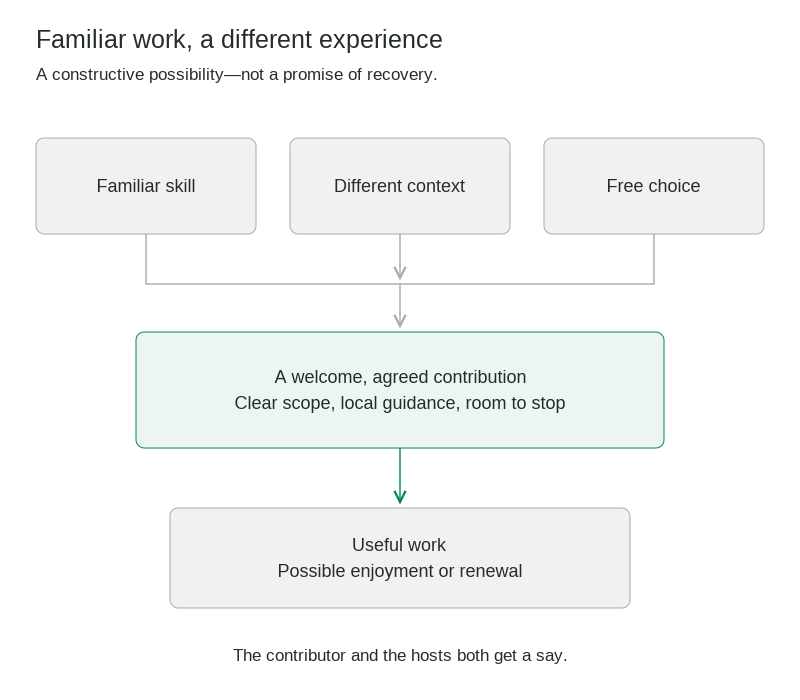
For Patternverse, the useful possibility is straightforward: a familiar skill can feel different when its purpose, setting, relationships, and degree of choice change.
What makes the experience different
Nina is still finding punctures and handling tools. Much of the physical activity resembles her working day.
What has changed is the arrangement around it.
She chose a short contribution. The workshop wanted that contribution. She works within its way of doing things, meets people through a shared activity, and remains free to finish.
As a Patternverse explanation of this fictional encounter, her pleasure might come from practicing the craft without some of its usual pressures. She can also be useful without being responsible for the entire operation. Learning from another volunteer gives her a different position from the expert expected to have every answer.
Those possibilities are not universal mechanisms. Someone else might find the same workshop tiring, socially demanding, or too similar to work.
The constructive sequence is an offer, an invitation, an agreed contribution, and a satisfactory ending. It does not require escalating obligations or a dramatic reversal. Its continuation may simply mean that people would welcome working together again.
Cultivating the constructive form
Berne supplies no separate antithesis for this entry. There is no reason to invent a problem that everyone must escape.
The suggestions below are original Patternverse adaptations for making participation useful and sustainable. They are not validated treatments or Berne’s established prescriptions.
Let the hosts define what would help
Occupational competence does not automatically reveal what another setting needs.
During a visit to friends, software developer Arun offers to help their small arts festival. He proposes an online booking system.
The organizer hesitates. “We’ve already printed the tickets. Our problem is that volunteers can’t find the information they need.”
Arun initially explains how much easier his system would make things. Then he notices that he is defending an interesting project rather than listening.
“What would be useful before Saturday?”
Together they simplify the existing volunteer spreadsheet and prepare a clear handover sheet. It is less technically exciting than his proposal, but the organizer can use it immediately.
Arun enjoys solving a contained problem. He also leaves with a more accurate understanding of the festival’s work. The revision matters more than the sophistication of the original offer.
Make the contribution specific
“I can help” can mean very different things to different people.
Nina’s two-hour arrangement tells the workshop what it can rely on. It also lets her partner know when they will meet again.
Natural language can be simple:
“I’d enjoy joining you for the morning. What could I reasonably finish in that time?”
Or:
“I can show you how this works today. I won’t be available to maintain it afterward.”
Specificity protects the usefulness of the offer. A generous contribution can become a burden if it leaves others depending on support that was never agreed.
Keep learning reciprocal
A visitor may bring expertise while needing guidance about materials, routines, language, relationships, or local constraints.
Nina knows bicycle mechanics. The coordinator knows how the workshop involves participants and manages its limited equipment. Respecting that knowledge makes the exchange more collaborative.
This is especially important when differences in money, professional status, or nationality make it difficult for hosts to contradict a visitor.
The question is not whether the visitor feels helpful. It is whether the contribution is welcome and useful on terms the hosts can influence.
Allow a complete ending
A satisfying afternoon need not become a standing commitment.
If the coordinator is disappointed that Nina cannot return, she can acknowledge that without extending her offer: “I understand another pair of hands would help. Today is what I can offer.”
Over time, someone repeatedly choosing this kind of holiday might consider what they enjoy about it. They may love the craft, value companionship, or appreciate contributing outside their usual hierarchy. Those are understandable reasons.
If being needed starts to feel compulsory, the arrangement deserves reconsideration. That inquiry need not become an accusation about hidden motives.
When similar activity means something else
Jin is on annual leave when colleagues repeatedly contact her about routine accounting problems.
She answers the first message because it seems quick. By the third afternoon, she has spent several hours working. Her manager praises her dedication and starts sending requests directly.
Jin is doing familiar work away from the office, but she is not having Nina’s experience. She feels that declining will count against her. The work has followed her into leave.
Calling this a “Busman’s Holiday” could conceal the loss of choice. Jin explains that she will be unavailable and asks for requests to go through the agreed cover arrangement. Her manager remains unhappy; the boundary does not produce instant cooperation.
For comparison, the International Labour Organization’s definition of volunteer work includes its non-compulsory character. That distinction does not resolve Jin’s employment situation, but it helps explain why unpaid activity and freely chosen contribution are different questions. ILO, “Volunteer work”
Where the interpretation can mislead
The historical heading “Good Games” does not guarantee that an activity is beneficial.
A visitor might prioritize photographs, gratitude, influence, or personal adventure over the work hosts actually need. Equally, visible enjoyment or taking photographs does not establish a concealed agenda. Examine agreements and consequences before interpreting motives.
Berne’s international examples also require care. Professional status does not erase local knowledge, and benevolent intentions do not establish competence in a new setting. In clinical or other sensitive work, the people receiving a service retain their own interests, choices, and protections.
Nor should this entry become a recommendation to make holidays productive. People facing exhaustion, disability, financial pressure, or substantial caring responsibilities may need their available time for rest. Contributing more is not a measure of generosity or psychological health.
United Nations Volunteers acknowledges that volunteering can have adverse effects on wellbeing, particularly when people already struggling take on additional roles. Broad volunteering evidence cannot establish that repeating one’s occupation during leave will be restorative. UNV, volunteering and wellbeing
Within TA, contemporary professional ethics emphasizes respect, autonomy, protection, and attention to practitioners’ agendas. Those commitments offer a useful reference point when professional skills travel into other relationships. ITAA Code of Ethics, 2024
Berne’s refreshment claim remains a historical interpretation. The sources cited here do not validate “Busman’s Holiday” as an intervention for burnout or distress.
Connections
Skills-based volunteering. This neighboring concept emphasizes matching existing abilities to a wanted contribution. It need not involve travel or a holiday.
“Happy to Help.” Berne’s neighboring entry also examines constructive action alongside mixed motives. Neither requires pretending that personal satisfaction cancels benefit to others. Berne’s discussion
“I’m Only Trying to Help You.” The distinction becomes useful if a declined offer turns into grievance about others’ ingratitude.
Clear agreements. Scope, authority, support, and an ending make room for both generosity and choice.
Sources and attribution: Historical description and classification: Eric Berne, Games People Play (1964), “Busman’s Holiday.” Later TA context: the ITAA documents linked above. Volunteering context: ILO and UNV. Encounters, practical suggestions, and illustration are original Patternverse adaptations.