
When an explanation becomes a blanket exemption—and the response becomes a contest.
“This is the third time the set list hasn’t arrived,” Maya says. “We needed it before rehearsal.”
Ellis looks away. “You know how chaotic things were growing up. Reliability wasn’t exactly something I learned. What do you expect?”
Maya knows that history matters. She also spent the afternoon reconstructing the missing list.
“Everyone has problems,” she replies.
They argue about whether she understands him. The practical question disappears.
The following week, Maya tries the opposite approach: “Don’t worry. I’ll handle it.”
Ellis feels less judged. Maya avoids another argument. But neither has established what Ellis can realistically undertake, what help he wants, or whether he wants this responsibility at all.
Soon, the same exchange returns. His history becomes the reason nothing can be discussed; her choices seem limited to criticism or taking over.
The core pattern
“Wooden Leg” is the seventh and final entry in the “Consulting Room Games” chapter of Eric Berne’s Games People Play (1964). He describes a plea that a condition or circumstance exempts someone from expectations, extending his account across disability, illness, personal history, and social conditions. Berne’s original description
The historical title is ableist. It associates physical impairment with evasion and should not become a label for a person.
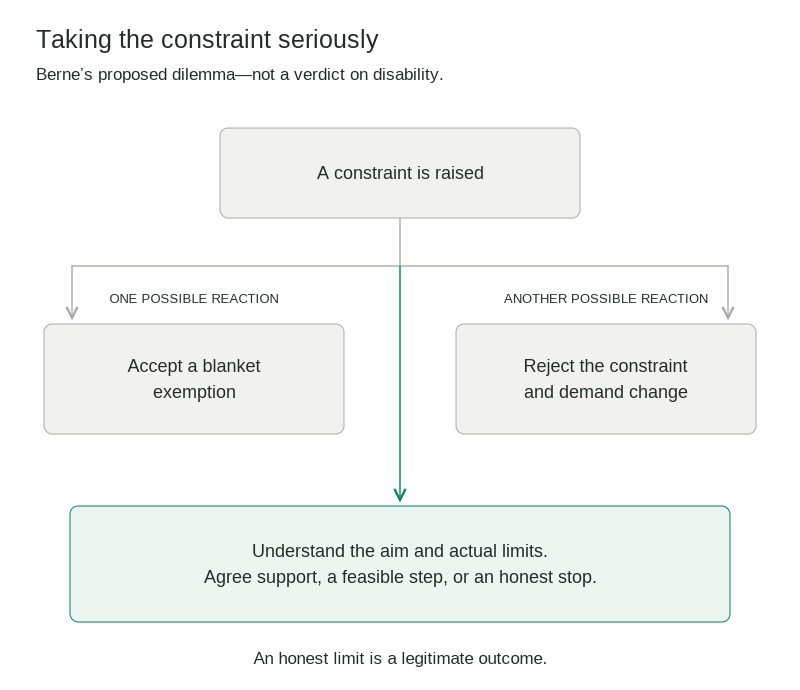
In transactional analysis, a game involves an apparent purpose and a hypothesized psychological function. Here, explaining a difficulty may also invite a familiar response: accept a blanket exemption, or reject it and enter a struggle.
The proposed distinction concerns what is being concluded from a constraint. “I cannot undertake this task” can be a complete and legitimate statement. “Therefore, no agreement, impact, or possible alternative can be discussed” is a broader conclusion worth examining—without assuming it is unjustified.
This framework cannot establish someone’s capacity or hidden motives. Disability, requesting accommodations, declining a task, or needing continuing care is not evidence of a game.
How the exchange sustains itself
In the fictional opening, a missed agreement prompts a question. Ellis invokes his history. Maya disputes its relevance, and the conversation becomes a test of whether she is compassionate.
Later, she takes over. That ends the immediate conflict but leaves the agreement unchanged.
As a Patternverse interpretation, Ellis might be protecting himself from another experience of failure or shame. Maya might gain temporary relief by either asserting standards or doing everything herself. Neither possibility proves that Ellis consciously wants the arrangement to continue.
The longer-term costs are clearer: expectations remain ambiguous, resentment accumulates, and neither person learns what arrangement is feasible.
Roles can shift. The disappointed collaborator becomes an accuser, then a caretaker. The person explaining a difficulty feels alternately disbelieved and relieved of responsibility, without necessarily feeling more understood.
These contributions are not equivalent. A manager, clinician, caregiver, or financially controlling partner may hold much greater power. Someone’s apparent agreement can reflect dependence or fear rather than freely chosen participation.
Berne’s antithesis—and a necessary correction
Berne’s antithesis, or proposed interruption, rejects both indulgent acceptance and a punitive contest of wills. He emphasizes an explicitly shared therapeutic aim, asks what the person expects of themselves, and allows time for an answer. Berne’s antithesis
This is a historical clinical proposal, not a validated solution. Asked impatiently, a question about self-expectation can become another demand to demonstrate capacity.
His account also contrasts disabled people’s limitations with other disabled people’s achievements. Those comparisons cannot establish what a particular person can do. Nor does entering therapy authorize a clinician to treat disability as an excuse. Historical discussion
Later TA criticism directly challenges such applications. Julie Hay argues that actual consequences of biology, circumstances, and victimization must be distinguished from psychological games; she also discusses changing the historical name. This is a corrective within TA, not evidence for a particular intervention. Hay, “Game changing dynamics,” 2022
Openings for change
The following are original Patternverse adaptations, not Berne’s established prescriptions or tested treatments.
Separate the constraint from the disputed agreement
Maya can acknowledge what she does not know:
“I’m not disputing what happened to you. I also don’t understand what makes this task difficult now. Can we discuss that without arguing about your whole history?”
Ellis can make the account more specific:
“I agree because I want to belong. Then I avoid opening the document when I’m afraid I’ll disappoint everyone.”
That disclosure creates information, not proof that the task is easy. He may need support, a different role, or permission to decline.
Revise a response that becomes pressure
Maya initially proposes a reminder system.
“If I text you on Wednesday, that should solve it.”
Ellis feels managed. “You’re still deciding what I ought to be able to do.”
She pauses.
“You’re right that I jumped to a solution. Do you actually want to organize the set list?”
He does not. He wants to play, and accepted the administrative role because he feared appearing unhelpful.
They agree that someone else will coordinate the list. Ellis offers to check one song transition during rehearsal, where he can ask questions immediately.
The new arrangement is smaller and more explicit. It does not resolve the effects of his childhood. It removes an agreement neither person was handling honestly.
Express a need without claiming total exemption
A person can describe a limit directly:
“I can’t commit to that reliably. Please plan without me.”
Or, where uncertainty remains:
“I want to contribute, but I don’t yet know what is manageable.”
Others can state their own limits:
“I can’t keep making plans that depend on this being finished. We need another arrangement.”
This is a boundary around participation. It need not be a verdict about character, deservingness, or whether the explanation is sufficiently serious.
Examine the recurring difficulty over time
If similar exchanges recur, useful inquiry may concern fear of disappointing others, inaccessible arrangements, coercive expectations, or difficulty recognizing and communicating limits.
Professional support may help clarify those questions. Assessment and practical assistance may matter more than interpretation.
When another person declines discussion, nobody can compel insight. A collaborator can stop relying on a disputed commitment. A recipient can seek advocacy or reconsider a relationship. Essential care and accommodations should not become rewards for accepting a psychological explanation.
When a broad limit is real
Priya has ME/CFS. She declines a weekend visit and says she cannot promise when she will manage another.
Her brother remembers a photograph of her outside a café. “You managed that. Surely you can manage lunch with us.”
Priya explains that the outing was brief and followed by worsening symptoms. She does not have spare capacity to demonstrate her limits repeatedly.
Her refusal is not evidence of “Wooden Leg.” NHS guidance describes post-exertional worsening after physical or mental activity, sometimes delayed by hours or days. Observing an activity does not reveal its later cost. NHS, ME/CFS symptoms
Her brother stops pressing for a visit. He offers contact on her terms, which may sometimes mean no contact while she rests.
The useful response is acceptance of a constraint. There need not be a hidden feasible step waiting to be discovered.
Pitfalls and limits
The most consequential misuse is treating a plausible explanation as an excuse whenever someone dislikes its consequences. Pain, cognitive difficulty, trauma, discrimination, poverty, and coercion can sharply restrict action.
The reverse mistake is assuming that acknowledging a cause settles every question about impact. Someone harmed by another person may still need protection, distance, or repair. They do not have to remain available while the other person works on changing.
Do not use this model to suggest that victims invite abuse or that a diagnosis makes someone manipulative. Accountability also does not mean demanding abilities a person lacks.
Contemporary ITAA ethics emphasizes dignity across differences in functioning and circumstances, alongside protection and autonomy. Those commitments should constrain any interpretation drawn from this entry. ITAA Code of Ethics, 2024
The cited sources do not establish a reliable diagnostic test for this game or effectiveness for these adaptations. General evidence about TA would not establish either claim.
Connections
“Stupid.” That interpretation centers on eliciting confirmation of a negative identity. “Wooden Leg” centers on the expectations said to follow from a condition or circumstance.
“I’m Only Trying to Help You.” Taking over can become invested in preserving the helper’s role, rather than understanding what assistance is wanted.
Explanation, capacity, and accountability. These are related questions, not interchangeable answers. Understanding causes should inform realistic expectations.
Explicit agreements. Clear limits, support, and stopping points can replace recurring arguments about what someone should be able to do.
Sources and attribution: Historical account and antithesis: Eric Berne, Games People Play (1964), “Wooden Leg.” Later TA context: Julie Hay (2022) and the ITAA ethics code. Medical context: NHS guidance. Encounters, practical responses, and illustration are original Patternverse adaptations.