
Keep a financial obligation from becoming a recurring contest over who is the wronged person.
Owen owes Sana money. Twice he has promised to repay it at the end of the month. Twice the date has passed without payment or explanation.
Sana begins sending reminders. Owen leaves them unanswered. Eventually, she writes, “You seem to have money for everything except paying me back.”
Now Owen responds immediately. He objects to her tone, recalls occasions when he helped her, and says she has made their friendship transactional. Sana starts assembling evidence of his ingratitude.
By the end of the evening, both have a detailed account of the other’s character. Neither has said what can happen about the outstanding money.
The core pattern
Debtor appears among the “Life Games” in Eric Berne’s Games People Play. He describes both a broader life script organized around owing money and a sharper interpersonal game called Try and Collect. In his interpretation, the latter offers two outcomes: avoiding payment when pursuit stops, or using escalating collection pressure to confirm that creditors are grasping and hostile. He also names a corresponding creditor game, Try and Get Away With It. Berne’s account
The distinctive movement is the shift from an obligation to a contest over moral standing. What began as a question about money becomes an occasion to establish who is greedy, irresponsible, exploited, or ungrateful.
This interpretation may be useful when a recognizable collection conflict repeats. Debt, late payment, embarrassment, or anger alone does not establish a game. A person may lack money, dispute the amount, misunderstand the agreement, or be responding to genuinely abusive collection practices.
The useful question is: Are we clarifying the financial situation, or repeatedly using the dispute to establish something about each other?
How the interaction sustains itself
Consider the sequence in the opening encounter:
Payment is expected → communication is avoided → reminders intensify → the pressure becomes personal → the argument shifts to character.
That sequence describes observable events. Its underlying functions remain open to inquiry.
For Owen, leaving a message unanswered may postpone an uncomfortable admission. Making another optimistic promise may briefly restore his image as a dependable friend. Once Sana’s message becomes accusatory, defending himself offers a more immediate task than explaining his finances.
For Sana, increasingly forceful reminders may feel like the only remaining way to be taken seriously. Gathering evidence of Owen’s spending may bring temporary certainty: she can explain why she is angry. Yet the exchange increasingly consumes the friendship without clarifying repayment.
These are possibilities illustrated by a fictional encounter, not findings about either person’s unconscious motives.
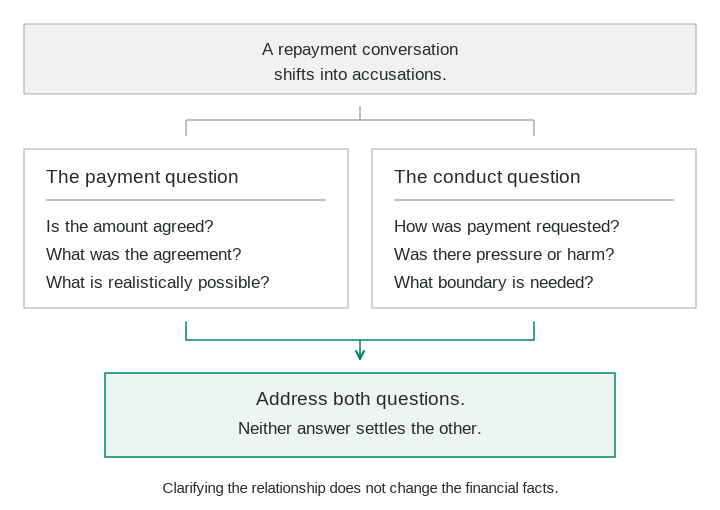
The shift can also conceal two legitimate problems. Money may genuinely be owed, and the method of requesting it may genuinely be harmful. Recognizing one does not settle the other.
Later TA summaries emphasize explicit agreements about desired outcomes in therapeutic work. That provides a neighboring principle for examining unclear expectations; it does not establish the validity of a particular “Debtor” interpretation. ITAA: Core Concepts
Openings for change
Berne proposed immediate cash payment as an antithesis to the borrowing-and-pursuit arrangement, and promptness and honesty for the creditor counterpart. These are historical suggestions, not evidence-based remedies for financial hardship. Preventing a credit arrangement cannot resolve an existing inability to pay. Original discussion
The following are Patternverse adaptations for discussing obligations and relationships.
Separate the account from the accusation. Establish what is agreed, what is disputed, and what remains unknown. A lender can state an amount and the original arrangement without asserting that the borrower never cared. A borrower can acknowledge an agreed obligation without accepting humiliating treatment.
Address conduct directly. It is possible to say:
“I understand that you want the money repaid. I also want us to stop discussing this through insults. Can we address the payment question separately?”
The other person may decline. A boundary does not depend on persuading them that the interaction is a game.
Replace reassurance with a realistic account. Another promise can briefly soothe the relationship while postponing the same difficulty. Where repayment is possible, the relevant information includes available resources, competing essentials, timing, and what happens if circumstances change.
MoneyHelper recommends realistic repayment arrangements, written records, and early communication about difficulties. These are practical safeguards, not psychological tests. MoneyHelper: Borrowing from or Lending to Family
Clarify the kind of arrangement. A gift, a loan, and an exchange of services carry different expectations. Discussing those expectations can expose an assumption that neither person had stated. The U.S. Consumer Financial Protection Bureau recommends clarifying what is being provided, repayment expectations, review points, and when the arrangement will be considered complete. CFPB: Family Lending and Borrowing
Someone can also decline further lending, limit the communication they will participate in, or seek independent advice. None of those choices guarantees repayment or repairs trust.
What this looks like in practice
Returning to the unresolved agreement
Sana initially tries to end the argument by asking Owen to admit that he has been selfish. Owen responds with another account of everything she has misunderstood.
Later, Sana changes her request: “My message about your spending was accusatory. I still need us to address the money. Do you agree about the amount outstanding?”
Owen agrees. He admits that he cannot make the repayment he promised and was embarrassed to say so. They discuss a smaller arrangement that he believes he can maintain and put it in writing. Sana decides not to lend more while the balance remains outstanding.
Trust has not been restored by this conversation. The change is narrower: an acknowledgment replaces avoidance, and a specific arrangement replaces competing judgments. If Owen cannot maintain it, they will still face a real financial problem.
When there is no money to negotiate with
Leila falls behind after her paid working hours are reduced. A relative interprets each missed payment as evidence that she is “playing Debtor.”
Reviewing her income and essential expenses reveals that even the proposed reduced payment is unaffordable. Asking for a more sincere commitment cannot create the missing income.
The relative’s own need for repayment also matters. They seek debt advice and discuss what can be paused or reconsidered. The advice may involve options outside the relationship, rather than another informal promise.
Their distress does not demonstrate a concealed payoff. In formal collection situations, verifying the claim and assessing a genuinely affordable proposal are practical starting points; the applicable rights and procedures depend on location. CFPB guidance on collection negotiations
When owing has become a source of direction
After years of repayment, Arun clears his final personal loan. He expects uncomplicated relief but finds his evenings strangely empty. So much of his effort has been organized around earning enough and watching the balance fall.
He starts considering another expensive commitment. In conversation, he notices that the new obligation would give him a familiar reason to keep pushing himself.
He does not conclude that his earlier financial difficulties were secretly desired. Instead, he begins considering what he wants his effort to serve now: more time with friends, learning a craft, or building a reserve.
This fictional example explores Berne’s broader script idea. It does not show that taking on debt is inherently pathological or that an uneasy response to becoming debt-free confirms his theory.
Pitfalls and limits
Poverty is not a psychological game. Neither are inaccessible benefits, disability-related costs, insecure employment, disputed invoices, or predatory lending.
Berne’s opening discussion includes colonial comparisons and gendered assumptions that offer no dependable basis for judging borrowers. The article’s useful distinction concerns a recurring interaction, not a type of person.
A lender has no entitlement to humiliation or control simply because money is owed. A borrower’s objection to mistreatment should be assessed on its merits. Conversely, an unpleasant reminder does not by itself settle an otherwise valid obligation.
Where threats, coercion, housing insecurity, or formal proceedings are involved, independent local support may matter more than a direct conversation. Do not ignore deadlines or surrender rights while trying to understand the relationship.
This interpretation cannot determine whether a debt is legally enforceable, what someone can afford, or why they have not paid. The proposed responses are educational adaptations, not a validated treatment or a substitute for debt advice.
Connections
Now I’ve Got You… examines how a specific breach can become an opportunity for a wider attack.
Courtroom concerns recruiting another person to pronounce who is right; debt disputes can develop that additional layer.
Proposed companion patterns include Make the Agreement Explicit and Separate Obligation from Identity. The first clarifies expectations; the second allows a financial difficulty to remain specific rather than becoming a verdict on someone’s worth.
Sources and attribution
Historical interpretation: Eric Berne, Games People Play (1964), “Debtor.” Later TA context: ITAA’s Core Concepts. Practical financial context: MoneyHelper and the U.S. Consumer Financial Protection Bureau; their jurisdiction-specific guidance should be read accordingly.
The encounters, suggested language, and illustration are original Patternverse adaptations. No claim is made that recognizing the game reliably resolves debt or relationship conflict.