
When sharing feelings becomes an exhibition—and curiosity loses its place.
“I think I’m finally in contact with my anger,” Nia says.
She is a recently qualified therapist attending a therapy group of her own. Speaking openly feels risky; she spends much of her working week helping other people make sense of themselves.
Another member nods. “There’s something powerful about how fully you’re allowing it.”
Nia describes the anger’s intensity. Several people thank her for bringing it into the room.
Marcus asks, “Is any of it about me looking at the clock earlier?”
Nia stiffens. “Could we stay with the feeling instead of analyzing it?”
The group’s therapist, Lena, lets the question drop. Everyone becomes careful again.
Over several weeks, similar exchanges recur. Feelings receive respectful attention, but attempts to explore what is happening between people are repeatedly set aside. Nia feels recognized. Marcus becomes quieter. Their tension remains.
The core pattern
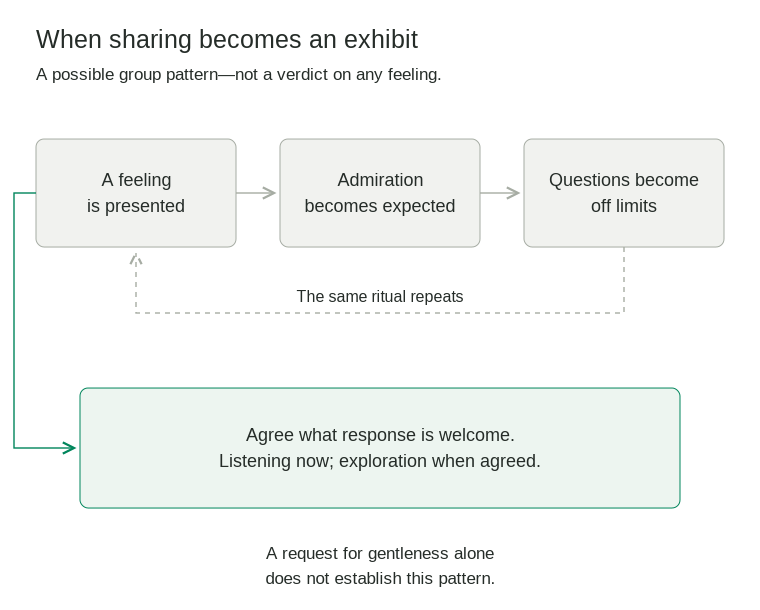
“Greenhouse” is the first entry in the “Consulting Room Games” chapter of Eric Berne’s Games People Play (1964). He particularly describes psychologically trained people participating in therapy groups: a feeling is ceremoniously presented, others respond appreciatively, and questioning may be treated as an intrusion. The greenhouse metaphor suggests something carefully cultivated under special conditions. Berne’s original description
In transactional analysis, a game involves a recurring interaction with an apparent purpose and a less explicit psychological outcome. That framework is interpretive; noticing repetition does not establish anyone’s hidden intention.
Here, the apparent purpose is emotional openness. Berne’s hypothesis is that restrictive rules around emotional expression can actually protect participants from intimacy. Games People Play, “Greenhouse”
The feeling need not be false. Someone can be genuinely angry, frightened, or moved while participating in an exchange that leaves little room for another person’s experience.
Recognizing the possibility becomes useful when a group repeatedly celebrates disclosure while struggling to discuss its relationships. One request for uninterrupted listening does not establish this pattern.
How the interaction sustains itself
In the fictional group, the opening move is an announcement of important emotional material. Others respond by appreciating its depth or authenticity. This may provide welcome recognition, particularly for someone accustomed to hiding distress.
The difficulty appears when appreciation becomes the only acceptable response.
A question about circumstances, meaning, or interpersonal impact is received as damage to the disclosure. The questioner retreats or apologizes. The group returns to respectful witnessing, and the same arrangement remains available next time.
As a Patternverse interpretation, several functions are worth considering. Presenting a feeling might feel safer than directly addressing someone. Admiring another person’s disclosure might protect a listener from disagreement. A facilitator might welcome the atmosphere because the group appears engaged.
These are possibilities to investigate, not explanations established by solemn language or visible emotion.
The costs can also be concrete: a misunderstood interaction remains unresolved; members stop offering honest responses; someone who feels little or cannot name it eloquently begins to feel inadequate. Emotional expression becomes something to perform correctly.
Responsibility is unequal. A therapist has greater authority over the group’s conditions and a professional responsibility to examine how those conditions are affecting participants.
Berne’s response—and a later corrective
Berne does give “Greenhouse” an explicit antithesis: an intervention intended to interrupt the game. He proposes well-timed irony or skepticism, directed at the teaching and cultural conventions surrounding emotional display rather than at patients themselves. His hope is that participants become less self-conscious and more spontaneous. This is his clinical prescription, not evidence that irony reliably improves therapy. Berne’s antithesis
His mocking language also deserves criticism. It can make a vulnerable disclosure sound ridiculous before its meaning has been understood.
Later TA writing offers a corrective. In The Heart of the Matter (2009), Claude Steiner criticizes Berne’s caricature of emotional expression and argues for including emotional understanding alongside problem solving. This represents a later perspective within TA, rather than a demonstrated treatment for “Greenhouse.” Steiner, chapter 6
Openings for change
The responses below are original Patternverse adaptations. They aim to preserve care while making the interaction discussable.
Interrupt the arrangement gently
A facilitator can describe what has happened without assigning a motive:
“We’ve given this feeling a lot of appreciative attention. When Marcus asked about something between you, we moved away from that. Could we notice that together?”
This is an invitation to examine the exchange. It does not establish that Nia is avoiding anything.
If Nia declines, Lena can respect that decision while asking what kind of work remains possible. Declining exploration is allowed; the group may still need to discuss how everyone’s participation will be accommodated.
Make the request more direct
Someone sharing a feeling can clarify what they want:
“I’m not ready for questions yet. Could you listen for a few minutes, then ask whether I want to explore it?”
Or:
“I’m angry with you, and I’m afraid saying why will damage our relationship.”
These statements give listeners more usable information than an unspoken requirement to respond correctly.
Listeners can also state their position:
“I can listen without offering advice. I also have a response to what happened, and I’d like us to find room for that later.”
Acknowledging an emotion need not settle every interpretation attached to it.
Revise a response that lands badly
Returning to the opening scene, Lena initially intervenes too quickly.
“What would you actually like Marcus to do differently?”
Nia hears an instruction to turn distress into a practical task. “I knew you’d make this about fixing me.”
Lena pauses. “I moved too fast. We don’t have to make a plan. I’m interested in what happened when he looked at the clock—and what happened when he asked you about it.”
Nia eventually says she felt boring and wanted Marcus to show interest without being prompted. Marcus explains that he was checking whether he would miss his bus. He also acknowledges that he had been distracted.
Neither explanation cancels the other. Nia remains hurt. But they are now discussing an encounter both participated in, rather than evaluating the quality of her anger.
Revisit the purpose over time
If the pattern persists, participants can review what they want from the group and whether its way of working supports that purpose. The ITAA’s Core Concepts describes therapeutic contracts as agreements about outcomes the client desires. Such an agreement might concern speaking directly, understanding relationships, or tolerating uncertainty—not producing impressive disclosures. ITAA, “Contracts”
If others will not cooperate, someone can stop supplying admiration they do not feel, discuss the difficulty privately with the facilitator, or reconsider participation. They cannot make another person become curious.
When similar behavior means something else
After a frightening medical appointment, Asha tells her friend:
“I need to say how scared I am. Please don’t ask questions yet.”
Her friend listens. Later, Asha says she still cannot discuss the details. They agree to eat together and leave the subject alone.
This is not evidence of “Greenhouse.” Asha has made a clear request, and her friend has freely accepted it. No emotional performance or immediate investigation is required.
Even repeated requests for careful listening may reflect grief, trauma, exhaustion, disability, or an established preference. The relevant distinction concerns the interaction’s recurring restrictions and consequences; intensity and slowness alone tell us little.
Pitfalls and limits
“You’re playing Greenhouse” can become a way to humiliate someone for having feelings. Used this way, the interpretation reproduces the very restriction it claims to expose: only the favored response is permitted.
A therapist’s question is not automatically helpful because it challenges the group. It may be premature, intrusive, culturally insensitive, or simply mistaken. Clients do not owe unrestricted access to their inner lives.
Where disclosure concerns discrimination, coercion, or abuse, investigate the reported harm on its own terms. Do not turn a request to be believed or protected into evidence of avoidance.
Contemporary ITAA ethics emphasizes respect, empowerment, protection, and responsibility, including dignity across differences in circumstances and functioning. Those commitments provide a necessary counterweight to using confrontation as proof of therapeutic courage. ITAA Code of Ethics, 2024
The sources cited here do not establish that “Greenhouse” is a validated diagnostic category or that the suggested responses reliably improve outcomes. Evidence about TA generally would not, by itself, establish either claim.
Connections
“Psychiatry.” Berne identifies “Greenhouse” as a variation of this neighboring game. His broader account examines how therapeutic roles and conventions can become part of the difficulty being treated. Berne’s description
Emotional literacy. Steiner’s later emphasis offers a complementary direction: understand feelings and their interpersonal significance without making either emotional display or emotional restraint the measure of maturity.
Explicit agreements. Naming whether someone wants listening, questions, or a later conversation can replace rules that others must guess. An agreement remains open to revision.
Acknowledgment and agreement. “I hear that you felt dismissed” recognizes an experience. It leaves room to explore what happened without requiring either person to surrender their perspective.
Sources and attribution: Historical account and antithesis: Eric Berne, Games People Play (1964), “Greenhouse.” Later perspective: Claude Steiner, The Heart of the Matter (2009), chapter 6. Contracting and ethical context: the ITAA documents linked above. Fictional encounters, practical responses, and illustration are original Patternverse adaptations.