
When unsuccessful help becomes proof that people are ungrateful.
“Have you tried blocking out your mornings?” Mara asks.
Ben, a new team leader, has asked her for help with an impossible workload. He explains that his manager keeps booking meetings into the time he reserves.
“Then make a priority list and send it over.”
“I did. She said everything was urgent.”
Mara schedules another conversation. She suggests delegating, then being more assertive. Ben tries some suggestions; others require authority he does not have. Three weeks later, his workload has barely changed.
“You keep telling me why nothing works,” Mara says. “I’ve made time for you every week. I’m only trying to help.”
Ben starts apologizing. They spend the remaining minutes discussing how much effort Mara has invested.
Later, Mara tells a colleague, “People ask for support, but they don’t really want it.”
She feels disappointed. Ben feels indebted and increasingly reluctant to explain what is happening.
The core pattern
“I’m Only Trying to Help You” is the second entry in the “Consulting Room Games” chapter of Eric Berne’s Games People Play (1964). His account follows repeated advice, disappointing results, and the helper’s eventual bewilderment at apparent ingratitude. Berne’s original description
In transactional analysis, a game is a recurring exchange whose apparent purpose differs from its hypothesized psychological function. It need not be consciously planned.
Berne’s distinctive hypothesis concerns the helper: disappointment can confirm an established belief that people are ungrateful, while protecting the helper from examining their own limitations. He calls the culminating bewilderment a payoff. That means a familiar psychological outcome, not necessarily pleasure. Games People Play, full entry
This is an interpretation to investigate. Unsuccessful help, frustration, or the title phrase alone cannot establish it.
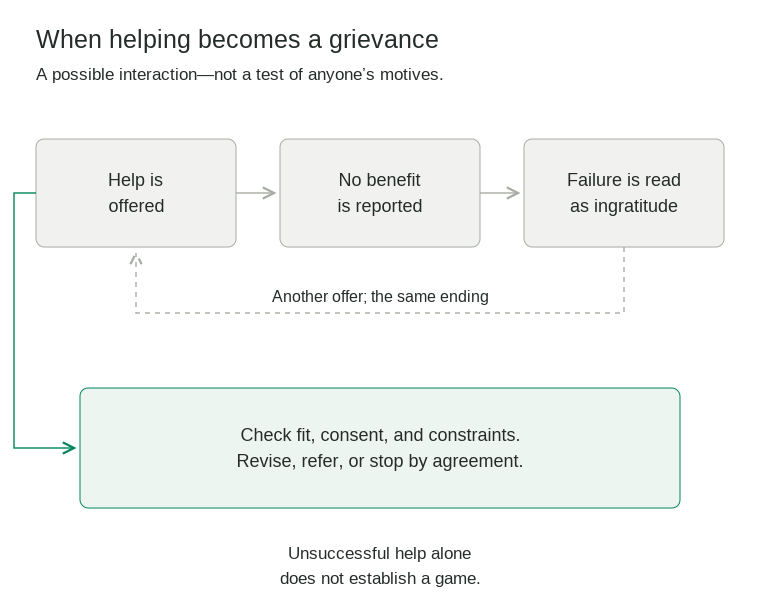
The useful question is whether feedback about assistance can change the assistance—or whether it repeatedly becomes evidence against the person receiving it.
How the interaction sustains itself
In the fictional encounter, Ben asks for support and Mara supplies methods. When they fail, she offers more methods without first establishing why the earlier ones were ineffective.
The conversation then changes subject. Ben’s workload recedes; Mara’s effort becomes central. His explanations sound to her like rejection. Her disappointment makes him feel obliged to reassure her.
Next time, Ben may conceal difficulties to avoid another uncomfortable exchange. Mara then has less reliable information, making further mismatches more likely.
As a Patternverse interpretation, the arrangement might offer Mara a temporary escape from uncertainty: she remains someone who knows how to help, even when the problem persists. Ben’s apologies might preserve access to a valued colleague. Neither possibility proves a hidden motive.
The longer-term costs are visible enough without that inference. Their conversations produce little useful adjustment. Ben becomes less candid. Mara becomes more resentful.
Their contributions are also unequal. Ben’s account deserves examination, but he is not responsible for making Mara feel effective. If she controls his appraisal, opportunities, or access to support, his freedom to disagree is narrower still.
Does Berne offer an antithesis?
Yes. His antithesis section—responses intended to interrupt the game—includes declining the invitation, distinguishing therapy from managing someone’s life, group work, and assessment of acute treatment needs. For recipients, he proposes specifying the assistance wanted. Some passages contemplate provoking anger or despair and warn that refusing help may bring retaliation. Berne’s antithesis
These are historical clinical proposals, not validated self-help techniques. Deliberately provoking distress or withholding needed care is not a suitable everyday adaptation.
Later TA institutional statements provide another emphasis. The ITAA’s Core Concepts describes agreements about outcomes the client desires. Its 2024 ethics code emphasizes autonomy, protection, and keeping practitioners’ personal agendas from contaminating their work. These principles support collaboration; they do not establish that any particular response cures this game. ITAA, “Contracts”, ITAA Code of Ethics
Openings for change
The following are original Patternverse adaptations, not Berne’s prescriptions or tested treatments.
Let feedback interrupt the helping
The helper can stop before proposing another solution:
“We’ve tried several approaches, and the situation hasn’t improved. What did I misunderstand about what you can actually change?”
This makes room for information the helper may have dismissed. It does not require the recipient to prove that every suggestion was impossible.
The recipient can distinguish appreciation from usefulness:
“I appreciate the time you’ve given me. The advice hasn’t addressed the part I can’t control.”
That distinction may be uncomfortable. Gratitude cannot substitute for an accurate account of results.
Agree on the actual offer
Mara initially notices her frustration and responds badly:
“I should step back. You need to take ownership.”
Ben hears another accusation. “I’m trying to. I came because I don’t have the authority to refuse the work.”
Mara revises her response.
“I’ve been offering ways to organize your time. You’re describing conflicting instructions from your manager. Would help preparing that conversation be useful?”
Ben accepts. They draft a short account of the competing deadlines and a request for a decision about priorities.
His manager still refuses to choose. The workload problem remains, but Mara now understands its source more clearly. They agree that another productivity discussion would add little. Ben decides to raise the unresolved conflict through an appropriate workplace channel.
The improvement is modest: the assistance becomes relevant, and its limits become explicit.
Keep boundaries separate from punishment
A helper can limit their contribution without making the limit a lesson:
“I can spend half an hour reviewing the options. I can’t make this decision for you.”
A recipient can decline a particular intervention:
“Please don’t contact them on my behalf. I’ll ask if I want that.”
In another fictional encounter, Elena asks her sister to stop rewriting her dating messages. Her sister replies, “Fine. I’ll never help you again.”
Elena briefly starts defending her gratitude, then returns to the boundary: “I’d still like your company. I’m keeping my messages private.”
Her sister remains offended and ends the call. Elena cannot secure cooperation through perfect wording. She can decide what access she allows and whether to resume the conversation later.
Where refusal brings threats, punishment, or loss of essential support, the issue requires attention to power and safety beyond conversational technique.
Examine the recurring difficulty over time
A helper may need space to understand why disagreement feels like personal rejection, or why stopping an ineffective approach feels like abandoning someone. Professional supervision or therapy can provide a setting for that inquiry.
Recipients may need help identifying what they want, communicating disagreement, or finding support that does not depend on reassuring the helper. These possibilities should remain open questions.
When unsuccessful help means something else
A rehabilitation worker and Omar have tried several ways to make his morning routine manageable. None has helped enough.
“That sounds frustrating,” the worker says. “Did the equipment reduce the effort at all?”
Omar explains that it did, but pain and fatigue still make the routine unreliable. They review what changed, what remains difficult, and what further assessment might be appropriate.
The worker feels disappointed. Omar continues needing substantial assistance.
There is no reason to infer a game from this outcome. The feedback is being heard, the approach can change, and nobody must demonstrate gratitude to keep the conversation going. Persistent disability and limited treatment options do not become manipulation because a helper feels ineffective.
Pitfalls and limits
The most damaging misuse is to interpret “not getting better” as evidence that someone wants help to fail. Poverty, inaccessible services, discrimination, illness, unsafe relationships, and conflicting institutional demands can defeat sincere efforts.
Berne’s entry contains stigmatizing diagnostic shorthand and sweeping judgments about helping professions. Those judgments should not be carried forward as current knowledge.
The label can also become a defense for the recipient: calling every unwelcome suggestion a game avoids discussing whether any part might be useful. Examine the particular offer and its consequences rather than assigning either person a fixed role.
Good intentions do not erase harmful effects. Equally, feeling hurt after helping does not establish a covert agenda. This interpretation is most useful when it increases openness to feedback.
The cited sources do not establish a validated diagnostic test for this pattern or reliable effectiveness for these adaptations. Evidence about TA generally would not, by itself, validate either.
Connections
“Why Don’t You—Yes But.” This neighboring game centers on suggestions repeatedly meeting objections. “I’m Only Trying to Help You” directs attention toward the helper’s investment and grievance. The same exchange can invite both interpretations without proving either. Berne’s neighboring entry
Explicit agreements. Clarifying the desired assistance, available authority, and limits makes it easier to revise an offer without treating revision as rejection.
Intent and impact. “I meant to help” explains an intention. Understanding what the assistance actually did remains a separate task.
Sources and attribution: Historical description and antithesis: Eric Berne, Games People Play (1964), “I’m Only Trying to Help You.” Later professional context: the ITAA’s Core Concepts (2000) and Code of Ethics (2024), linked above. Encounters, practical adaptations, and illustration are original Patternverse material.