
When a helping arrangement preserves the problem it is meant to address.
“You’ve kept up your attendance,” Tam says. “That’s real progress.”
Jo has been coming to the employment program for six months. His résumé has been rewritten twice. Today they discuss two vacancies and arrange another appointment.
Jo knows he will not apply. Interviews frighten him, and the weekly meetings have become a reliable point of contact in an otherwise lonely week. He has not told Tam either thing.
Tam suspects the applications are going nowhere. But she is stretched, Jo appreciates her attention, and continued attendance makes the program’s monthly figures look reassuring. She records another productive session.
At the next review, she recommends repeating a preparation course. Her supervisor approves: Jo is engaging well.
Both leave with something preserved. Jo keeps a familiar relationship without approaching an interview. Tam can report useful work without confronting an uncomfortable uncertainty. Neither has said what would make the arrangement meaningfully different.
The core pattern
“Indigence” is the third entry in the “Consulting Room Games” chapter of Eric Berne’s Games People Play (1964). He presents it as complementary to “I’m Only Trying to Help You”: apparent efforts toward employment coexist with an arrangement that keeps client and agency in their established roles. Berne’s introduction
In transactional analysis, a game involves recurring exchanges with an apparent purpose and a less explicit psychological function. Here, the stated purpose is change; the hypothesized function is preserving the helping relationship without reaching its announced goal.
This is an interpretive framework, not a test for whether someone deserves assistance.
Berne himself distinguishes the proposed game from need caused by physical, psychological, or economic disability, and acknowledges limited personal experience with it. Games People Play, full entry
The distinctive feature is the complementary arrangement. An unemployed person, an ineffective service, or a missed application alone does not establish it.
How the interaction sustains itself
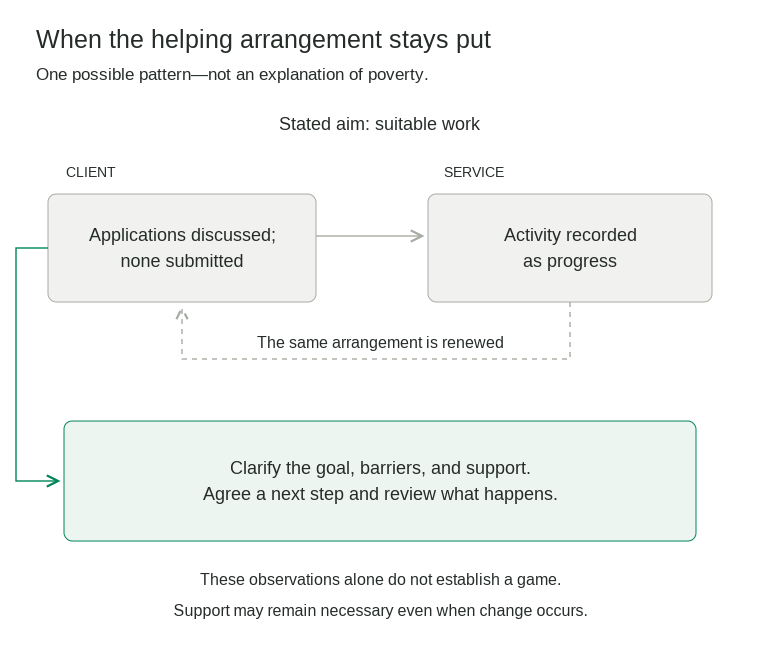
The fictional encounter begins with a shared description: Jo is preparing for work. He attends, discusses vacancies, and accepts further preparation. Tam records these activities as progress.
The consequential omission is that neither examines what happens between discussing an application and sending it.
When little changes, they renew the arrangement. Another course supplies another activity to record. Eventually, changing direction may feel disruptive: Jo could lose valued contact, while Tam might have to acknowledge that the service has misunderstood his needs.
These are Patternverse hypotheses about the fictional encounter, not motives to infer from attendance records.
The immediate protections are understandable. Jo avoids a frightening situation. Tam avoids uncertainty and preserves an apparently successful working relationship. The longer-term costs include Jo’s narrowing expectations, Tam’s misleading account of progress, and resources spent repeating an approach that neither examines.
Institutional incentives can matter without proving a psychological game. If a service rewards attendance, repetitive appointments may reflect how it is funded. Distinguishing policy, resource shortages, individual choices, and relational avoidance requires inquiry.
Responsibility is unequal. A client seeking essential support does not have the same freedom or authority as the organization assessing them.
Berne’s antithesis—and its limits
Berne explicitly proposes withholding benefits as the antithesis, or interruption, “if indicated.” His supporting narrative describes a worker threatening withdrawal, some clients finding employment, and conflict with her agency. This is an anecdotal account, not a controlled evaluation of effectiveness or harm. Berne’s antithesis
Removing someone’s means of subsistence is a consequential intervention. A game interpretation cannot establish its appropriateness.
Modern policy evidence also cautions against equating departure from benefits with improvement. A UK government evaluation published in 2023 estimated that sanctions increased exits from Universal Credit without recorded payroll earnings and reduced subsequent earnings on average. It did not evaluate TA, and it did not measure the overall deterrent effects of a sanctions regime. Department for Work and Pensions evaluation
Later criticism within TA challenges explanations that replace material reality with psychological labels. Julie Hay argues that actual victimization arising from circumstances must be distinguished from game roles. That is a corrective to overinterpretation, not a validated treatment for “Indigence.” Hay, “Game changing dynamics,” 2022
Openings for change
The following are original Patternverse adaptations. Their purpose is to make the arrangement more candid and useful.
Replace recorded activity with a shared account
Tam can begin with an observation rather than an accusation:
“We’ve discussed several vacancies, but I don’t know what happened afterward. Have our meetings helped you take a step you actually wanted?”
Jo can correct the account:
“I’ve been agreeing to applications I wasn’t going to send. I’m frightened of interviews, and I didn’t know whether I could say that here.”
Such honesty may carry real consequences. A worker should explain the purpose of questions, confidentiality, and any relevant reporting duties before inviting sensitive disclosure. They should not promise protection they cannot provide.
Revise an approach that creates more concealment
Tam’s first attempt goes badly.
“Next week, bring evidence of three applications.”
Jo agrees. He leaves planning to bring screenshots of vacancies instead.
At their next meeting, Tam notices they are negotiating another appearance of effort. She revises her approach:
“I made this about producing evidence before understanding what was stopping you. Can we work out whether the obstacle is the application, the interview, the job conditions, or something else?”
Jo identifies interviews and the fear of losing regular contact. Tam explains what the program can realistically offer. They agree to prepare for one suitable vacancy, with a separate review of what support could continue.
Jo misses their first preparation appointment. This does not settle the interpretation. They discuss what happened and revise the plan. Progress consists initially of a more accurate conversation.
Make the goal negotiable and concrete
A useful agreement names the desired change, available support, and how the approach will be reviewed. The ITAA’s Core Concepts describes therapeutic contracting around outcomes the client desires. Applying that principle to this fictional service is a Patternverse adaptation. ITAA, “Contracts”
A meaningful goal might be obtaining suitable work, understanding capacity, arranging accommodations, or securing appropriate continuing support. Immediate employment cannot be assumed to fit every person.
Workers can also question organizational reporting: “We can demonstrate attendance. What evidence shows that the service is useful?”
Recognize limits to cooperation
A client can request a clearer explanation, a different worker, or independent advocacy where available. They may need to document a disagreement without persuading the service to accept their interpretation.
A worker can record that an intervention has not helped, seek supervision, or propose a different service. They cannot manufacture vacancies, health, housing, or childcare through insistence.
Where cooperation remains impossible, the useful outcome may be an accurately recorded disagreement or a supported transition rather than another cycle of nominal progress.
When similar behavior has another explanation
Iris repeatedly declines available jobs. Her adviser begins to suspect she is avoiding employment.
They examine the offers. One requires overnight shifts when Iris has sole responsibility for her child. Another involves lifting that conflicts with her documented limitations. A third is unreachable by available transport.
Iris has been applying, attending interviews, and explaining these constraints. The service has continued counting unsuitable referrals as opportunities.
Calling this “Indigence” would obscure the problem. Iris’s refusals provide relevant information. The next task is to improve the fit of the assistance, not uncover a concealed wish to remain dependent.
Pitfalls and limits
The title itself can encourage a damaging shortcut: treating poverty as a personality pattern. Financial need is not evidence of deception, and receiving assistance is not a psychological payoff.
Berne’s account also risks equating apparent physical capacity with readiness for employment. Invisible disability, fluctuating illness, distress, discrimination, coercion, and unsafe work require consideration.
Do not assume equal responsibility because both parties remain involved. Someone can comply with an ineffective process because the alternative is losing essential support. Nor does an agency benefit from every continuing case; staff may be struggling with inadequate resources.
Contemporary ITAA ethics calls for dignity regardless of economic circumstances, protection from harm, and attention to practitioners’ agendas. These commitments constrain how any game interpretation should be used. ITAA Code of Ethics, 2024
The cited sources do not establish that this category reliably identifies people or that these adaptations improve outcomes. General evidence about TA would not establish either claim.
Connections
“I’m Only Trying to Help You.” This neighboring game examines the helper’s investment in unsuccessful assistance. “Indigence” emphasizes the complementary arrangement and its institutional setting.
Activity and outcomes. Attending, preparing, and reporting may be useful steps. Their usefulness needs examination rather than automatic acceptance or dismissal.
Explicit agreements. Shared goals and review points make it easier to distinguish ongoing support from an unexamined routine.
Sources and attribution: Historical account and antithesis: Eric Berne, Games People Play (1964), “Indigence.” Later TA context: Julie Hay (2022) and the ITAA documents linked above. Sanctions evidence: the cited DWP evaluation. Encounters, practical adaptations, and illustration are original Patternverse material.