
When admiration becomes more important than finding out what helps.
“Nobody has understood me the way you do,” Eli tells his therapist, Nora.
He discovered her through a podcast. After several disappointing experiences elsewhere, her explanations feel unusually clear.
“You’ve thought deeply about this,” Nora replies. “You recognize things many people miss.”
Their conversations become warm and appreciative. Eli quotes her observations between sessions. Nora feels she has finally reached someone who values her approach.
But Eli still avoids the train journey that keeps him from visiting his daughter. When Nora asks about it, he describes another insight from their previous conversation. She accepts his enthusiasm as reassurance that the work is progressing.
Months later, Eli tells a friend that therapy is wonderful. He has not made the journey.
The conversations may have real value. What remains unclear is whether either person can question the arrangement without threatening something precious.
The historical pattern
“Peasant” is the fourth entry in the “Consulting Room Games” chapter of Eric Berne’s Games People Play (1964). Its prototype is a villager who admires a professor’s treatment but lacks the facilities to carry it out. The professor later accepts her gratitude without noticing her continuing disability. Berne’s account
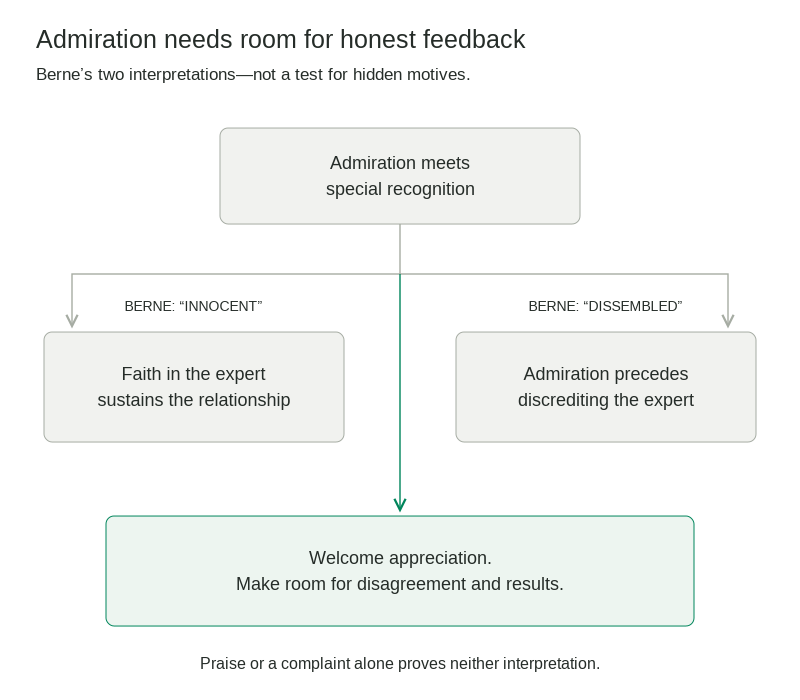
Berne distinguishes two forms. In the “innocent” form, admiration is sincere; clinically, he suggests that belief in the therapist may even help someone remain well. In the “dissembled” form, flattery invites the expert’s reciprocal appreciation, followed by making the expert look foolish. Berne’s description, reproduced by his estate
These are historical interpretations, not established categories of people.
In transactional analysis, a game involves an apparent purpose and a less explicit psychological function. Here, seeking help or expressing admiration may also sustain an arrangement built around being wonderful and being specially recognized.
In the more adversarial version, apparent devotion changes into discrediting the admired person. That reversal matters: “Peasant” is more specific than praising someone while making little progress.
How the arrangement sustains itself
In the fictional opening, Eli’s admiration gives Nora evidence that she matters. Her appreciation gives him a place as an unusually perceptive client.
Neither response is inherently problematic. The difficulty appears when protecting those positions takes priority over examining the work.
Eli reports another insight instead of discussing the journey. Nora accepts it without asking whether the original goal still matters. The exchange ends comfortably, making the same response easier next time.
As a Patternverse interpretation, Eli might fear that disappointment would cost him a valued relationship. Nora might find appreciation easier to receive than uncertainty about her effectiveness. These possibilities require exploration; they cannot be read from compliments.
The costs can be concrete. Important difficulties remain unexamined. Doubts become harder to express. The expert may overpromise, while the admirer becomes increasingly dependent on maintaining the expert’s approval.
A different fictional encounter shows the reversal more clearly. Sam tells a writing coach that only she can recognize his talent. Flattered, she promises publication success she cannot control. After several rejections, he publicly mocks that promise.
Later, Sam acknowledges that part of the appeal was getting a celebrated expert to make a claim he could expose. He had felt belittled by teachers and enjoyed reversing the position.
That admission makes the hypothetical mechanism clearer. Without it, admiration followed by criticism would not establish concealed intent. The coach remains responsible for her promise.
Does Berne offer a response?
Yes. His antithesis distinguishes preserving a potentially supportive innocent form from interrupting a dissembled one. After preparation, he proposes refusing advice, anticipating possible anger or acute anxiety and further clinical management. Berne’s antithesis
This is a historical clinical prescription, not evidence that withholding advice reliably improves outcomes. Deliberately provoking distress or withdrawing necessary information is not an everyday response to praise.
A later professional reference point is the ITAA’s 2024 ethics code, which emphasizes autonomy, protection, and keeping practitioners’ personal agendas from contaminating their work. Those commitments support examining the expert’s participation, not merely scrutinizing the client. They do not validate a specific treatment for “Peasant.” ITAA Code of Ethics
Openings for change
The following are original Patternverse adaptations, not Berne’s established prescriptions or tested treatments.
Receive appreciation without accepting exceptional status
An expert can acknowledge gratitude while leaving room for limits:
“I’m glad these conversations matter to you. I also want you to be able to tell me when something misses the mark.”
The purpose is to make disagreement compatible with continuing contact. A modest reply alone will accomplish little if subsequent criticism brings defensiveness.
The person receiving help can make the same distinction:
“I value your understanding. I’m also disappointed that this difficulty hasn’t changed.”
Appreciation and disappointment can both be accurate.
Revisit what the relationship is for
Nora initially responds too abruptly.
“Perhaps we should stop discussing insights and focus on results.”
Eli hears that the conversations he values have been dismissed. He becomes quiet.
Nora revises her approach:
“I made that sound as though our conversations don’t count. They do. I’m wondering whether visiting your daughter still matters to you, and whether we’re giving that enough attention.”
Eli says it does matter. He also explains that describing insights feels safer than admitting how frightened he remains.
They agree to review the travel difficulty and the support available for it. The next conversation is less flattering and more uncertain. Nora does not promise that a journey will follow.
The useful change is that disappointment becomes discussable.
Replace promises with clear limits
The writing coach can acknowledge her contribution:
“I promised an outcome I couldn’t guarantee. That was a mistake. I can assess the work and explain my reasoning; I can’t promise acceptance.”
Sam can still criticize the advice. She can decline abusive exchanges without withdrawing accountability for her promise.
If another person insists that help must prove someone exceptional—or that disappointment proves them worthless—an agreed stopping point may be appropriate. In professional relationships, ending work requires attention to continuity and relevant responsibilities.
Understand the recurring need over time
Someone repeatedly drawn to admired authorities may want to explore what those relationships offer: hope, belonging, certainty, recognition, or access to opportunities.
An expert may need supervision to examine why being admired makes boundaries harder to maintain. These are questions for inquiry, not explanations to impose.
When praise and unchanged symptoms mean something else
Leila warmly thanks a specialist for explaining her condition. At follow-up, she is no better.
A hurried observer might see admiration without improvement. The fuller account is practical: Leila could not obtain the recommended equipment, and the nearest service has no available appointments. She also felt embarrassed asking the specialist to repeat unfamiliar instructions.
Her gratitude was sincere. Her symptoms provide no evidence of a hidden wish to defeat treatment.
The specialist asks what Leila could actually access and understand, then reviews the plan. Whether it helps remains uncertain.
Current NHS Specialist Pharmacy Service guidance similarly distinguishes decisions shaped by beliefs and preferences from practical barriers to taking medicines, and recommends examining individual circumstances. That guidance concerns medication support; it does not validate TA game analysis. NHS SPS, understanding adherence
Pitfalls and limits
The historical title is class-laden and patronizing when used to characterize a person. Berne’s gendered portrayals also invite suspicion of women’s admiration while granting the male expert interpretive authority. Those assumptions should not become contemporary knowledge.
Persistent symptoms, declining advice, changing therapists, or making a complaint cannot establish manipulation. Complaints may identify poor care or misconduct.
Nor does admiration transfer responsibility for exploitation. A professional who crosses boundaries remains responsible for that conduct. A client’s warmth or idealization does not invite abuse.
Later TA criticism has challenged the tendency to substitute game explanations for actual circumstances and victimization. Julie Hay’s argument is a useful restraint on this entry’s more accusatory possibilities. Hay, “Game changing dynamics,” 2022
The cited sources do not establish a reliable test for either form or demonstrate that these adaptations improve outcomes. General evidence about TA would not establish those claims.
Connections
Idealization. Admiring someone’s strengths can become difficulty recognizing their limits. This neighboring concept does not imply deception.
“I’m Only Trying to Help You.” That game centers on the helper’s grievance when assistance fails. “Peasant” centers on admiration and recognition, sometimes followed by discrediting.
Feedback about results. Asking what changed, what remained difficult, and what was inaccessible allows gratitude to coexist with an accurate account.
Sources and attribution: Historical forms and antithesis: Eric Berne, Games People Play (1964), “Peasant.” Later TA context: the ITAA ethics code and Julie Hay (2022). Practical clinical context: NHS SPS guidance. Encounters, response suggestions, and illustration are original Patternverse adaptations.