
Useful generosity can serve another purpose. Both deserve attention.
Without Theo’s donation, the neighborhood club would have closed its meeting room for the winter. He paid for the heating repair, helped arrange the work, and refused reimbursement.
“I’m happy to help,” he told Inez, the coordinator.
The room stayed open. Older residents continued meeting there; the children’s group kept its sessions. Inez thanked him publicly.
Three months later, Theo asks her to support his nomination as club chair.
“You know how much I’ve done for this place.”
Inez hesitates. She values his contribution but prefers another candidate.
Theo looks hurt. “Apparently helping counts for nothing.”
Now a useful gift carries a disputed meaning. Inez thought she had accepted assistance. Theo appears to understand her gratitude as a reason to support him.
The repair remains real. So does the pressure.
The core pattern
“Happy to Help” is the third entry in the “Good Games” chapter of Eric Berne’s Games People Play (1964). He describes consistent helpfulness serving an ulterior purpose: prestige, competition, expiation, concealment of wrongdoing, or opportunities for later exploitation. He nevertheless insists that useful actions deserve recognition. Berne’s original description
In transactional analysis, a game involves an apparent exchange alongside a less explicit psychological function. Here, assistance may also serve an undisclosed personal aim.
The distinctive feature is that the assistance can genuinely help. Unlike an arrangement that depends on help failing, this one may provide substantial benefit.
That does not make every rewarding act of generosity a game. Enjoying usefulness, recognition, or friendship is not enough to establish a covert purpose. The ITAA’s later Core Concepts summary retains covert transactions and a psychological payoff as defining features of games. ITAA, “Games”
Recognition is useful when it helps distinguish what was provided, what the helper may want, and what anyone actually agreed to give in return.
How the arrangement sustains itself
In the fictional opening, Theo provides effective assistance. The club benefits and expresses gratitude. That recognition may encourage further giving.
A difficulty appears when Theo treats the contribution as grounds for another claim.
As a Patternverse interpretation, he might be seeking belonging, status, influence, or reassurance that he matters. He may not have understood that wish clearly when he offered the money. None of these possibilities can be established from generosity alone.
Inez also has understandable reasons to hesitate. She wants to acknowledge the contribution and fears discouraging someone the club may need again.
The immediate rewards can therefore sustain an ambiguous arrangement: practical benefit for the club, recognition and access for Theo, and no difficult discussion about expectations.
Over time, the costs may include constrained decisions, dependence on one benefactor, and resentment when appreciation does not produce loyalty.
Berne also describes a familiar polarization: supporters emphasize the helpful actions, while critics emphasize the motives. His discussion of competing interpretations
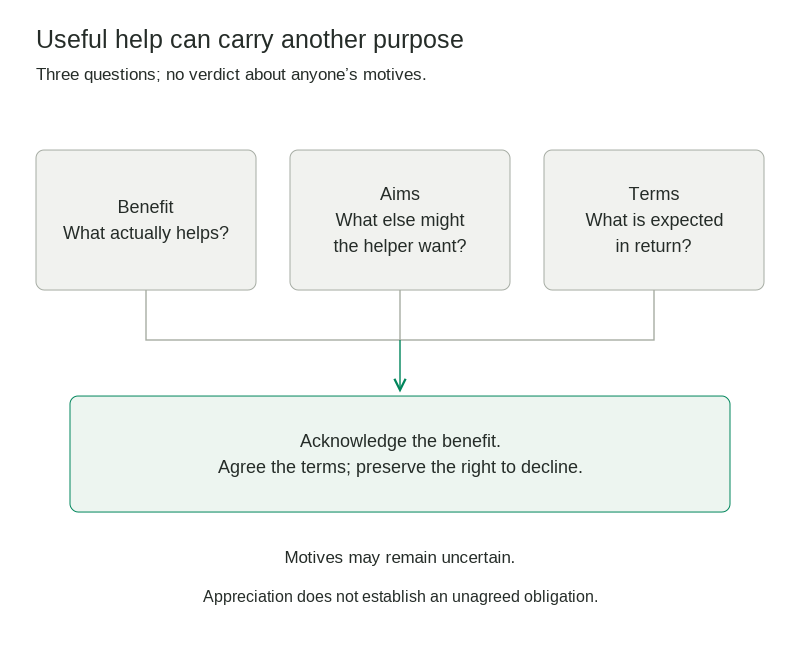
A more useful inquiry can keep both in view. “The heating repair helped” and “we did not agree to support his nomination” are compatible statements.
Does Berne propose an antithesis?
There is no separate antithesis in this entry. Berne mainly asks readers to recognize constructive action despite questionable motives. He also discusses harmful forms, including parents competing through helpfulness for their children’s affection. Full entry
His constructive classification should not become a moral exemption. Providing something valuable does not authorize exploitation or erase harm elsewhere.
Later TA professional ethics emphasizes autonomy, protection, and keeping practitioners’ personal agendas from contaminating their work. Those principles offer a reference point for examining assistance; they are not a tested response to this particular game. ITAA Code of Ethics, 2024
Keeping the contribution useful
The following are original Patternverse adaptations, not Berne’s established prescriptions or validated treatments.
Acknowledge the benefit specifically
Inez first responds angrily.
“So you were buying our votes?”
Theo says she has insulted him. The conversation becomes an argument about whether he is generous or calculating.
She revises her approach:
“The heating repair made a real difference. I remain grateful. Supporting your nomination is a separate decision, and I can’t promise it.”
This neither proves nor disproves his original motive. It identifies the disputed expectation without denying what he provided.
Specific appreciation is often clearer than a sweeping endorsement of the helper’s character: “Your contribution kept the room open” says what happened.
State conditions before assistance is accepted
A helper can make an offer easier to evaluate:
“I can donate the equipment. I’d like a public acknowledgment, but I’m not asking for a role in choosing how the program runs.”
A recipient can clarify uncertainties:
“Before we accept, is there anything you expect us to do in return?”
An explicit condition may be acceptable, negotiable, or unsuitable. Transparency allows that discussion before gratitude and dependence complicate it.
Not every private wish needs disclosure. Someone can hope to feel useful without making that feeling the recipient’s responsibility.
Make another wish a direct request
Theo can ask for participation without presenting it as repayment:
“I’ve enjoyed contributing and would like a larger role. Could you explain how nominations are considered?”
The club can recognize his contribution while considering his suitability through its ordinary process.
If he wants recognition, that too can be discussed directly. Acknowledgment is easier to negotiate than an undefined expectation of allegiance.
For a helper, a useful longer-term inquiry is whether giving remains satisfying when others retain their own preferences. If refusal feels intolerable, it may reveal an expectation worth understanding.
Allow refusal to have a clear meaning
Theo declines Inez’s distinction. He says he will reconsider future contributions.
Inez cannot make him remain generous on different terms. She repeats her appreciation without promising support, then brings the funding vulnerability to the club’s committee.
They begin looking for alternatives. That takes time, and the relationship remains strained.
Progress here means making an unagreed obligation explicit. It does not mean securing cost-free independence or proving that Theo never cared.
Where assistance is essential, recipients may need practical support before challenging its conditions. A boundary can be legitimate and still carry serious consequences.
When similar help is an open exchange
A local printing business offers discounted posters for a community festival. In return, it asks for its name on the program.
The organizer agrees after checking the arrangement with colleagues. The posters arrive, the acknowledgment appears, and neither party expects further favors.
The owner enjoys the publicity and hopes to attract customers. The festival benefits from lower costs.
There is no need to interpret this as “Happy to Help.” The relevant exchange was stated and accepted. Personal advantage does not make it covert.
Likewise, a friend may enjoy bringing meals during someone’s recovery without expecting repayment or influence. Feeling good about helping does not establish an undisclosed claim.
Pitfalls and limits
The first misuse is cynicism: assuming that generosity is fraudulent because the giver gains something. Human purposes can be mixed without making an action worthless.
The opposite misuse is moral bookkeeping: assuming enough good deeds cancel unrelated wrongdoing. Assistance and accountability can coexist.
Berne’s relative approval of constructive competition also needs limits. Children should not have to reward one parent’s gifts by taking sides against another. Material provision does not justify emotional pressure.
Recipients are not equally responsible for an arrangement simply because they accept needed help. Poverty, disability, illness, discrimination, or coercion may sharply restrict their choices. Accepting support does not mean consenting to abuse.
Nor should suspicion substitute for evidence. A helper’s prominence, pleasure, or imperfect history cannot establish the motive behind a particular act. Conduct, conditions, and consequences are more accessible than inner purpose.
The cited sources provide an interpretive account and ethical guidance. They do not establish a reliable diagnostic test for “Happy to Help” or demonstrate effectiveness for these adaptations. Evidence about TA generally would not establish those specific claims.
Connections
“I’m Only Trying to Help You.” That game centers on the helper’s grievance when assistance fails or is rejected. Here, the contribution may work while serving another aim.
“Busman’s Holiday.” A contribution can provide both useful work and personal satisfaction without those benefits becoming concealed obligations.
Explicit reciprocity. Stated exchanges allow people to evaluate terms that covert expectations leave ambiguous.
Gratitude and autonomy. Appreciation can remain sincere while the recipient makes independent decisions.
Sources and attribution: Historical description and classification: Eric Berne, Games People Play (1964), “Happy to Help.” Later TA context: the ITAA’s Core Concepts (2000) and Code of Ethics (2024), linked above. Encounters, practical suggestions, and illustration are original Patternverse adaptations.