
Being someone people can turn to—without needing every answer.
Ada has lived in the village for six months. A retired librarian who also repairs furniture, she has become someone people ask about things.
At the community hall, Ewan finds her fixing a drawer. He brings a letter from his landlord.
“You understand this stuff. Can they really make me leave?”
Ada reads it twice. She can identify the date and the contact details, but she cannot answer his question.
“I can help you find someone who knows,” she says. “Would that be useful?”
Ewan looks disappointed. He wanted reassurance, preferably today. Ada offers to sit with him while he contacts a housing advice service. The first available appointment is next week.
The problem remains. But Ewan leaves with an appointment, and Ada has resisted becoming an authority on something she does not understand.
A useful place in other people’s lives
Eric Berne includes “Homely Sage” as the fourth entry in the “Good Games” chapter of Games People Play (1964). He immediately qualifies its classification: it is more properly a script than a game, although it has game-like aspects.
His example concerns an educated man who develops interests beyond his occupation, retires from a responsible city job, and settles in a small town. People discover that he listens, helps where competent, and refers elsewhere when necessary. Through this approachable usefulness, he finds a place in his new community. Berne’s original description
That qualification matters. In transactional analysis, a game generally means a recurring exchange with an apparent purpose, another psychological level, and a familiar payoff. A later ITAA summary retains this emphasis on covert transactions and hidden advantages. ITAA, The Core Concepts
Berne does not give “Homely Sage” a detailed sequence of deception, reversal, and disappointment. Here, “script” directs attention toward an unfolding life pattern: becoming the person others consult. There is no need to invent a concealed trap to make the entry resemble his more adversarial games.
The observable pattern is approachable, knowledgeable help with acknowledged limits. Possible psychological satisfactions—belonging, recognition, continuity after retirement—are interpretations to explore. Enjoying usefulness does not prove manipulation.
How the role takes shape
Someone asks a modest question. The answer helps, or the listener finds an appropriate source. Word spreads. More people approach them, and an informal role develops without anyone announcing it.
In Ada’s case, several contributions accumulate: a repaired drawer, help finding an old document, an introduction to someone with relevant experience. Their value depends partly on her willingness to distinguish these abilities from expertise she lacks.
Other people help establish the role. They bring questions, recommend her, and express appreciation. In TA vocabulary, these expressions of recognition are strokes. They need not be covert or unhealthy. ITAA, The Core Concepts
A difficulty may emerge when the role becomes too important to disappoint. “People value my contribution” can gradually become “I must always have something useful to say.” The person consulted may answer too quickly; others may mistake broad knowledge for universal competence.
That is a possible development, not Berne’s established hidden mechanism. A flourishing version can remain ordinary: people exchange help, acknowledge uncertainty, and retain relationships when no solution is available.
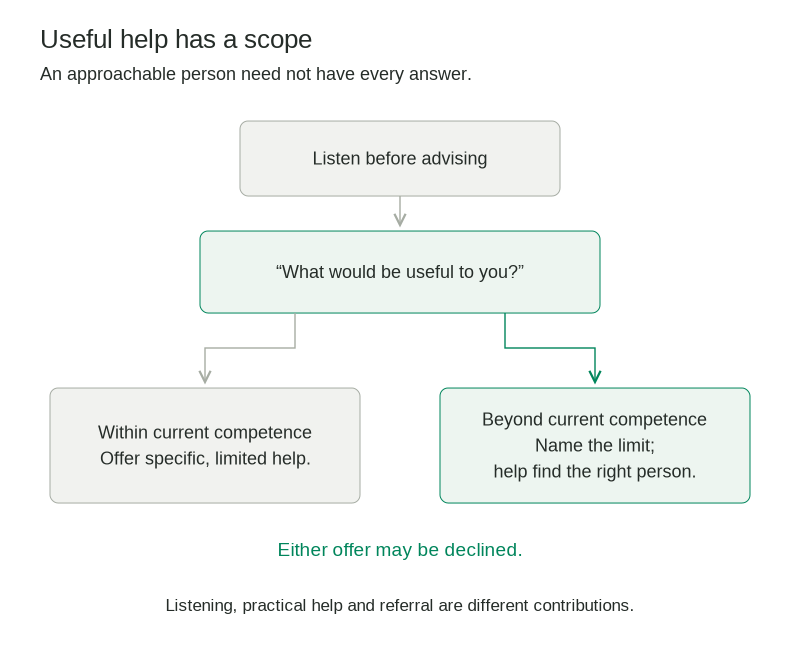
Cultivating the role without enlarging it indefinitely
Berne supplies no separate antithesis for this entry. His explicit precaution is that, in its best form, the person has consulted a psychiatrist to examine their motives and possible errors. That is a historical recommendation, not evidence that psychiatric consultation is a universal prerequisite or a proven safeguard. Games People Play, “Homely Sage”
The following are Patternverse adaptations, intended as practical ways to cultivate the constructive role.
In the immediate conversation, establish what is being requested. “Would you like me to listen, help investigate, or offer an opinion?” gives the person a chance to specify the need. Someone describing a difficult week may want company rather than an interpretation of their family.
Make the contribution specific. Ada can say, “I can help you organize the papers for that appointment.” This is a smaller promise than “Leave it with me.” It also makes the limits visible before anyone depends on an imagined service.
Let referral remain an offer. “I know someone with relevant experience. Would you like their details?” preserves a choice. Passing on private information or arranging an introduction without permission can turn helpfulness into an intrusion.
Later professional TA ethics give competence, informed agreements, autonomy, and protection a more explicit framework. The ITAA’s 2024 code addresses practitioners, rather than prescribing rules for every neighbor; it nevertheless provides a useful reference for thinking about limits. It is not research demonstrating that these informal responses work. ITAA Code of Ethics
Over time, examine what happens when help is unnecessary. Can the knowledgeable person enjoy a visit without solving anything? Can someone disagree and return next week? These questions make the role’s flexibility easier to assess.
Availability also needs limits. “I can talk on Saturday; I cannot be available every evening” may disappoint someone without wronging them. If a person insists on advice beyond the helper’s competence, the helper can decline that task. If unwanted advice continues, its recipient can end the discussion.
When an answer needs revising
At a neighborhood gathering, Leon asks Ruth, a respected retired manager, whether he should leave his job. Ruth rapidly lists opportunities and recommends applying elsewhere.
Leon goes quiet.
“You make it sound easy,” he says. “I’m supporting my sister. I can’t risk a gap in income.”
Ruth first responds, “I’m only offering options.” That defends her intention but leaves his concern unanswered.
She revises: “I moved too quickly. What would make a conversation about this useful?”
Leon asks her to read a draft request for different working hours. She agrees to comment on its clarity while acknowledging that she cannot predict his employer’s response.
Recognizing the pattern helps Ruth relinquish the broad adviser role and accept a narrower contribution. Leon does not resign, and the working-hours request remains uncertain. The useful change is that his actual constraint now shapes their conversation.
A contrasting case concerns Mina, who repeatedly asks a neighbor to help navigate an inaccessible online service. The repetition could tempt an observer to imagine someone cultivating dependence. But Mina knows what she needs, directs the task, and would prefer an accessible system.
Repeated help here does not establish a psychological game. Requiring Mina to demonstrate independence by struggling alone would compound the barrier. The relevant questions concern access, consent, and whether the arrangement suits both people.
Where the interpretation can mislead
“Homely Sage” can romanticize informal authority. Being patient, articulate, or widely read does not establish competence in another person’s medical, legal, financial, or personal circumstances. Professional qualifications also have specific scopes; a former occupation does not authorize every kind of advice.
Berne’s educated male retiree reflects a narrow social picture. A contemporary adaptation need not assume that wisdom arrives from a prestigious city career, that older people possess it automatically, or that a small community awaits an outsider’s enlightenment. Practical knowledge may be distributed among people whose work and experience receive little public recognition. His description also uses an outdated, imprecise label for an older relative’s difficulties; that language should not become a present-day diagnosis.
Power matters. Advice from someone controlling housing, money, employment, or community standing may be difficult to refuse. A request for confidentiality or a refusal of help must not become evidence of ingratitude. Coercion and abuse require attention to the conduct and available protection, rather than speculation about a shared game.
Nor can a resourceful neighbor compensate indefinitely for absent services, discrimination, poverty, or inaccessible institutions.
This framework offers a way to examine a relationship, not a reliable method for discovering motives. Nothing in the cited description establishes the effectiveness of a specific intervention.
Connections
Busman’s Holiday concerns bringing occupational abilities into leisure. “Homely Sage” places more emphasis on broad learning, community belonging, listening, and referral. The roles may overlap without being identical.
Happy to Help, another of Berne’s good games, explicitly considers useful action accompanied by ulterior purposes. Its question concerns the relationship between benefit and motive; “Homely Sage” emphasizes a sustained, approachable role. Berne, “Good Games”
Clear agreements complement this role by specifying the requested contribution, its limits, and each person’s choices. Here, that is a Patternverse response suggestion informed by TA’s attention to contracting—not a claim that a named Patternverse entry already exists.
Sources and attribution: Historical account from Eric Berne, Games People Play (1964), chapter 12, checked against the original text and the Berne family website. Later TA context comes from the linked ITAA core-concepts summary and 2024 ethics code. All encounters, explanatory extensions, practical adaptations, and illustrations are original Patternverse material.