
Making something good of the kindness people showed you.
Before her first exhibition opens, Nina moves two chairs closer to the photographs. They are for Jo and Martin, former colleagues who lent her equipment and encouraged her to apply.
“I want them to see this properly,” she tells her partner.
“They already like your work.”
“That’s different. I want them to feel they were right to help me.”
Nina has paid particular attention to crediting everyone who contributed. She has also chosen a photograph Jo once encouraged her to keep, despite her doubts.
When the two arrive, Martin studies the prints. Jo recognizes the photograph and smiles.
“You kept it.”
For Nina, that recognition matters more than the sales list. The exhibition has given something back to the people who believed in her.
Success addressed to someone
Eric Berne places “They’ll Be Glad They Knew Me” fifth and last in the “Good Games” chapter of Games People Play (1964). He introduces it through a comparison with “I’ll Show Them,” where achievement can be directed toward making former detractors regret their treatment of someone. Berne family website
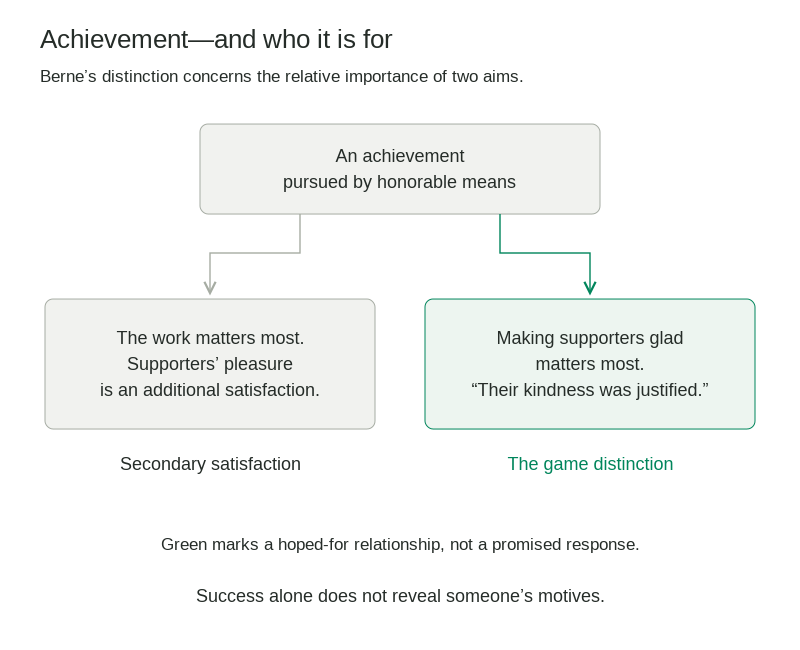
Here, the intended audience is friendly. The person wants former associates to feel pleased that they offered friendship and respect. Berne makes honorable conduct part of the pattern: both the means and the ends must be honorable. Crucially, he distinguishes a secondary satisfaction of success from a game. He calls it a game when the effect on those other people matters more than the accomplishment itself. Berne, “They’ll Be Glad They Knew Me”
The apparent activity might be making an exhibition, completing training, or building a useful organization. Its additional relational purpose is: Your kindness was well placed.
This is an unusual entry in a book associated with troublesome interactions. Berne supplies no elaborate trap, accusation, or reversal here. Recognizing it can illuminate a constructive ambition without requiring us to discover something sinister underneath.
A dedication, thank-you message, or wish to make a mentor proud does not establish a game. The distinction concerns the relative importance of purposes, which an observer cannot reliably read from achievement alone.
What may sustain it
As a Patternverse interpretation, the pattern can unfold across years rather than within one conversation.
Someone offers encouragement or respect. The recipient remembers it, undertakes something worthwhile, and imagines sharing the result. That imagined encounter helps sustain effort. When the supporter expresses pleasure, the achievement acquires another meaning: a relationship has borne fruit.
The supporter need not know they occupy this position. Their contribution may have been modest—an introduction, patient attention, a refusal to dismiss an early attempt. This does not make them responsible for everything the recipient subsequently undertakes.
Possible satisfactions include gratitude expressed through action, continuity with an earlier community, and the pleasure of giving someone a reason to smile. A possible cost appears when appreciation becomes an obligation to produce an impressive life.
Neither outcome is inevitable. Nina’s wish may enrich her exhibition. It would become more burdensome if every later project had to reassure Jo and Martin that helping her had been a sound investment.
Cultivating gratitude without making it a debt
Berne gives this entry no separate antithesis. The following suggestions are Patternverse adaptations, concerned with preserving its constructive possibilities.
In the immediate exchange, express the appreciation directly. Nina could tell Jo, “You helped me take the application seriously. I wanted you to know that.” The message can reach Jo without requiring her to decipher an exhibition as proof of gratitude.
The response can be equally specific: “I’m glad I encouraged you, and I enjoyed seeing what you made.” A supporter can acknowledge the achievement without claiming ownership of it or demanding a larger sequel.
When choosing an undertaking, give the work its own reasons to exist. A project might benefit customers, develop a skill, or offer something its maker values. These reasons need not displace affection for supporters. They provide grounds for continuing, revising, or stopping when the hoped-for audience is unavailable or unimpressed.
Over time, notice whether remembered kindness has become a performance requirement. Someone might say, “I keep imagining that changing direction would make your support a mistake.” That opens a more direct conversation than repeatedly producing evidence of worthiness.
Later TA language offers a useful connection: strokes are acts of recognition, including appreciation. The ITAA’s core-concepts summary also describes games as recurring covert exchanges with a payoff—a psychological advantage or familiar outcome. These concepts help explain the vocabulary, but do not prove that a particular ambition conceals such an exchange. ITAA, The Core Concepts
Directness cannot secure a desired response. A former mentor may have moved away, forgotten the incident, or become someone the person no longer wants to contact. Gratitude can still inform a worthwhile choice without a reunion. Repeatedly seeking acknowledgment from someone who has declined contact would require a boundary, not a more impressive achievement.
When encouragement becomes pressure
Owen’s former supervisor, Farah, recommended him for a development program. Months later, he volunteers to lead an ambitious workplace project. He tells a friend that completing it will show Farah her recommendation was justified.
The project interests him, but its timetable depends on colleagues working evenings. Owen has begun treating their reluctance as a threat to something personal.
“You don’t owe Farah anything,” his friend says.
Owen hears this as a dismissal of her generosity. He argues harder for the project.
The friend revises: “Her support mattered. Does this particular timetable express that well, given what it asks from everyone else?”
Owen proposes a smaller first stage and acknowledges the staffing limit. He also writes to Farah about what the program has already helped him learn. She replies warmly, without mentioning the project.
His manager still wants the original deadline. Owen cannot resolve that pressure simply by understanding his motives. He documents what the team can deliver and requests a decision about scope. Progress consists partly in distinguishing his wish to honor Farah from a real disagreement about workload.
A similar scene with another explanation
At a graduation celebration, Salma thanks an aunt who provided childcare during her course.
“I wanted you to be glad you helped,” she says.
That sentence resembles the title, but Salma explains that she chose the qualification for its employment prospects. When her aunt misses the ceremony because of a transport problem, Salma sends photographs and enjoys the celebration anyway. They arrange lunch later.
The aunt’s pleasure matters, but the qualification retains its purpose independently. Within Berne’s distinction, this is compatible with appreciation as a secondary satisfaction.
Even this account remains incomplete. Motives can overlap and change. The useful inquiry concerns how a person makes choices, rather than whether one sentence reveals a hidden identity.
Where the interpretation needs limits
The title can become harmful if it suggests that receiving care creates a duty to become successful. Kindness does not require repayment through prestige, productivity, recovery, or public gratitude.
Disability, distress, discrimination, poverty, and caring responsibilities can constrain achievement. An abandoned project does not prove insufficient gratitude. Nor should encouragement from a powerful person be used to excuse coercion: “After everything I did for you” can impose demands that were never agreed.
Berne’s historical account centers a male protagonist and gives considerable attention to success and prestige. A contemporary adaptation should leave room for less visible accomplishments and for lives whose value is not measured by achievement.
Later professional TA ethics explicitly emphasize dignity and autonomy and warn against a practitioner’s agenda contaminating the work. That supports caution about making someone else’s preferred outcome the measure of a person’s worth; it is not a tested antithesis for this game. ITAA Code of Ethics
The sources checked here do not establish that these Patternverse suggestions improve outcomes. Evidence about TA more generally would not, by itself, validate this particular interpretation or response.
Connections
“I’ll Show Them” directs achievement toward former detractors’ regret or envy. “They’ll Be Glad They Knew Me” addresses former supporters’ pleasure. That difference changes the intended relational result. Berne’s comparison
Happy to Help considers useful actions accompanied by ulterior purposes, such as prestige or competition. Here, the distinctive purpose is vindicating earlier kindness through honorable accomplishment. Berne, “Happy to Help”
Direct appreciation, as used here, is a Patternverse response suggestion: tell someone what their support meant, while leaving future choices open. It complements constructive ambition without requiring a lifetime of demonstrations.
Sources and attribution: Historical description and absence of a separate antithesis checked in Eric Berne, Games People Play (1964), chapter 12; the family-maintained website provides an incomplete excerpt. Later TA context comes from the linked ITAA publications. Fictional encounters, practical adaptations, explanatory extensions, and illustrations are original Patternverse material.