
When departure is wanted—and becoming possible is frightening
A familiar scene
For weeks, Jonas has asked his hospital team, “What else needs to happen before I can go home?”
A discharge-planning meeting is arranged. He has been discussing transport, appointments, and returning to his flat.
On the morning of the meeting, Jonas refuses to attend.
“There’s no point. You’ve already decided everything.”
His nurse, Kira, becomes frustrated. “You keep asking to leave, then won’t discuss the plan.”
“You’re just finding another reason to keep me here.”
The meeting is postponed. That night, Jonas feels some relief: another evening with staff nearby, meals provided, and someone available if he becomes frightened.
He still wants his own life back. He is also afraid of the first night alone. Neither feeling has found a useful place in the conversation.
The historical pattern
Eric Berne places “How Do You Get Out of Here?”—also called “Want Out”—second in the “Underworld Games” chapter of Games People Play (1964). He discusses prisons and psychiatric hospitals.
He distinguishes straightforward efforts to obtain release, which he calls an operation, from a proposed game: someone appears to work toward leaving, then undermines that outcome as it approaches. Berne interprets this as fear of the uncertain world outside overcoming the stated wish for release. Berne estate: “How Do You Get Out of Here”
The distinctive feature is the timing of the setback at the threshold of departure.
Within transactional analysis, or TA, a game involves an apparent purpose and a hypothesised psychological function. Here, the apparent purpose is leaving; the proposed function is preserving a familiar setting without directly acknowledging the wish for continued protection.
That is an interpretation. A postponed departure does not establish it. Wanting freedom and fearing the transition can coexist without deception or game-playing.
The useful question is narrower: What changes when leaving becomes real? The answer may concern fear, illness, missing support, an unsuitable destination, or decisions controlled by other people.
How the interaction may sustain itself
The following is a Patternverse explanation of one possible recurring arrangement.
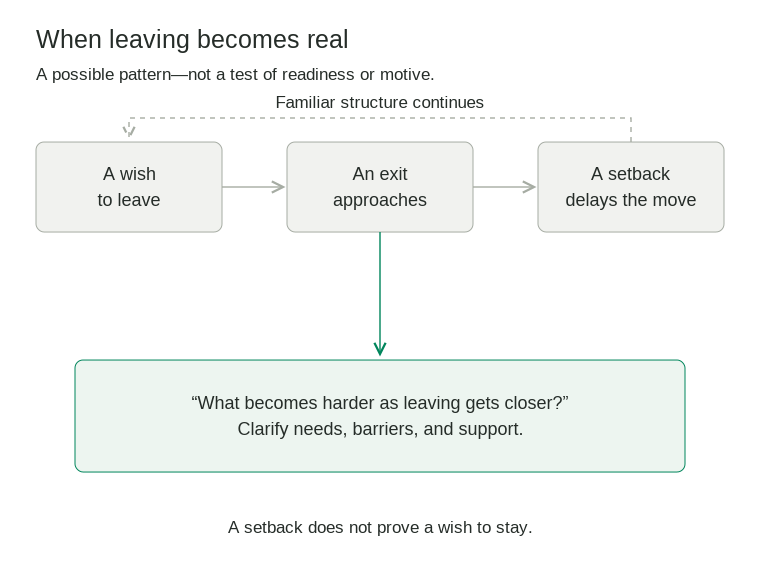
A person asks to leave. They complete preparatory steps. As departure becomes concrete, a meeting is missed, an argument occurs, or another difficulty emerges. The transition pauses.
Familiar structure continues. Immediate uncertainty decreases. Later, the person renews their request to leave, and the sequence begins again.
Staff may increasingly interpret setbacks as evidence of unwillingness. The person may increasingly experience staff as obstructive. Their positions become fixed: “Prove you’re ready” and “You never let me move on.”
Possible immediate functions include relief from uncertainty, continued access to support, or avoiding a difficult admission of fear. Staff might gain temporary relief from a complicated transition. These are possibilities to investigate, not hidden benefits to assign.
The longer-term costs can include mistrust, reduced confidence, prolonged restriction, and less honest discussion of support needs.
Power is unequal. Staff and institutions often control decisions, information, and resources. Their responsibilities cannot be reduced to the role they occupy in a psychological sequence.
Openings for change
Replace the accusation with an inquiry
Berne’s antithesis calls for administrators to distinguish genuine efforts toward release from “Want Out,” and for active therapy addressing the frightened person. It supplies no specific, tested technique. Its language of exposing manipulation also creates a risk of treating distress as misconduct. Games People Play, antithesis
The suggestions below are original Patternverse adaptations, not Berne’s prescriptions or validated treatments.
A more useful opening concerns the observable difficulty:
“You’ve said you want to go home, and today’s meeting felt impossible. What became harder when the date got closer?”
The answer should remain open. “I’m frightened” and “Nobody has arranged transport” require different responses. Neither needs to become a confession that the person secretly wants confinement.
Separate the goal from the missing support
Jonas might say:
“I want to leave. I’m scared about being alone at night, and I don’t understand who I can contact.”
Kira can explore that concern without deciding, by herself, what discharge should happen:
“Let’s make the first evening concrete and identify what is arranged, what is missing, and who needs to resolve it.”
NICE guidance recommends collaborative, suitably paced discharge planning, attention to housing, and discussion of follow-up support before departure. These are care-planning recommendations, not validation of a TA game or evidence that one conversation will resolve the difficulty. NICE NG53, published guideline copy
Make an agreement that permits mixed feelings
Later TA’s core-concepts account emphasises explicit agreements about the outcome a client wants, alongside support for change. That offers a useful emphasis: define the work together rather than require agreement with an interpretation. ITAA: The Core Concepts
An agreement might concern understanding the proposed plan, identifying unanswered questions, or practising a particular task with appropriate support.
It should not require someone to become entirely unafraid. Nor should care, rights, or consideration for discharge depend on accepting the game name.
Revise the response when cooperation breaks down
Kira initially tells Jonas, “You’re sabotaging your discharge.”
He becomes more defensive. The discussion turns into an argument about whether he means what he says.
Later, she revises her approach:
“I treated the missed meeting as proof of your intention. I don’t know that. We still need to understand what happened and review the plan.”
Jonas says that part of him hoped someone would say “not yet.” He also explains that the proposed support arrangements remain unclear to him.
They arrange a shorter meeting, with an advocate present, to clarify those arrangements. Jonas attends. He remains anxious afterward, and one question about evening support is still unresolved.
Progress means that fear and practical uncertainty can now be discussed separately. It does not establish that the original episode was a game.
If the person declines discussion, staff can explain decisions, offer accessible information and advocacy, and review actual needs. Disagreement alone does not settle motive.
A contrast: the destination is unsuitable
In supported accommodation, Amara repeatedly says she wants her own home. She then refuses an offered flat.
A worker describes this as another example of backing away when independence becomes possible.
Amara asks them to look at the entrance. The flat is reached by stairs she cannot reliably manage. The photographs sent to her had not shown them.
The worker checks the property details and corrects the record: this was an unsuitable offer, not evidence of unwillingness to move. The housing search resumes.
Amara still has no departure date. Naming the real barrier has not removed it, but it has stopped a practical problem becoming an accusation about her character.
Pitfalls and limits
Berne uses recurrence of psychotic symptoms near discharge as evidence for his interpretation, including an anecdote about German immigrants in the late 1930s. That account does not establish deliberate symptom production or an unconscious wish to remain confined. Worsening illness requires appropriate assessment and care. Games People Play, “Want Out”
A genuine wish to leave does not guarantee that compliance will secure release. Housing shortages, inaccessible services, poverty, discrimination, legal restrictions, and institutional decisions can determine what happens.
Trauma, disability, distress, or communication difficulties may also affect participation in planning. These should not become evidence of manipulation.
Later TA criticism offers a broader corrective. Julie Hay challenges game explanations that displace actual victimization, power, and material consequences. Her critique does not supply a tested replacement treatment for this entry. Hay: “Game changing dynamics”
Current ITAA ethics emphasise dignity, empowerment, protection, and responsibility. Those principles support inquiry without presuming equal freedom or responsibility. ITAA Code of Ethics
Neither the historical formulation nor the sources cited here establish the effectiveness of the proposed adaptations. Discharge and release decisions require their proper clinical, legal, and practical processes; game analysis cannot substitute for them.
Connections
Ambivalence. Wanting change and fearing its consequences can both be sincere.
Transition planning. A clear destination, practical arrangements, and continuing support address what leaving will actually involve.
Explicit agreements. Shared goals make responsibilities visible without requiring a theory about hidden motives.
Sources and attribution
Berne supplies the historical formulation and antithesis. Later perspectives draw on ITAA concepts and ethics, Hay’s critique, and NICE guidance. The fictional encounters, illustration, narrower interpretation, and practical responses are original Patternverse adaptations.