
When a real mistake becomes permission for a wider attack
A familiar scene
The presentation file was due at nine. At 9:18, it arrives.
Cara, the project lead, has already rearranged the client meeting. She has good reason to be annoyed.
“There it is,” she tells Sam. “Finally, something you can’t explain away.”
Sam apologises and offers to call the client.
But Cara continues: his attitude, his untidy desk, the time he interrupted her last month. Sam explains that the export failed. She calls that another excuse. He eventually says, “Fine. I’m apparently useless.”
Afterwards, Cara tells a colleague, “At least he finally admitted it.”
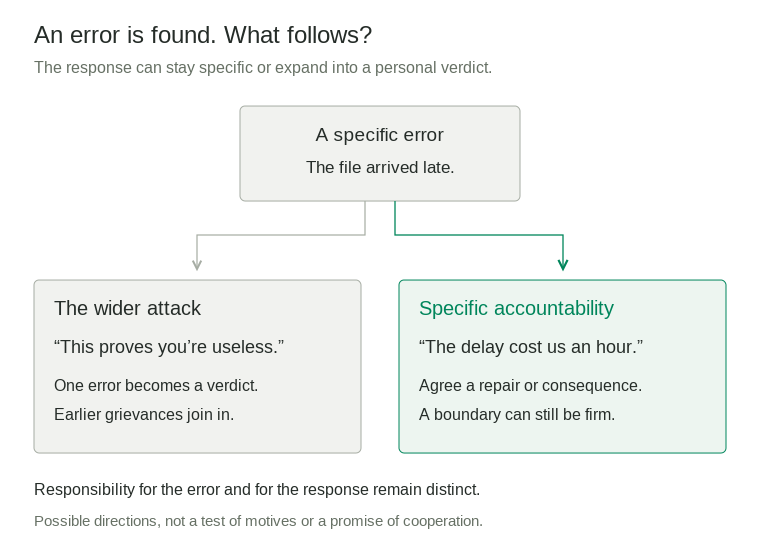
The late file needed addressing. Somewhere in the exchange, correcting a mistake became obtaining a verdict about a person.
The core pattern
Berne placed “Now I’ve Got You, You Son of a Bitch” among the Life Games in Games People Play (1964). His example concerns a customer who uses a small, unauthorised plumbing charge as grounds for an extensive personal attack. The customer’s legitimate objection becomes an opportunity to discharge accumulated anger. Berne’s estate-hosted excerpt
Its distinctive feature is the discovery of something defensible to attack: Now I have grounds.
In transactional analysis, a game is a recurring exchange with an apparent social purpose, an inferred psychological level, and a familiar ending or payoff. Here, the apparent purpose is accountability; the hypothesised function is obtaining justification for hostility. That interpretation does not require conscious plotting, and it cannot be established merely by observing anger. ITAA, Core Concepts
Strong criticism, refusing an apology, or imposing serious consequences can all be appropriate. The useful distinction concerns what the response addresses, how it proceeds, and whether repair remains relevant.
How the issue expands
The sequence may begin before the mistake. Someone watches closely, already expecting dishonesty, carelessness, or disrespect. When an error appears, uncertainty gives way to apparent certainty.
Attention shifts from the incident to the offender’s character. Explanations become further evidence against them. Earlier grievances accumulate. A practical correction may no longer satisfy, because the exchange is now pursuing an admission, submission, or opportunity to punish.
For Cara, being unquestionably right might offer temporary relief from feeling ignored. That is one possible interpretation, not knowledge of her motive. What we can observe is that Sam’s proposed repair receives little attention while the accusations widen.
Sam’s defensive explanations prolong the argument, but that does not make him responsible for Cara’s personal attacks. His silence or capitulation might simply be an attempt to end an unpleasant encounter.
The immediate ending can feel conclusive: one person has “proved” the other unreliable; the other has “proved” that admitting mistakes is unsafe. The practical problem survives inside a larger rupture.
Berne’s antithesis—and its limits
Unlike some entries, this one includes an explicit antithesis: Berne’s proposed counter-response. He recommends clear agreements and careful adherence to them, including accurate clinical billing. He also suggests temporarily yielding when an unforeseen dispute arises, until the therapist is prepared to address the game. Games People Play, “Life Games,” §4
Clear agreements can reduce ambiguity. They cannot guarantee protection from aggression, shifting demands, or fabricated accusations. Temporary concession may sometimes settle a minor dispute; it is not a general prescription to surrender a legitimate claim or tolerate coercion.
The responses below are Patternverse adaptations, not Berne’s prescriptions or validated treatments for this game.
Openings for change
Keep the complaint answerable
For the person making the complaint, an opening appears when the accusation starts expanding.
Cara could stop and say: “The file was late, and changing the meeting cost us an hour. I want to understand what happened and agree how we handle the next deadline.”
If older problems matter, they can be discussed separately, with examples and an opportunity to respond. Separating them makes each concern easier to examine.
The person receiving criticism can acknowledge an accurate complaint without endorsing a global verdict:
“I missed the deadline. I’ll contact the client and explain. I’ll discuss my reliability using specific examples, but I’m not going to agree that I’m useless.”
Sam first tries, “You’re just looking for an excuse to attack me.” Cara hears another accusation, and they argue about her intentions.
He revises: “We’re going beyond this morning’s delay. Can we finish the repair plan, then arrange a separate discussion about the other concerns?”
Cara refuses. Sam sends the repair plan in writing and requests a supported follow-up meeting. The immediate conversation ends without agreement.
Say what the mistake has touched
At home, Elena finds that her brother has returned her camera with its lens cap missing.
“I knew lending it to you was a mistake. You’ve always treated my things as disposable.”
He offers to replace the cap. She starts listing incidents from their childhood.
Then she stops: “I’m angry about the cap, but I also felt pressured to lend you something expensive. I should have said I wasn’t comfortable.”
Her brother agrees to replace it. Elena decides she will not lend the camera again. He thinks that is excessive.
They remain in disagreement, but there is a specific loss to repair and a clear boundary. Elena does not need a verdict on his entire character to decide what she will lend.
Understand the recurrence
When catching someone out repeatedly feels more satisfying than resolving the issue, there may be something else worth understanding: accumulated resentment, an unspoken limit, or fear of being dismissed.
That exploration belongs to the person concerned, perhaps with professional support. It should not become another accusation delivered by someone else.
Where cooperation is absent, a boundary may concern the form of contact: “I’ll answer the specific complaint in writing. I’m ending this call because the insults are continuing.” Someone can still correct their error while declining an abusive exchange. Where direct refusal is unsafe, support and safer arrangements take priority over demonstrating communication skill.
When it is a real accountability process
Leila has reported a leaking ceiling several times. After another unanswered message, she sends photographs, dates, and a firm request for an inspection.
The property manager replies, “You’ve just been waiting to catch us out.”
Her record establishes a continuing problem. It does not establish a covert wish to punish. She rejects another vague assurance and seeks independent support.
Repeated failures can warrant wider scrutiny, formal complaints, or ending a relationship. Looking for evidence after promises have repeatedly failed is not equivalent to waiting gleefully for a mistake. Accountability does not become a game because the person responsible dislikes being confronted.
Pitfalls and limits
“You’re playing Now I’ve Got You” can itself become a way to escape scrutiny. The label neither disproves the complaint nor reveals the complainant’s intentions.
An apparently small incident may also be the latest part of a serious pattern. Its significance depends on history, impact, authority, and available alternatives—not merely its immediate size.
Disability, distress, workload, unclear instructions, and discrimination may affect what happened. Investigating them need not remove responsibility; it can change what a fair response requires.
Berne’s account includes gendered marital assumptions and confident interpretations of hidden motives. These require historical distance. A person who makes an error has not thereby invited humiliation or abuse. Persistent put-downs and misuse of workplace power may themselves constitute bullying behaviours. Acas, Bullying at work
These adaptations are plausible communication choices, not an established treatment protocol. Evidence supporting TA generally would not, by itself, establish their effectiveness for this particular interaction.
Connections
Kick Me examines an interaction ending in familiar rejection. Here, the focus is the use of another person’s fault as permission to attack. Neither interpretation establishes that mistreatment was invited. Berne’s original entries
The Drama Triangle, developed by Stephen Karpman in 1968, offers a later TA lens on shifts between Persecutor, Rescuer, and Victim roles. These describe positions within the model; they do not determine who has actually suffered harm. Karpman’s original article
Specific accountability keeps facts, impact, repair, and consequences connected.
Boundaries without humiliation allow someone to decline further contact, lending, or collaboration without turning that decision into a verdict on another person’s worth. These last two are neighboring response concepts, not claims about existing Patternverse entries.
Sources and attribution
Historical description and antithesis: Eric Berne, Games People Play (1964), “Life Games,” §4, checked against the full entry and estate-hosted excerpt. Later TA concepts and workplace guidance are linked where discussed.
All encounters are fictional. The examples, explanatory diagram, and practical responses are original Patternverse adaptations.