
When treatment becomes a way to protect a role.
“That sounds like my avoidant attachment pattern,” Leah says.
Her therapist, Arun, asks what happened when her sister called.
“I became activated. Then I intellectualized.”
Arun has heard increasingly fluent explanations over several months, while the conflicts Leah came to discuss continue. He feels uncertain about his effectiveness.
“Perhaps understanding has become another defense,” he says.
“So even my insight is a problem?”
“I’ve worked with this pattern many times.”
“And I’ve been in therapy for fifteen years.”
The conversation becomes a comparison of qualifications: Arun’s clinical experience and Leah’s experience of treatments that have disappointed her. They leave with familiar explanations. He thinks she resists help; she thinks another therapist cannot help her.
Leah wants relief and fears being dismissed again. Arun wants to be useful and finds his uncertainty uncomfortable. Neither has discovered much about the telephone call—or about what just happened between them.
The core pattern
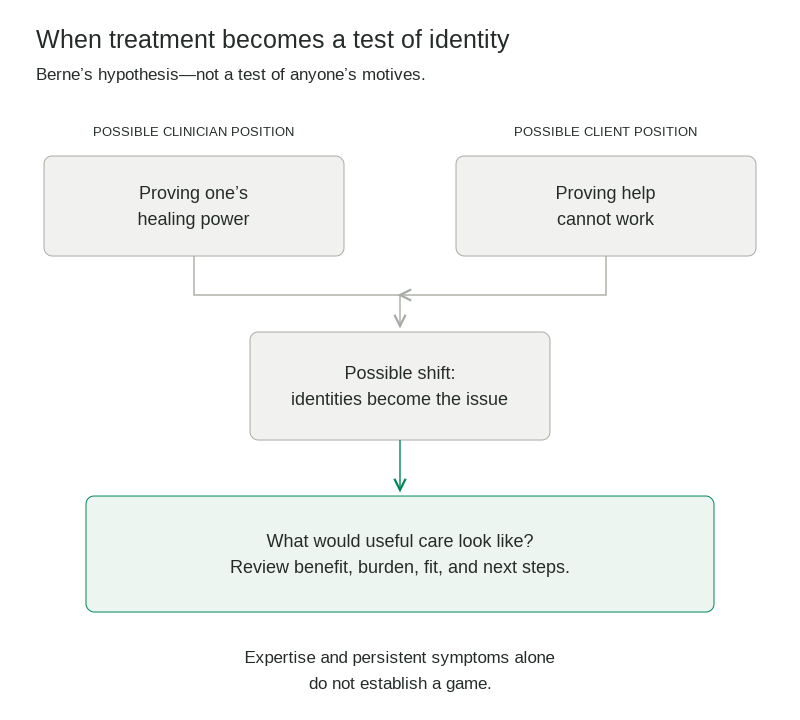
“Psychiatry” is the fifth entry in the “Consulting Room Games” chapter of Eric Berne’s Games People Play (1964). He explicitly distinguishes psychiatric treatment from the game. His clinician-side concern is identification with being a healer; his patient-side hypothesis concerns apparently seeking help while demonstrating that help cannot succeed, sometimes learning increasingly sophisticated therapeutic explanations along the way. Berne’s original description
In transactional analysis, a game involves an apparent purpose and a less explicit psychological function. Here, the announced purpose is treatment. The proposed function is preserving a familiar position within treatment.
That position might concern professional authority, being an exemplary patient, or being someone no professional can understand. These are hypotheses, not conclusions available from a diagnosis, vocabulary, or treatment history.
The useful distinction is whether therapeutic knowledge remains open to correction. Can people examine the approach, the relationship, and the results—or must every development confirm an established account?
Long treatment, persistent symptoms, disagreement, and psychological sophistication do not answer that question by themselves.
How the interaction sustains itself
In the fictional opening, Leah offers an explanation. Arun supplies an interpretation of that explanation. She challenges it; he invokes experience; she invokes her own.
The exchange shifts from understanding a difficulty to defending credibility.
As a Patternverse interpretation, Arun’s certainty might protect him from acknowledging that his approach needs review. Leah’s detailed explanations might help her stay engaged while keeping a vulnerable experience at a manageable distance. Her expectation of disappointment might also make another disappointing encounter feel familiar.
None of these possibilities establishes that she wants to remain distressed.
The immediate protections can coexist with considerable costs. Arun avoids uncertainty but receives less candid feedback. Leah avoids feeling exposed but leaves feeling misunderstood. Each departure reinforces the expectation brought to the next appointment.
Responsibility is unequal. A clinician controls aspects of the setting, holds professional authority, and has duties that the client does not share. Describing an interaction involving two people does not divide responsibility evenly.
The pattern becomes especially restrictive when disagreement itself is treated as confirmation: accepting the interpretation proves it right; rejecting it proves resistance. The explanation can no longer be meaningfully questioned.
Berne’s antithesis
Berne’s proposed antithesis—a response intended to interrupt the game—emphasizes professional humility: apply learned procedures in the hope of helping, without treating professional status as a guarantee of healing. He invokes Ambroise Paré in making this distinction. Berne’s discussion
This is a clinical stance, not a demonstrated solution. Humble wording changes little if the practitioner continues treating every difficulty as the client’s failure.
A later TA institutional reference point is the ITAA’s emphasis on agreements about outcomes the client desires. Its 2024 ethics code also addresses autonomy, protection, and practitioners’ personal agendas. These principles support reviewing the work collaboratively; they do not validate a specific intervention for this game. ITAA, “Contracts”, ITAA Code of Ethics
Openings for change
The following are original Patternverse adaptations, not established antitheses or validated treatments.
Interrupt the contest over interpretation
Arun can describe his own participation:
“I notice I started defending my expertise when you questioned the interpretation. I’d like to understand what you were telling me before that happened.”
This creates an opening without requiring Leah to agree that she is playing anything.
Leah can also name the difficulty directly:
“Can I say that a session left me feeling worse without that becoming evidence that I’m resisting?”
The response matters more than the elegance of the question. A practitioner who welcomes feedback needs to demonstrate that welcome when it is uncomfortable.
Recover the experience beneath the explanation
Arun initially tries another correction.
“Let’s put the labels aside and talk normally.”
Leah feels chastised for using language she learned in therapy. She becomes quieter.
He revises his approach:
“That sounded dismissive. Those ideas may help you describe things. I’m missing what the call was like for you. Would it help to start there, or is there something about how I’m responding that we need to address first?”
Leah says she felt ashamed before answering her sister. She also admits that arriving with a polished explanation feels safer than arriving confused.
Arun acknowledges that his interpretive responses may have encouraged that preparation. They agree to make more room for uncertainty.
The family conflict remains unresolved. Their progress is a clearer account of the encounter and greater freedom to question the therapy itself.
Agree on what useful care means
A review can consider several kinds of value: relief, understanding, stability, improved relationships, practical functioning, or support through an ongoing condition. It can also examine burden, adverse effects, access, and what has not helped.
A client might say:
“These conversations help me feel less alone. I also want us to review whether this approach addresses the panic.”
A clinician might respond:
“We can value the support and still reconsider how we are addressing that difficulty.”
This avoids making immediate symptom reduction the only legitimate outcome. It also avoids assuming that attendance or fluency demonstrates benefit.
Make room for limits and alternatives
Someone may need a different explanation, a revised assessment, another approach, or a second opinion. Sometimes the most honest conclusion is that the current practitioner cannot offer what is needed.
A clinician can acknowledge limits and discuss appropriate continuity of care. A client can request a review or seek independent support without first persuading the clinician to accept a game interpretation.
If feedback repeatedly produces blame, the person may choose to end the relationship or use an available complaints process. A clinician’s refusal to reconsider cannot be solved by a client finding the perfect phrase.
When persistent difficulty means something else
Sofia has recurrent depression and has received several treatments. She knows the terminology and can describe previous approaches in detail. Her symptoms remain substantial.
Her clinician does not treat that history as a challenge to defeat. They review what helped, what caused problems, and what Sofia currently wants from care.
She reports that regular contact helps her remain connected during difficult periods, although it has not removed the depression. They discuss the continuing limitations and options together.
There is no reason to infer a game from this outcome. Knowledge can support informed participation. Continuing care can have value even when recovery is incomplete.
Likewise, exploring childhood, grieving, or understanding relationships need not produce an immediate behavioral result to be worthwhile.
Pitfalls and limits
The greatest danger is using “Psychiatry” to make treatment failure unfalsifiably the patient’s fault. A condition does not become manipulation because it persists.
Berne’s entry includes a vignette treating anger at an indifferent response to childhood abuse as game material. That framing risks dismissing victimization and legitimate distress. Historical vignette
Abuse, coercion, discrimination, disability, poverty, and unsafe living conditions require attention in their own right. They cannot be explained away as investments in a therapeutic role.
Later criticism within TA challenges the substitution of psychological game explanations for actual circumstances and harm. Julie Hay’s argument is a useful restraint on overusing this entry. Hay, “Game changing dynamics,” 2022
The model should also apply scrutiny to its own use. An analyst who interprets every objection as another game may become equally unable to learn.
The cited sources do not establish a reliable diagnostic test for “Psychiatry” or demonstrate effectiveness for these adaptations. Evidence about TA generally would not establish either claim.
Connections
“Tell Me This.” Berne’s variant turns questioning into a demonstration that the helper has done their part when the patient cannot answer. Inquiry becomes a contest. Berne’s variant
“Peasant.” Admiration and special recognition can protect a therapeutic arrangement from honest feedback.
“I’m Only Trying to Help You.” Here, unsuccessful assistance becomes the helper’s grievance about apparent ingratitude.
Collaborative review. Shared examination of benefit, burden, and fit keeps professional knowledge accountable to the person receiving care.
Sources and attribution: Historical account, variants, and antithesis: Eric Berne, Games People Play (1964), “Psychiatry.” Later TA context: the ITAA documents and Julie Hay (2022), linked above. Encounters, practical responses, and illustration are original Patternverse adaptations.