
When a difficulty becomes a verdict about a person.
“I’ve done it again,” Rae says, looking at the staff rota. “Wednesday twice. You know me—the office idiot.”
A colleague laughs. “We should keep you away from anything important.”
Rae laughs too. The mistake feels less embarrassing once everyone is amused. Someone else takes the spreadsheet and finishes it.
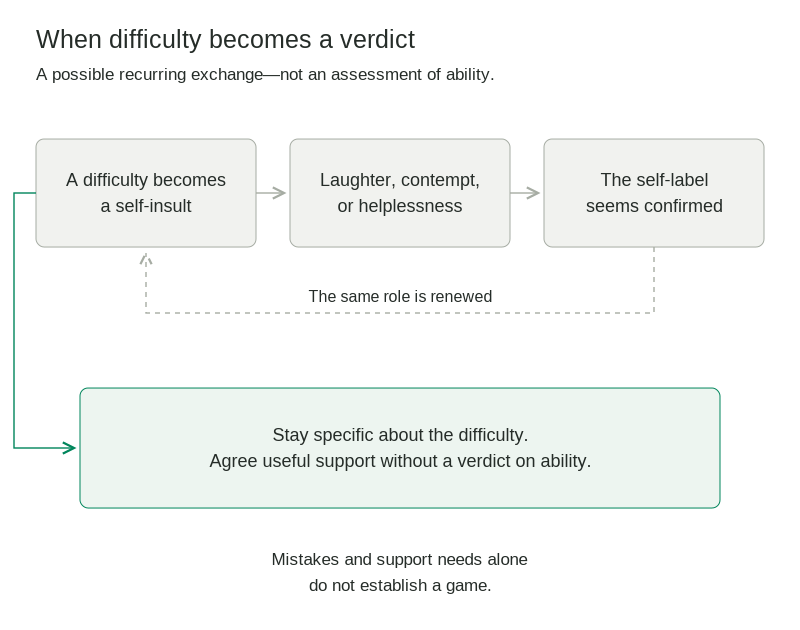
Similar exchanges follow over the next few weeks. Rae jokes before anyone can criticize her; colleagues supply the familiar response.
Then a supervisor asks another employee to learn the new scheduling system.
“I thought I could do that,” Rae says.
Her colleague looks surprised. “But you’re always saying you’re hopeless with this stuff.”
What began as a way through embarrassment has helped establish a role Rae now finds difficult to leave.
The core pattern
“Stupid” is the sixth entry in the “Consulting Room Games” chapter of Eric Berne’s Games People Play (1964). The title is historical and demeaning; it should not become a label for a person.
Berne’s defining feature is an interaction that elicits being called stupid or treated accordingly. He distinguishes a milder, apparently humorous form from a more confrontational form that invites others’ helplessness or exasperation. Berne’s original description
In transactional analysis, a game involves recurring exchanges with an apparent purpose and a hypothesized psychological function. Here, apparent joking or asking for help may also secure confirmation of a familiar negative identity.
That is an interpretation to investigate—not evidence that mistakes are deliberate.
The useful focus is the movement from a particular difficulty to a global judgment: one error becomes proof of what someone is, and other people begin responding to that identity.
Self-deprecating humor, repeated mistakes, or needing substantial assistance does not establish the pattern.
How the exchange sustains itself
In the fictional opening, Rae makes an error, supplies the insult herself, and receives laughter. A colleague takes over. Everyone gets through the awkward moment.
The next time, the response comes more easily. Rae knows how to make the situation socially manageable. Her colleagues know their lines.
As a Patternverse interpretation, joking first might give Rae some control over anticipated humiliation. Joining in might help colleagues avoid an uncomfortable conversation about training or workload. Taking over might relieve immediate pressure.
These possibilities do not tell us what Rae consciously wants.
The longer-term costs are more observable: fewer opportunities to learn, less specific feedback, and decisions made on Rae’s behalf. When she objects, her earlier jokes are cited as permission.
There may also be a change in emotional tone. Shared amusement becomes resentment when someone discovers that others have taken the role seriously.
Responsibility remains unequal. A supervisor who controls assignments has greater power than an employee trying to belong. A person’s self-insult does not authorize colleagues to demean or exclude them.
Berne’s responses—and their limits
For the milder form, Berne proposes declining ridicule and derision. He also cautions against sweeping reassurance, favoring respect for particular abilities. For the more confrontational form, he explicitly acknowledges that there is no easy solution: either action or inaction may become confirmation of the familiar position. Berne’s antithesis
These are historical clinical proposals, not demonstrated treatments.
Berne also links the pattern to depressive states and historical mood-disorder categories. His entry supplies no basis for using a mood-disorder diagnosis as evidence that someone is playing a game.
Later TA writing has challenged ableist assumptions. In their publicly available abstract, Beren Aldridge and Ronen Stilman propose a neurodiversity-informed revision of TA and discuss negative self-concepts associated with being categorized as lazy, stupid, or disruptive. This is a theoretical development, not an evaluated antithesis for this game; the full article was unavailable for this entry. Aldridge and Stilman, 2024
Openings for change
The following are original Patternverse adaptations, not Berne’s established prescriptions or validated treatments.
Respond to the difficulty without endorsing the insult
A colleague can remain warm while staying specific:
“There are two Wednesdays in this version. Shall we check where the dates shifted?”
This addresses the error without requiring a debate about intelligence.
Someone noticing their own self-insult can translate it into a clearer request:
“I’m embarrassed, and I’m getting confused by the dates. Could you show me that step again?”
The request does not guarantee a considerate response. It makes the actual difficulty easier to discuss.
Avoid turning reassurance into another argument
Rae’s colleague initially tries to repair things with enthusiasm.
“Don’t be ridiculous. You’re brilliant!”
Rae replies, “You only say that because you feel bad.”
The colleague changes course.
“I don’t need to rank your intelligence. I joined in with a joke that became hurtful. Do you want help checking the sheet, or would you prefer to finish it yourself?”
Rae asks for help checking it. Later, she tells her supervisor that she wants to learn the new system.
The supervisor agrees to a supported trial. Rae still makes errors and needs a written sequence. The useful change is that those needs can be addressed without treating them as her identity.
Keep help negotiable
In a more difficult fictional exchange, Amir tells a counselor, “I’m thick. Nothing gets through. You fix it.”
Repeated reassurance irritates him. When the counselor falls silent, he says, “So you’ve given up too.”
There is no phrase that reliably resolves this arrangement. A possible response is:
“I hear how defeated you feel. I’m not going to call you names or pretend this is easy. Can we work out what you wanted help understanding today?”
Amir declines. They stop trying to solve the task and discuss whether he wants to continue the conversation. The counselor considers what assessment or support may be needed rather than treating refusal as proof of concealed intent.
Understand the recurring difficulty over time
Repeated self-insults may warrant exploring where the person learned that role, what happens when they ask directly for help, and whether others punish attempts to change.
That inquiry should also examine teaching, accessibility, fatigue, fear, and the demands of the task.
If colleagues continue the jokes, Rae can set a boundary: “I used that word about myself. I don’t want it used about me now.”
She cannot make them cooperate. She can document repeated incidents, seek appropriate support, or end a particular exchange. Maintaining a boundary does not require proving that she never struggles.
When similar behavior has another explanation
During a training session, Nina repeatedly asks for instructions to be read aloud.
“I’m being stupid,” she says after losing her place again.
The trainer notices that Nina understands the explanation when it is spoken but struggles with the dense written handout. Nina explains that she has dyslexia and has been trying to manage without drawing attention to it.
They agree on accessible instructions and more time. Nina continues to need support.
Her self-insult may reflect experiences of being judged; it does not establish a covert interaction aimed at confirming incapacity. NHS guidance notes that adults with dyslexia can have uneven strengths and difficulties and may benefit from changes such as screen readers or information on video. NHS, dyslexia in adults
Difficulty learning in one format is information about support needs, not evidence of manipulation.
Pitfalls and limits
The most consequential misuse is assuming that someone could perform if they stopped “playing stupid.” Intellectual disability, specific learning difficulties, neurodivergence, illness, distress, language barriers, and inadequate instruction deserve attention in their own right.
Being capable in one situation does not prove that difficulty elsewhere is feigned. People also do not have to reveal an exceptional talent to deserve respect.
Humiliation and bullying remain the responsibility of those who enact them. A victim’s nervous laughter, appeasement, or self-criticism does not invite abuse.
Contemporary ITAA ethics calls for dignity across differences in functioning and circumstances. That commitment should govern interpretation, particularly when the historical vocabulary itself can wound. ITAA Code of Ethics, 2024
The cited sources do not establish a reliable diagnostic test for this pattern or effectiveness for these adaptations. Evidence about TA generally would not establish either.
Connections
“Schlemiel.” Berne distinguishes seeking forgiveness after mishaps from eliciting confirmation of a negative identity. Berne’s distinction
Self-deprecating humor. Humor can soften embarrassment without establishing a restrictive role. Its meaning depends on context, consent, and consequences.
Specific feedback and accessible support. Naming what happened and what assistance is useful avoids turning performance into a judgment of the whole person.
Sources and attribution: Historical description and antithesis: Eric Berne, Games People Play (1964), “Stupid.” Later TA context: Aldridge and Stilman (2024), public abstract only, and the ITAA ethics code. Learning-support context: NHS guidance. Encounters, practical responses, and illustration are original Patternverse adaptations.