
When a quarrel makes distance easier than asking for it
A familiar scene
After dinner, Amir suggests that he and Nell spend the evening together.
Nell looks at the kitchen. “You’ve left everything for me again.”
“I cooked.”
“And apparently that means the rest is my problem.”
Within minutes, they are arguing about whose work matters, who always complains, and what happened last weekend. Amir says, “Forget it.” Nell disappears into the bedroom. A door slams.
The kitchen remains untidy. Neither mentions the evening they had planned.
Behind the anger, Nell feels relief: she wanted time alone but dreaded another conversation about their dwindling intimacy. Amir also feels relief. He no longer has to risk asking whether she still wants him.
Tomorrow, they may apologise for shouting. The questions underneath remain untouched.
The core pattern
Eric Berne places “Uproar” fifth in the “Sexual Games” chapter of Games People Play (1964). His characteristic sequence moves from fault-finding and retaliation to escalating voices and withdrawal, marked by a slammed door. He interprets the resulting separation as a way to avoid sexual intimacy. Berne estate: “Uproar”
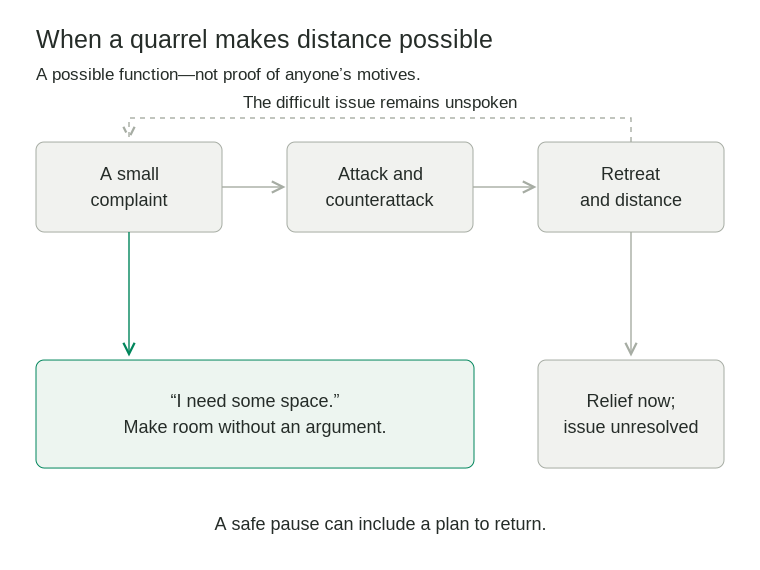
The distinctive feature is the ending: anger provides a reason to separate without directly discussing the distance wanted or feared.
Within transactional analysis, or TA, a game involves an apparent exchange and a hypothesised psychological function. The apparent purpose here is settling a grievance. The proposed function is obtaining distance while leaving a more difficult issue unspoken.
That interpretation exceeds what an observer can see. Raised voices and retreat are observable; a wish to avoid intimacy is not. A real grievance may deserve attention regardless of any additional function the argument serves.
Applying the idea to emotional closeness or an ordinary need for solitude is a Patternverse extension. A single argument, a refusal of intimacy, or leaving an overwhelming conversation does not establish a game.
How the interaction sustains itself
The following is a Patternverse explanation of one possible recurring arrangement.
A moment of anticipated closeness or difficult conversation approaches. Someone raises a complaint, perhaps a legitimate one. The response shifts from addressing the complaint to defending character: “Nothing I do is enough.”
Counteraccusations follow. The original issue becomes difficult to locate. Eventually, one person withdraws, the other gives up pursuing, or both retreat.
Separation brings immediate relief. Nobody has to say, “I want to be alone,” “I’m afraid you’ll reject me,” or “I don’t know how I feel about our relationship.”
That relief might help sustain the sequence without anyone consciously arranging it. The longer-term costs include unresolved practical problems, reduced trust, and increasing difficulty approaching one another.
Each person can examine their own actions without assuming equal responsibility. Criticism, insults, threats, pursuit, and withdrawal are different behaviours with different consequences. A person retreating from intimidation is protecting themselves; that does not demonstrate a shared psychological payoff.
Openings for change
Interrupt the escalation without settling the relationship
Berne’s antithesis includes a daughter leaving through early or forced marriage, changes in the mother’s sexual behaviour, or the father finding an outside sexual interest. These are historically important, ethically troubling proposals—not recommendations adopted here. Forced marriage is coercion, and children are not responsible for managing adults’ sexuality. Games People Play, antithesis
The suggestions below are original Patternverse adaptations, not Berne’s prescriptions or validated treatments.
Someone can interrupt their own participation:
“I’m getting louder and starting to insult you. I need to stop this conversation.”
Where both people are safe and willing, a pause can include a specific proposal to resume:
“Can we return to the kitchen problem at eight?”
The purpose is to interrupt escalation while preserving a route back to the actual issue. A pause should not require permission to leave danger.
Ask for distance directly
Nell could make the immediate need explicit:
“I want an evening alone. I know we’ve been distant, and I’m willing to discuss that tomorrow.”
Amir could separate his disappointment from a demand:
“I was hoping for time together. I’m disappointed, but you don’t have to spend tonight with me.”
Neither statement resolves their relationship. It does make separation possible without manufacturing a justification through conflict. Declining sex, affection, or conversation requires no quarrel to make it legitimate.
Keep the practical issue available
The kitchen may still represent an unfair division of work. Recognising a possible pattern should not erase that grievance.
A later conversation can distinguish two matters:
“I needed space last night. I also need us to agree who cleans after dinner.”
They may discover that exhaustion and resentment have been affecting their desire for closeness. That is something to understand through their accounts, rather than presume in advance.
Revise a response that becomes another accusation
The next evening, Amir says, “You start fights whenever I want to get close.”
Nell hears an accusation that her complaints are dishonest. They begin arguing about her motives.
Amir stops and revises:
“I don’t know why it happens. I notice we often end these evenings in separate rooms, without talking about either the chores or our relationship.”
Nell acknowledges wanting solitude. She also says she has felt pressured to make every quiet evening an opportunity for intimacy.
They agree to discuss household work on Sunday and leave tonight unplanned. Amir still feels rejected. Nell still feels wary. They have gained clearer information, rather than a neat reconciliation.
If one person refuses discussion, the other can still change their own conduct and set limits. They cannot compel openness or guarantee reconnection. Persistent insults, intimidation, or punishment for requesting space call for attention to safety and outside support.
What evidence supports a pause?
There is relevant evidence outside TA, with important limits. A 2024 laboratory experiment found that short imposed delays reduced aggressive noise-blast choices between romantic partners when negative emotion was high. It did not test “Uproar,” establish why couples quarrel, or demonstrate that a particular pause resolves arguments at home. McCurry, May, and Donaldson, 2024
Gottman-based guidance also recommends taking time apart to settle rather than rehearsing the argument. That is clinical guidance, distinct from evidence validating Berne’s interpretation. Gottman Institute: conflict and flooding
A contrast: retreat as protection
Seventeen-year-old Leah returns home later than expected. Her father shouts insults, threatens to throw her belongings outside, and follows her as she tries to leave the room.
Leah shouts back, closes her bedroom door, and contacts a trusted adult. The next day, she speaks with a member of staff at school about what happened.
From outside, someone might describe raised voices followed by retreat. That resemblance is insufficient. The threats and unequal authority matter more than the shape of the exchange.
Leah’s priority is safety and support. She is not responsible for finding a calmer phrase that will make her father behave differently, and her retreat does not establish that she wanted or benefited from the confrontation.
Pitfalls and limits
Berne’s central family example attributes sexual tension to conflict between a father and adolescent daughter and implicates the mother’s sexual life. Those assumptions should not be inferred from ordinary family arguments or used to explain away coercion. His gendered language and allocation of responsibility require explicit criticism.
Later TA writing offers a broader corrective. Julie Hay challenges the use of psychological game language where it displaces actual victimization, power, and material consequences. This is a critical development within TA, not a tested replacement treatment for “Uproar.” Hay: “Game changing dynamics”
Pain, disability, sensory overload, fatigue, distress, and real external pressures can make withdrawal necessary. Anger can express a justified objection. Quiet speech can carry threats. Loudness alone tells us little about responsibility.
Current ITAA ethics emphasise dignity, empowerment, protection, and responsibility. Those principles support examining conduct and power without presuming hidden agreement. ITAA Code of Ethics
The model remains interpretive. Relief after an argument does not prove that someone created it for relief, and reluctance to reconnect does not prove avoidance of intimacy.
Connections
Direct requests for space. These make distance available without requiring conflict.
A pause with a return plan. In a safe relationship, this distinguishes temporary separation from abandoning an unresolved issue.
Demand and withdrawal. Pursuit and retreat describe observable interaction; they do not establish a shared hidden purpose.
Sources and attribution
Berne supplies the historical formulation and antithesis. Later perspectives draw on Hay and ITAA ethics; the pause discussion distinguishes experimental findings from clinical guidance. The fictional encounters, illustration, broader applications, and response suggestions are original Patternverse adaptations.