
The shared pleasure of a well-made compliment.
“You have a talent for making strangers feel expected,” Lea tells Mara.
They are at Mara’s dinner table. Two guests who arrived knowing nobody are now absorbed in conversation.
Mara smiles. “I’m keeping that sentence.”
“You’re welcome to it.”
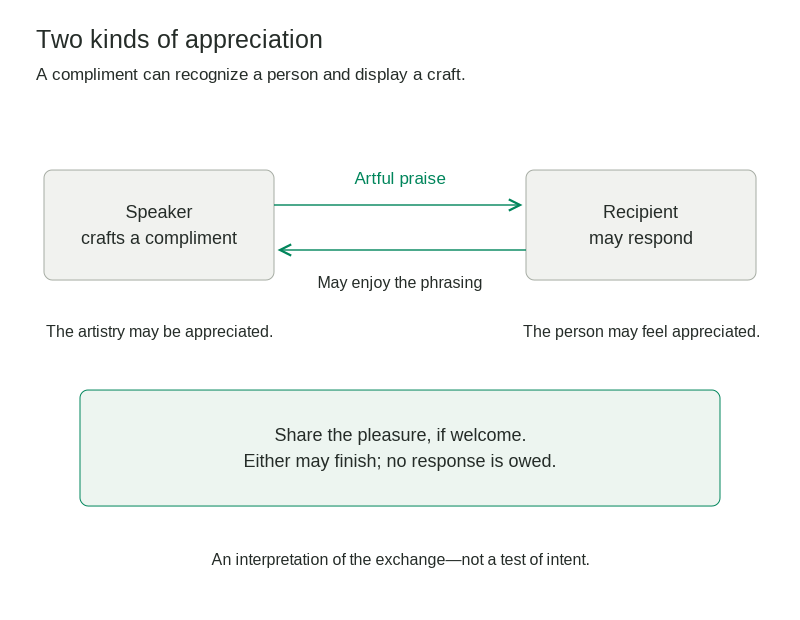
The friends enjoy these small exchanges. Lea likes finding a phrase that fits; Mara appreciates both the observation and its expression.
Lea could elaborate. Instead, she notices Mara turning toward the kitchen.
“Shall I bring the plates?”
The moment ends easily. Mara has received appreciation. Lea has enjoyed offering it with some artistry. Neither understands the exchange as a promise of anything further.
The core pattern
“Cavalier” is the second entry in the “Good Games” chapter of Eric Berne’s Games People Play (1964). He describes creative compliments offered for their artistry rather than as a means of seduction. The recipient enjoys the appreciation; the speaker enjoys having their expressive skill recognized. Berne’s original description
His analysis distinguishes two levels: appreciation of the recipient’s qualities and appreciation of the speaker’s ingenuity. This double recognition makes “Cavalier” more specific than ordinary praise. Berne’s partial analysis
In transactional analysis, a game involves an apparent exchange and a less explicit psychological function or reward. “Cavalier” sits awkwardly within that terminology because both participants may understand and enjoy the performance.
The useful Patternverse interpretation is modest: someone can appreciate a person while also enjoying the craft of expressing it. Recognizing that possibility need not turn the encounter into a diagnosis.
A pleasing compliment alone establishes neither a game nor a hidden romantic intention.
Berne’s original account assigns the creative role to a man and the appreciative role to a woman. The fictional encounters here are broader Patternverse adaptations, not a description of his original casting.
How the exchange develops
Lea notices something particular and gives it an expressive form. Mara responds to both the observation and the phrasing. Lea accepts that recognition without requiring the exchange to continue.
The constructive sequence is an offer, an appreciative response, perhaps some further play, and a comfortable ending.
As a Patternverse explanation of the fictional encounter, Lea might enjoy verbal invention and the pleasure of getting an observation right. Mara might enjoy feeling seen, alongside the small surprise of an unusual phrase. Their amusement may reinforce an existing friendship.
Those are possible functions, not motives that an observer can reliably read from elegant language.
In the constructive form, there need not be a dramatic reversal. A shared moment can simply finish. Its familiar outcome is mutual pleasure, rather than humiliation or defeat.
The arrangement becomes more restrictive when the speaker needs a particular response. An appreciative smile becomes an expectation of laughter, praise, or continued attention. The recipient is then managing the speaker’s feelings rather than freely enjoying the offering.
Stopping is part of the skill. A successful compliment does not become more successful merely because it is followed by three more.
Berne’s antithesis—and its problem
Berne supplies an antithesis section, but largely describes the response he considers complementary: appreciating the creative production. He also disparages women who refuse participation and interprets rebuffs through his stigmatizing “Rapo” category. Historical antithesis
That treatment of refusal is unacceptable. A speaker’s claimed intention does not determine what another person must enjoy. Declining, misunderstanding, or ending an exchange is not evidence of stupidity, hostility, or a psychological game.
Because “Cavalier” belongs to Berne’s constructive category, there is no reason to invent a problem that everyone must escape. The useful task is to preserve what is enjoyable while making participation optional.
Later TA institutional summaries provide another vocabulary: a stroke is recognition, including verbal appreciation. The ITAA’s 2024 ethics code emphasizes dignity, autonomy, and protection. These are conceptual and ethical reference points, not a tested replacement intervention for this particular game. ITAA, “Strokes”, ITAA Code of Ethics
Cultivating the constructive form
The suggestions below are original Patternverse adaptations, not Berne’s established prescriptions or validated treatments.
Let the observation lead the ornament
A compliment becomes more personal when it notices something actual.
“You explained that difficult point without making anyone feel foolish” gives the recipient something recognizable. Between people who enjoy verbal play, a more elaborate expression may follow naturally.
The artistry should remain connected to the observation. If the phrase could be delivered unchanged to almost anyone, its main function may be displaying the speaker’s repertoire.
That need not make it malicious. It may simply make it less personal.
Leave room for an ordinary response
A recipient may say:
“Thank you. That means a lot.”
Or, if the expression itself pleased them:
“That was beautifully put.”
Neither response needs to become a compliment in return. Awkwardness, silence, or a change of subject also creates no debt.
The speaker can receive what is offered and move on. Trying to extract a more appreciative reaction changes the terms of the encounter.
Revise a performance that misses
At a book-club gathering, Daniel tells Nadia that her questions are “a lighthouse rescuing us from the shipwreck of our own opinions.”
Nadia laughs briefly. Daniel continues with another metaphor.
“Please don’t make me the evening’s entertainment,” she says.
He initially protests: “I was paying you a compliment.”
Then he stops defending the intention.
“I overdid it. I appreciated your question about the ending. I’ll leave it there.”
Nadia accepts the clarification but remains uncomfortable for a while. They return to discussing the book with other people.
The useful response is not a better line. Daniel notices that his pleasure in performing has overtaken her pleasure in receiving it. Their conversation can continue without requiring Nadia to endorse the performance.
Make another wish direct
Compliments may accompany a wish for companionship, reassurance, or romantic attention. Those wishes need not be shameful.
They become easier to answer when expressed directly:
“I’ve enjoyed talking with you. Would you like to meet again?”
The recipient can then respond to an invitation rather than decipher what continued praise is supposed to mean.
Over time, someone repeatedly hurt by unreturned compliments might explore what recognition they were hoping to receive. Someone repeatedly uncomfortable receiving praise might explore that experience too—if they want to. Neither inquiry is a condition of being allowed to end an exchange.
When similar words mean something else
On a first date, Ivo tells Sam, “I like how animated you become when you talk about your garden. I’d like to see you again.”
The words are appreciative and carefully chosen, but the romantic wish is explicit. Sam says they enjoyed the afternoon but do not want another date. Ivo accepts the answer.
There is no need to interpret this as “Cavalier.” It may simply be affection and a straightforward invitation.
Likewise, a colleague saying, “Your clear notes helped me finish the report,” may be ordinary thanks. A second psychological purpose should not be invented because the words were pleasing.
Pitfalls and limits
The historical arrangement gives one person creative initiative and assigns the other appreciative reception. A contemporary adaptation should allow everyone to offer, respond, redirect, or decline.
Context matters. A manager, teacher, clinician, customer, or influential acquaintance may hold power that makes polite participation difficult to interpret. A smile can express enjoyment, courtesy, uncertainty, or an attempt to manage the situation.
Repeated appearance-focused comments can be unwelcome even when the speaker considers them elegant. A recipient need not prove hidden intent before asking that they stop.
If the speaker persists, mocks a boundary, or punishes refusal, the concern is the conduct itself. The recipient does not have to resolve its game classification before seeking support or ending contact.
Communication style, culture, language, disability, and personal preference can also affect how praise is offered and received. An unexpected response does not establish coldness, vanity, or incapacity.
The sources consulted here provide historical interpretation and ethical guidance. They do not establish a diagnostic test for “Cavalier” or demonstrate that these adaptations improve wellbeing or prevent conflict. Evidence about TA generally would not establish those specific claims.
Connections
“Peasant.” Admiration can become organized around an exceptional person. “Cavalier” particularly concerns appreciating the expression or performance.
Straightforward appreciation. Specific thanks can be complete without inviting verbal play.
Direct invitations. Naming a wish for friendship or romance makes the proposed relationship easier to answer freely.
Recognition without obligation. Appreciation can be offered generously while leaving the recipient’s response their own.
Sources and attribution: Historical description and antithesis: Eric Berne, Games People Play (1964), “Cavalier.” Later TA context: the ITAA’s Core Concepts (2000) and Code of Ethics (2024), linked above. Encounters, practical suggestions, and illustration are original Patternverse adaptations.