
When participation becomes a defence against responsibility
A familiar scene
At their fifth counselling session, Arun lists what he has done: attended every appointment, bought the recommended book, and arranged dinner twice.
Leila asks about the agreement to discuss difficult decisions before making them.
“Nothing I do is ever enough,” he says, turning towards the counsellor. “You’ve seen me trying.”
The next week, he cancels. Leila says she cannot continue the relationship on its present terms.
Later, Arun tells a friend, “I went to counselling. I did everything she asked. She’s the one giving up.”
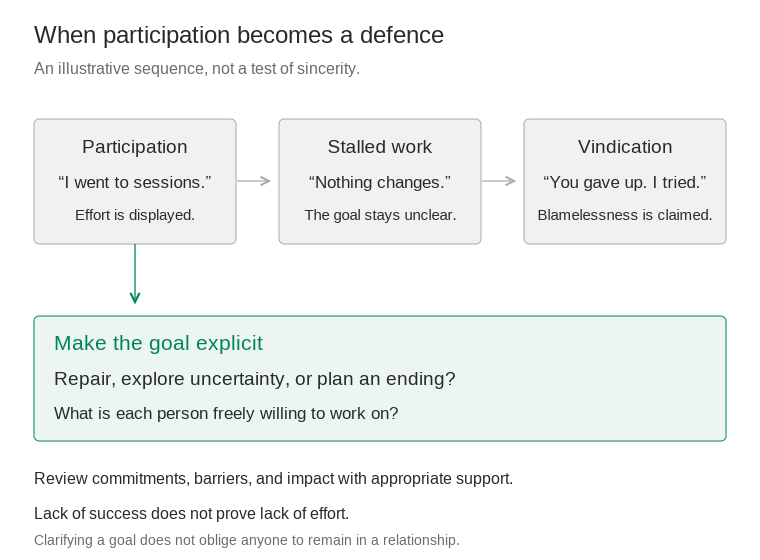
His attendance is real. So is her disappointment. What remains unclear is whether they were working towards the same goal—or whether participation has become evidence intended to settle who bears responsibility for the ending.
The core pattern
Berne placed “Look How Hard I’ve Tried” among the Marital Games in Games People Play (1964). His principal example involves a couple and a psychiatrist: one spouse wants to leave while claiming to seek reconciliation, participates sufficiently to demonstrate cooperation, then withdraws. When the other initiates divorce, the participation becomes grounds for claiming blamelessness. Berne’s estate-hosted account
The distinctive move is effort presented as an alibi for an outcome that the person has not openly acknowledged wanting.
In transactional analysis, a game means a recurring exchange with an apparent purpose, an inferred psychological function, and a familiar ending or payoff. Here, the apparent purpose is repair; the hypothesised function is vindication without openly owning a different aim. Neither wanting to leave nor attending unsuccessfully establishes that interpretation. ITAA, Core Concepts
Recognising the possibility can help when repeated demonstrations of cooperation replace discussion of willingness, commitments, and consequences. It cannot establish someone’s sincerity from their results.
How the demonstration becomes the point
The sequence may begin with pressure to change. Someone agrees to a process: counselling, a course, a new arrangement. Visible participation receives approval.
When difficulties continue, attention shifts towards the record of effort. Questions about an unfulfilled agreement become accusations of ingratitude. A helper may be recruited as witness: You saw what I did.
Eventually someone stops the process or ends the relationship. That decision is presented as proving who failed.
In Arun’s encounter, we can observe attendance, an unanswered concern, withdrawal, and a claim about Leila’s responsibility. We cannot infer his private aim from those events alone.
A possible function is avoiding the guilt or social judgment associated with openly wanting an ending. The other person may keep organising another attempt because they hope a clearer method will restore commitment. The helper may inadvertently sustain the arrangement by praising attendance without checking its purpose.
These contributions do not imply equal responsibility. Someone’s effort can be genuine while its use as a blanket defence remains unfair.
Berne’s antithesis—and its limits
Berne proposes seeing the couple together, then offering individual treatment to the spouse more ready to engage while ending the other’s participation. He hopes the disruption will lead the latter to distress and subsequently more genuine treatment elsewhere. Original entry, “Marital Games,” §6
That is a historical clinical proposal, not a standard solution to apply oneself. Distress should not be manufactured to motivate change. Professional transitions require attention to consent, roles, safety, and continuing care.
The useful underlying question is whether there is an agreed purpose for the work. The following responses are Patternverse adaptations, not Berne’s prescriptions or validated treatments for this game.
Openings for change
Acknowledge effort without letting it answer every question
Leila can recognise what happened while keeping the unresolved issue visible:
“You attended the sessions, and I recognise that. I’m asking whether you’re willing to discuss decisions with me before committing us.”
This does not require declaring the attendance worthless. It separates recognition from an agreement about what happens next.
Arun can also separate the two:
“I have put time into this. I’m feeling defensive, and I haven’t answered your question.”
Such language is useful only when it opens a more honest exchange. It cannot substitute for following through.
Clarify the actual aim
At a final meeting they voluntarily arrange, Leila begins, “You never really tried.”
Arun starts reciting the appointments again. They are back in the same dispute.
The counsellor asks what each currently wants from the meeting. Arun says he attended partly because he feared being seen as the person who walked away. He is uncertain whether he wants reconciliation.
Leila initially hears that as proof that everything was false. After a pause, she revises: “Some of what you did mattered. I also needed to know you weren’t committed to the goal I thought we shared.”
His admission provides information in this fictional encounter. It is not something the counsellor could establish merely from stalled progress.
They do not renew the reconciliation work by default. They discuss appropriate separate support and how to approach the ending. The change is a clearer purpose, not a saved relationship.
Make commitments specific and revisable
Where people do share a goal, “try harder” leaves too much unspecified.
A more answerable agreement identifies an action within someone’s control, necessary support, and a time to review it. If it does not happen, the review can examine willingness, capability, competing demands, and whether the agreement was realistic.
An unsuccessful attempt can provide useful information. It should not automatically become either proof of bad faith or exemption from addressing its impact.
Later TA writing explicitly centres agreements about the client’s desired outcome. The ITAA’s current ethical framework also calls for informed contracts and distinguishes clients’ interests from a practitioner’s agenda. These principles support clarification; they do not validate these particular response scripts. ITAA, Core Concepts, ITAA, Code of Ethics
Allow an honest refusal
Someone can say, “I’m not willing to pursue reconciliation,” without staging another attempt to obtain permission to leave.
The other person can decide what they will continue participating in. They need not prove insincerity before setting a boundary: “I’m not continuing this arrangement without the change we discussed.”
If cooperation is refused, further persuasion may achieve little. Progress may mean ending a process clearly, seeking support, or acknowledging that the parties want different things.
When the effort is real and the barrier remains
Milan attends workflow training and practises the new process, but still misses deadlines. Her manager hears “I’ve tried” as another excuse.
A review shows that the documents supplied to her do not work with her assistive technology. Training did not remove that barrier.
Milan identifies where the process stops. The team changes the document format and reviews the time allocated. Some tasks remain difficult, so they continue examining the arrangement instead of issuing a verdict about her motivation.
Acas guidance on disability and performance recommends discussing expectations, support, and adjustments, while avoiding assumptions about capability or reasons for behaviour. Acas, Capability and performance
Poor results can reflect inaccessible conditions, inadequate resources, or an unsuitable method. They do not reveal a covert wish to fail.
Pitfalls and limits
The label can become coercive: If you stop trying, you prove you never cared. People may leave relationships, decline treatment, or stop ineffective work without demonstrating a hidden game.
Nor does effort cancel harmful conduct. Someone can work hard and still need to address consequences. The person harmed does not owe continued participation as recognition.
Abuse requires a different priority. Attendance at counselling does not establish safety or repair; joint sessions can expose someone to retaliation. Specialist guidance cautions against couples counselling in abusive relationships. National Domestic Violence Hotline
Berne’s extended entry makes disturbing inferences about serious illness and suicide, including blame directed at bereaved partners. These must not become grounds for attributing intent or responsibility for illness or death. Original entry
The model remains interpretive. Evidence about TA generally would not establish the effectiveness of these adaptations or provide a reliable test of sincerity.
Connections
Courtroom recruits an authority to deliver a verdict. Here, that authority may become a witness to apparent cooperation.
Harried concerns recurring overcommitment and exhaustion; the relevant questions include capacity and responsibility, rather than how impressive the effort looks.
Goal agreement distinguishes shared work from participation under incompatible assumptions.
Recognition with accountability allows effort to matter alongside impact and unfinished obligations. These connections do not imply that corresponding Patternverse entries already exist.
Sources and attribution
Historical account and antithesis: Eric Berne, Games People Play (1964), “Marital Games,” §6, checked against the full entry and estate-hosted excerpt. Later TA and practical guidance are distinguished where used.
All encounters are fictional. The examples, explanatory diagram, and practical responses are original Patternverse adaptations.