
When an affectionate word makes a put-down harder to challenge
A familiar scene
At dinner with friends, Tomas tells the story of Mia arriving at the wrong railway station.
The mistake happened. Everyone missed a train.
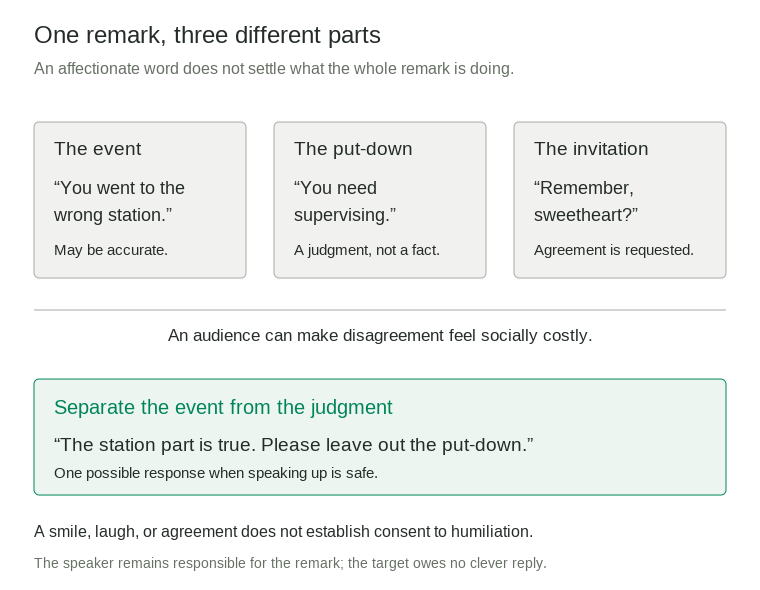
“Travelling with her is practically a supervision job,” he adds, smiling. “You remember, sweetheart?”
Mia smiles too. “Yes, I went to the wrong station.”
Someone laughs. Another guest looks down at their plate. The conversation continues.
Later, Mia says she disliked being described as someone who needs supervising.
“But the story was true. You agreed with me.”
She confirmed the event. He treats that as agreement with the judgment attached to it.
It is not the first time an embarrassing story has ended with an affectionate name and an invitation to confirm it.
The core pattern
Berne placed “Sweetheart” in the Marital Games chapter of Games People Play (1964). He describes a derogatory anecdote followed by an endearment and a request for agreement. The story’s broad accuracy makes disputing its implication seem petty; the affectionate address makes objection risk appearing unfriendly. He discusses both marital-group therapy and social occasions. Berne’s estate-hosted excerpt
The distinctive mechanism is the combination: a put-down, affectionate packaging, and pressure to endorse the account publicly.
Within transactional analysis, a game is a recurring exchange with an apparent social purpose, an inferred psychological function, and a familiar ending or payoff. In this interpretation, apparent affectionate storytelling also communicates devaluation, while agreement allows the exchange to pass without acknowledgment of the resentment. ITAA, Core Concepts
The words, setting, and responses can be observed. A deliberate intention to humiliate cannot simply be read from them. Recognising the pattern may help separate an accurate event from a demeaning interpretation without requiring certainty about motive.
An endearment alone establishes nothing. Neither does one unsuccessful joke.
How the exchange protects itself
The opening often contains something difficult to deny: a mistake, a familiar habit, an incident the listeners already know.
A broader judgment is then attached. Going to the wrong station becomes needing supervision. Forgetting something becomes being incapable. The affectionate ending presents the remark as evidence of closeness.
The recipient faces an awkward choice. Agreeing may appear to endorse the whole account. Objecting may be presented as spoiling a pleasant evening or failing to appreciate a joke.
Possible immediate functions include releasing irritation without discussing it directly, gaining approval from the audience, or maintaining a superior position. These are interpretations to investigate, not established motives.
For Mia, smiling may have helped end an uncomfortable moment. That does not make her responsible for the remark. An audience’s nervous laughter likewise does not necessarily indicate approval.
Over time, the cost may include less trust, reluctance to share mistakes, and growing uncertainty about whether affection will be used to soften another humiliation.
Berne’s antithesis—and its limits
Berne proposes objecting specifically to the endearment while allowing the derogatory anecdote. He also offers the reply “Yes, honey!” as a counter-response he considers less dangerous. He acknowledges risks in interrupting the exchange. Original entry, “Marital Games,” §7
These are historical suggestions, not established safety guidance. Objecting only to the affectionate word can leave the put-down intact. Echoing the endearment might communicate resistance, apparent agreement, or retaliatory sarcasm.
There is no reason to assume either response will reliably change the interaction.
The suggestions below are Patternverse adaptations, not Berne’s prescriptions or validated treatments for “Sweetheart.”
Openings for change
Separate the event from the judgment
Where speaking up is safe, Mia can acknowledge the accurate detail without accepting the description:
“The station part is true. Please leave out the part about needing supervision.”
She does not need to disprove the story or explain every circumstance surrounding the mistake. The concern is how it is being used now.
Another option is shorter: “I don’t want that story told about me.”
A public explanation is optional. Someone may prefer to change the subject, leave the conversation, or address the matter later.
Avoid replacing one humiliation with another
At another gathering, Mia answers one of Tomas’s anecdotes with an embarrassing story about him.
The guests laugh more loudly. For a moment she feels less exposed. Then they exchange another pair of stories. Afterwards, she feels that she has helped establish a contest neither enjoys.
Privately, she tries a different approach:
“I don’t want us trading put-downs. I’ll stop telling those stories about you. I’m asking you to stop describing me as incompetent.”
Tomas says she used to laugh.
“I sometimes laughed because I wanted the moment to end. I’m telling you now that I don’t want it.”
He remains defensive. The conversation does not settle their disagreement, but her request becomes explicit rather than another invitation to retaliate.
Let the speaker take responsibility
The person telling the story can interrupt their own remark:
“That was a put-down. I’m sorry. I shouldn’t have described you that way.”
A useful repair addresses the audience too, where appropriate: “Mia made one travel mistake. My comment about supervision was unfair.”
If there is a genuine practical concern—such as how travel arrangements are shared—it can be discussed separately and specifically. A public character judgment does not resolve that concern.
An apology also needs follow-through: retiring the anecdote, changing how the person is described, and respecting a request not to share private information.
Give the audience a different part to play
A friend need not establish anyone’s hidden motives before declining to reinforce the remark:
“We can tell travel stories without making Mia the punchline.”
Or they can redirect the conversation and check privately afterwards. The aim is support, not making the recipient explain their relationship in front of everyone.
Mia tells the host that she would appreciate a subject change if it happens again. At the next dinner, the host redirects a similar story. Tomas is irritated, but Mia is no longer managing the moment entirely alone.
That is a limited change, not evidence that the underlying difficulty has disappeared.
Understanding a recurring difficulty
Over time, useful questions concern observable conduct: which stories recur, what judgments accompany them, what happens when someone objects, and whether requests are respected.
Voluntary professional support might address resentment, public humiliation, or communication without requiring everyone to accept a game label.
Later TA ethics provides an important distinction from some of Berne’s assumptions. The ITAA’s current code emphasises dignity, protection, and responsibility for conduct. Those principles support taking harm seriously; they do not prove these particular adaptations effective. ITAA, Code of Ethics
If another person refuses to cooperate, further explanation may not help. Boundaries may concern participation in gatherings, disclosure of personal stories, or access to outside support. Where objection risks retaliation, safety takes priority over confronting the remark.
When affectionate teasing means something else
Ava and Mo enjoy telling the story of a camping trip when both forgot essential equipment. Ava calls it their “grand expedition, sweetheart.” Mo adds his own favourite detail, and both enjoy the telling.
Later, Mo says he does not want the story repeated at a work event.
Ava agrees and chooses another story.
Their enjoyment does not grant permanent permission for every audience or occasion. His changed preference does not invalidate the earlier warmth.
The useful contrast is the place available for disagreement and revision. Welcome teasing can accommodate a limit without turning the objection into another joke at the person’s expense.
Pitfalls and limits
Berne attributes the wife’s agreement partly to a self-devaluing position and claims she chose someone who would expose her deficiencies. These historical interpretations should not become explanations of why someone experiences humiliation. Original entry
Smiling, freezing, agreeing, or remaining in a relationship does not establish that someone invited the treatment.
Power also matters. A junior employee, dependent partner, disabled person, or child may have little room to challenge a public remark. Cultural differences in endearments and humour require context, rather than automatic suspicion.
Repeated humiliation and dismissing objections as an inability to take a joke can also belong to emotional abuse. That requires attention to safety and control, beyond an interpretation of mutual interaction. National Domestic Violence Hotline, Emotional Abuse
This framework cannot diagnose a person or establish hidden intent. Evidence about TA generally would not validate a particular response to this pattern.
Connections
Courtroom recruits an audience or authority into judgment. “Sweetheart” can recruit agreement through apparent warmth.
Schlemiel is Berne’s stated neighbouring game: he connects both with an expectation of forgiveness. Original entry
Separating observation from judgment helps distinguish what happened from what is being claimed about someone.
Direct requests and repair make concerns answerable without public devaluation. These connections do not imply that corresponding Patternverse entries already exist.
Sources and attribution
Historical description and antitheses: Eric Berne, Games People Play (1964), “Marital Games,” §7, checked against the full entry and estate-hosted excerpt. Later TA and safeguarding guidance are distinguished where used.
All encounters are fictional. The examples, explanatory diagram, and practical responses are original Patternverse adaptations.